
It’s Health Insurance, Jim, But Not As the Rest of the World Knows It
7 big health insurers reported $683 billion in revenues for just the first half of 2023 — how “exceptional” is U.S. healthcare compared to other countries?

Related and recent articles
• Protection Racket Healthcare and Its Reliance on Smoke and Mirrors • Has U.S. Healthcare Really Become a Mob Protection Racket? • The Embarrassing Part about Big Pharma’s Dirty Little Secret • How Can U.S. and Japanese Healthcare Costs Be So Insanely Different? • A Friend Texted to Ask “Who I Favored” for 2024 and Hated My Answer • Life Expectancy vs. Healthcare Costs in the U.S., Japan, Germany, etc. • My Top 1% Friend Was Floored by the Cost of His Family’s Health Insurance
(Subscribe to receive email notifications when I post new articles.)
First, if the form of this article’s title sounds familiar to you, then you are probably remembering the Star Trekkin’ parody video and song from years ago. The article title definitely reaches back to the lyrics of that song. Here is the link for the video, and I will also embed the video toward the end of this article.
There were several gorilla-sized takeaways from the news this week about the King Kong-sized total revenue numbers from 7 of the largest for-profit health insurers.
The one-two punch that hit me right at the start
Let’s lead with this news from the headline: “7 big health insurers pulled in $683 billion in revenues.” Because there is a one-two punch that comes directly out it.
Punch #1: $683 billion is a big number.
Heck, that’s 83% of what the U.S. has committed for the Fiscal 2023 National Defense Authorization Act, which allotted $817 billion to the Defense Department.
$683 billion is roughly $2,000 per person for every man, woman, and child, in the United States.
And this was just for the first half of 2023.
If we assume that second half revenues are at least as high, then that's over $4,000 per person in health insurance revenues for just the seven companies for every man woman and child in the US.
That means a family of four would pay on average about $16,000 in 2023 to cover insurance costs for mom, dad, and two kids.
But wait — don’t companies in the U.S. pay for most of the health insurance costs for most people?
Well, sort of.
But not exactly.
When the company you work for allocates money for “their share” of employee health insurance costs, that’s money that they could otherwise be paying you directly as part of your compensation if they didn’t have to spend it on an employee “benefit” like health insurance.
So the correct way to think about that $4,000 per year per person — or $16,000 for a family of four — is that one way or another, all of that money really comes out of the employee’s pocket and in order to get funneled up to one of those 7 big health insurance companies.
Punch #2 — The $683 billion number would mostly go away if we had a single-payer, Medicare-for-All healthcare system.
Do you get it?
As Congresswoman Katie Porter (D-CA) demonstrated in a tour-de-force during a Congressional Hearing in March 2022, private health insurance companies like the ones that just reported record windfall profits spend 17 times — 17 times! — more on administrative costs than our existing Medicare program does.
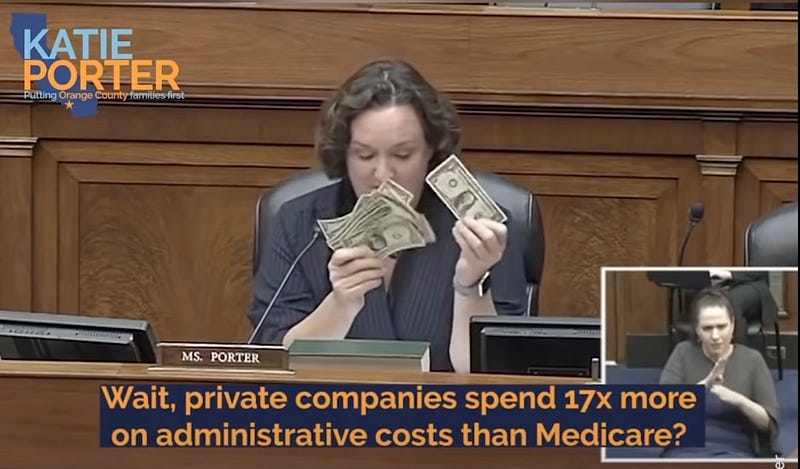
Think of all the things that Americans could use that money for instead of enriching shareholders and executive management of these health insurers.
Imagine for a moment that we had a single payer, Medicare-for-All-ish kind of national healthcare system in the U.S.
You know — the same kind of system that pretty much every other advanced industrialized country in the world has.
In that system, there wouldn’t be a need for a health insurance industry the way it exists today in the U.S.
Yes, exactly.
Most of that $4,000 per person per year health insurance cost would go away.
Sure, there would still be a need for some number of health insurance companies to serve the market of people who want to buy additional or special kinds of coverage. But revenues for that kind of health insurance industry would be a LOT smaller than what the revenues are today.
Here are other insights, thoughts, and takeaways I had from Wendell’s article and accompanying video:
#1. For-Profit Motivations vs. Patient Well-being
Health insurance companies prioritize shareholder value over patient care.
No big surprise here if you live in the U.S. (…although totally shocking if you live in any other industrialized nation around the world.)
But folks, if we the people are paying so incredibly much for a health insurance industry that never misses an opportunity to deny care in order to fatten their profit margin, then shouldn’t we demand a “health insurance supplier” who will put our patient care and us first?
There’s always concern about Wall Street’s expectations potentially compromising ethical considerations in healthcare.
“Potentially” compromising ethical considerations…?
Are you kidding me?
Does anybody out there really doubt that it’s 100% certain that Wall Street’s expectations are compromising ethical considerations and decisions made across our for-profit healthcare landscape?

#2. Vulnerable Populations
Shift towards Government Programs
Insurance companies’ revenue growth is largely in taxpayer-financed programs such as Medicare and Medicaid.
So according to news articles and pundits, this would indicate a “potential retreat from the commercial market, placing more responsibility on the government.”
Again, are you kidding me? Don’t bring the smoke-and-mirrors back out again. (See: Protection Racket Healthcare and Its Reliance on Smoke and Mirrors)
Let’s pretend for at least a moment that we don’t live in a “protection racket healthcare” kind of world here in the U.S. (See: Has U.S. Healthcare Really Become a Mob Protection Racket?)
This isn’t some morally neutral, intellectually-driven, arm’s length “shift of business” away from a vaguely worded “commercial market” to place “more responsibility on the government.”
These health insurance companies are shifting their focus to taxpayer financed programs like Medicare and Medicaid precisely because they look like easier, plumper targets.
That’s all it is. Easier money.
There’s nothing more complicated going on than that.
Remember, it’s not about serving the end customer.
The goal of health insurance companies is to maximize profits and cash flow. That’s it.

Rising Medical Debt
Over 100 million Americans are burdened with medical debt, highlighting systemic affordability issues.
News articles will look at the fact of so many Americans being burdened with substantial medical debt, but their takeaway in the news articles is that we should be concerned about “system affordability issues.”
WTF?
That is a classic use of “blackballing” to stall and deflect the real debate that we should be having — namely, why are we the only industrialized country in the world that (1) has a for-profit healthcare system that costs its people more than twice the world per-capita cost for healthcare and (2) delivers a life expectancy that ranks 47th among the nations of the world in 2023?
And this has been going on for a long time, too.
At what point do we wake up and ask why the hell we pay more than twice the world average in per capita healthcare costs when we rank 47th in terms of life expectancy (and also rank very, very low in most other ways of measuring the quality of our healthcare and its outcomes.)
Beyond metrics like life expectancy, shouldn’t moral and ethical human beings also be deeply concerned about the financial and emotional and stress burdens being placed on those 100 million Americans who are burdened with medical debt?
Isn’t that the real story? Isn’t this worth having a national debate over?
These stories will also proclaim — as though it’s CNN news flash material— that this medical debt is “potentially a result of insurers passing on the pressure from Wall Street to patients through higher costs.”
Ya think?
Shouldn’t our real focus here be on the fact that our healthcare system is the only one in the modern industrialized world that is for-profit based healthcare system?
Maybe the problem isn’t that Wall Street is putting too much pressure on companies to raise profits.
Maybe it’s that we have a for-profit healthcare system in the first place.
What do you think?
As promised, here is the Star Trekkin’ video that was the inspiration for today’s article title, It’s Health Insurance, Jim, But Not As the Rest of the World Knows It:
Related and recent articles
• Protection Racket Healthcare and Its Reliance on Smoke and Mirrors • Has U.S. Healthcare Really Become a Mob Protection Racket? • The Embarrassing Part about Big Pharma’s Dirty Little Secret • How Can U.S. and Japanese Healthcare Costs Be So Insanely Different? • A Friend Texted to Ask “Who I Favored” for 2024 and Hated My Answer • Life Expectancy vs. Healthcare Costs in the U.S., Japan, Germany, etc. • My Top 1% Friend Was Floored by the Cost of His Family’s Health Insurance
Again, thank you for reading, subscribing, clapping, and sharing — I appreciate your time and attention!


