
Why Did We Do An Art Show During a Pandemic?
How an art show showed me the importance of staying human while staying alive.
March 11th will be the third anniversary of Covid. Strangely, though its mark is indelible — it has shuffled my timeline — memories of it are hazy. I went back to my writing (it recovers a memory differently than a photo, writing gives access to inner thoughts) to remember how I survived it. For me, it was an art show that showed me the importance of not losing our humanity while trying to stay alive.
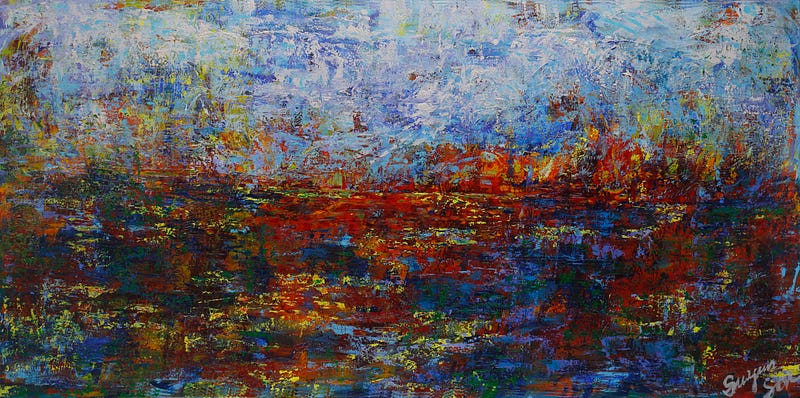
It’s been seven months since the lockdown order in Louisville. So, putting on my wine-dark-red tie to join my wife, Suyun Son, for her art show on Friday night, felt excessive. Wine and art! How much more hedonistic can one get in these lean times? I even walked into a mist of Calvin Klein cologne before jetting downtown.
Nobody expected the pandemic to last this long, though in hindsight why anyone of us thought the virus would quickly move on and leave us alone to return to our routines is a conundrum. Global stupidity is what Covid-19 hitch hiked on to globetrot. Now, the end is not in sight. While I’m writing this, I hear from NPR that a vaccine trial has come to a screeching halt due to “unknown illness.” I can’t help but see people turning into cannibalistic zombies after a rushed “miracle” vaccine.
When we were cock-sure that everything was becoming tamable by human ingenuity and tech, a .125-micron virus emptied savings accounts and the streets of Manhattan.
And 2020 was supposed to be the year of clarity when we would be gifted a 20/20 vision. It was a corny meme, but it proliferated in tweets and business magazine articles. I bet all my two-digit savings that some companies were concocting new business plans on the back of that catchy slogan. Now into the third quarter of 2020, how can this not be God’s biggest prank, that the year of clarity has been most obfuscating. 2020 is the year of cataracts. Even atheists are doubting their atheism because the irony is too sharp not to be divine humor. When we were cock-sure that everything was becoming tamable by human ingenuity and tech, a .125-micron virus emptied savings accounts and the streets of Manhattan.
In March, Suyun and I went to gather all her artworks that were basking in their own spotlight in galleries to store them in the dark of our basement. The school sent my kids home and told me to keep them for three weeks. The three weeks transmogrified into indefinite. Kids are hoping school remain shut for good.
“Do you know what you are asking for?” I asked, startled by their insensitivity. “Yeah. I know,” the 8th grader replied while scrolling through Tik-Tok, “Lost jobs. Death. But still, no school is a fair tradeoff, don’t you think?” My company banned all business trips, and I am stuck with these cruel teens for the rest of the year.
I choke their cruelty up to their underdeveloped cerebrum with little capacity for empathic imagination. But my teens aren’t the only ones stuck in that apathy. Trump’s speeches are evidence that his brain stopped developing after his bout with acnes. His thinking isn’t so much emotional as hormonal. He runs the country the way a teenager drives his car when his friends are riding along, reckless. Fidgety for attention, he sees global crises through the prism of popularity points. He checks his tweet likes “like every five seconds.” But he has the money and the requisite white skin to market his eternal-adolescence as fearless leadership. Only a rich white male can be a “bad boy” and still get to sit on the Supreme Court and the Oval Office. Wealth and white male privilege. They still work like a charm.
So.
What value does art, or looking at art, have in this time of global crisis being managed by a spoiled teenager?
-art show in midst of pandemic? a friend texted.
Is that judgment I detect in the text?
-masks and RSVP required. we good, I texted back. Tone is notoriously hard to read in San Francisco, Apple’s homemade font. Maybe he’s raising the question of aesthetics? A philosophical question heightened in a time where any indoor venture is a Russian-roulette?
What’s the purpose of art when people are forced to choose between dying or going crazy?
For the wealthy who are getting fatter from Covid, buying art is another way to preen and say they have so much money to throw that they need to inflate monetary value for something with zero practical value. You are rich when you can spend million dollars on what would be firewood come nuclear holocaust. During lockdown, the rich buy diamond-stud masks and art.
But for us who don’t have chauffeurs or have first dibs on ventilators, art show is not actually about art alone. We don’t go to buy art — though buying is encouraged so more artists can make art. We go to talk. And not really about art either. By looking at art on a wall, we get to talk about our own lives. It’s about the way looking at art positions people to be near each other without facing each other, a spacing for a sense of intimacy without the awkwardness of direct eye contact — it also protects us from invisible spit projectiles potentially carrying those damn viruses providing additional protection on top of the mandatory masks.
And it’s not just the standing arrangement; an artwork offers itself as a subject matter.
Visual art is the most immediate and democratic form of art. Anyone can immediately start talking about art. You can’t do that with a book unless you have read it — although many still blabber about books unfinished.
Poetry is a lot shorter than novels, but there’s much snobbish obscurity to it. And even those that are direct and spoken-word like, it’s still experienced through time. Even with a short poem, you must wait for it to be done. There is a mandatory silence before one can talk about it.
A painting, on the other hand, doesn’t have a beginning and an end. It is not experienced through time; Artwork is a spatial experience. You can take in the whole art piece at one time with your eyes. Reading is always temporal, sequential. Seeing is spatial. That immediacy means you can share the experience of that art right then and there with whoever is besides you and looking — or pretending to look — at the artwork. There is no negotiating of time, of waiting for the performance to end.
That “waiting” for a poem to end, a novel to finish, or the orchestra to get to the denouement is a form of authorial authority. The book dictates, the poet speaks, the musician plays, the rest of us shut up and listen. A painting doesn’t say a word. There is no word demanding agreement. The artist doesn’t have a word in the experience of it. You, the viewer, can have the first word. Which is another way to say anyone can talk about visual art right away. Visual art is democratic, whereas literary art has an oligarchic tendency. Art is available to all and invites all to speak first (or not to speak at all). Before we started writing, we drew. Every kid was an artist at the start of their life.
This democratic openness created by the immediacy of the experience makes art shows the perfect place to socialize: deepen friendships and befriend strangers.
It beats the bar. A bar has a limited range of conversation -– boss-chewing, sports-ranting, pick-up lines, and other cliched-machismos. Art shows offer greater varieties of conversation, differing by each artwork offering itself as a conversation starter. Artworks are visual prompts.
For sure, art is always in dialogue with art; but that dialogue has been professionalized by artists and art critics, i.e. people who make money from talking about art, so they are “kind of invested” in that talk. But for most people who come to Friday night gallery hops, art is there to help us to talk about our lives. Art is always in dialogue with the person next to me; a way to listen, vent, and commiserate; all to remember that we are not alone, though social distancing makes us feel so. It’s in dialogue with the singular frustration of raising a 13-year-old daughter who is a prima donna, or not being able to hold grandpa’s hands as they lose grip on this life or having to close a store then make a plucky move and open a new business during a pandemic. It’s about staying human even as one is trying to stay alive.


