
NBA Hot Take 12–31–17
It’s always darkest before the dawn
The Lakers end 2017 with a double overtime loss, but there’s still plenty of cause for hope in the New Year.
It’s been three weeks since my last deep dive into the Lakers and the NBA. Spending the Christmas holidays with my wife’s family, I’m writing this at the dining room table in a suburb south of Paris, 5,642 miles from home, and totally cut off from NBA broadcasts. The French version of New Year’s Eve is “Le Reveillion,” and usually lasts until 3 or 4 in the morning, regardless of whether you are out on the town, or simply dining with the family. When we finally got home, I checked out the results on my computer and was amazed to see the Lakers up 125–122 in the first overtime. Rather than sleep, I followed the ESPN play by play and saw the Lakers blow a 4-point lead at the end in the second overtime.
Chapter 1: Houston 148, Los Angeles 142 2OT
Another disappointing loss, especially in conjunction with the three other overtime losses the Lakers have suffered over the last month. Another lost opportunity after the Lakers blew a 17-point 3rd quarter lead. Another black mark on a season that started with so much promise, but has seen the team lose 14 of its last 17 games.
Is it really falling apart? Are the Lakers headed for another 25-win season?
Based on how the team has played, I would say there is a very good chance they will turn their season around and make a big jump in 2018. They probably won’t make the playoffs, but they won’t end up in the bottom 5, which means their draft pick will go to Philadelphia instead of Boston. (suck it, Celtics!)
What I saw in the game stats
The Lakers were playing without three starters, Lonzo Ball, Brooke Lopez, and Kentavious Caldwell-Pope (KCP). Houston was at full strength, but their starters were banged up.
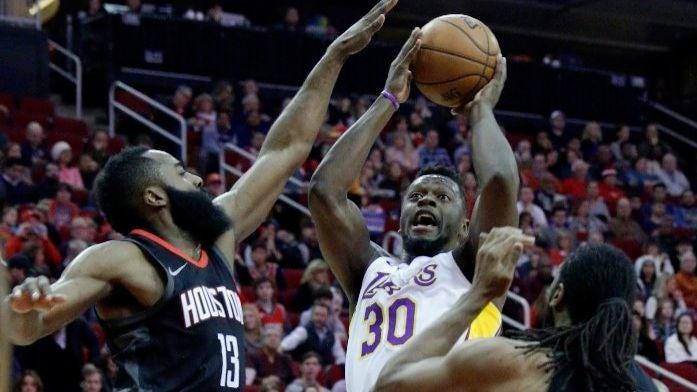
Sometimes, basketball is a game of addition by subtraction. Replacing the Lakers’ starters were Tyler Ennis (a solid point guard who shoots better than Ball), Julius Randle (the Lakers’ best two-way player and a beast on the boards), and Josh Hart (a solid defensive presence who won’t shoot the team out of the game by taking horrible 3-pointers).
The three replacements didn’t disappoint, as they combined for 75 points, 25 rebounds, and 18 assists. For context, Houston’s big 3 consists of Harden, Chris Paul and Clint Capela, and all sport PER ratings of over 25 (Randle is the highest rated Laker at 18.66). The Rockets trio combined for 75 points, 15 rebounds, and 23 assists.
For the game, the Lakers shot over 50% from the field, dominating the points in the paint (82-58), fast break points (12–3), and total rebounds (69–58). They edged the Rockets in total assists (31–29) and almost matched them in free throws attempted (37–39). The only areas they trailed Houston were 3-point field goals made (10–18), free throws made (26–32), and turnovers (16–12).
If you told me that the Lakers would dominate the 4th best team in the NBA and shot 50%, I would be overjoyed and expect a 20-point victory. Instead, they lost by 6 in double overtime, but I am still overjoyed by the way the young guys are playing and wished I had seen what should have been an unbelievably exciting game, right up there with the two overtime losses to the Warriors. This game encapsulated not only the 2017 part of this NBA season, but shows how the building blocks are being put in place for the team going forward, and also provides some perspective on the nature of being a sports fan.
Chapter 2: The Return to Greatness
The return to greatness is a three step process. It doesn’t guarantee a championship, but gives teams a chance to go the distance. Each season is completely different and subject to all kinds of factors outside a team’s control, such as injuries, a series changing play, or simply being in the wrong time and place. (Just ask all the great teams that got steam rollered by the Phil Jackson Bulls and Lakers.)
Step 1: Change the team culture.
The Lakers’ coaches and front office want to create Show Time 2.0 by running the court, sharing the ball and playing defense. Looking at this season’s advanced stats at the end of 2017, we get a very clear picture of the progress this team has made in changing the team culture by competing hard in almost every game, regardless of the current talent gap. As I mentioned above, Julius Randle is the team’s best player, with a PER rating of 18.66. Every other team in the NBA, including the league’s worst team has at least one starter with a PER over 19. Every team the Lakers play will have the best player on the court (and sometimes the top two or three), which gives them no margin for error in their games.
Here are the advanced stats that show the team’s transformation, even though their current record is one game worse than last year.
Running: Transition frequency measures how often a team creates an advantage by running the floor. In 2016–2017, the Lakers were #12. For 2017, they have jumped to #1, edging out the Warriors.
Sharing: Sharing the ball is clearly measured by team assists. In 2016–2017, the Lakers were #24. For 2017, they have jumped to #9, but need to improve to 25 assists per game to enter an historically elite level (it’s only been done by a handful of teams).
Defense: The key metric used that controls for the pace teams play at is team defensive efficiency (points per possession). In 2016–2017, the Lakers were #30. For 2017, they were in the top 10 most of the season, and are currently #15.
These factors combine to create more winning situations: If you can get stops, and rebounds (the Lakers are #10 in rebound differential), these lead to wide open 3-pointers in transition, layups on fast breaks, and free throws as teams may foul to stop easy baskets. If you spread the floor and move the ball, you are able to penetrate for shots in the paint, create open looks on 3-pointers, and put pressure on defenses that also result in more free throws. It all shows up in a statistic called expected points per possession (EEP). It should be no surprise that the Warriors are #1 in the NBA in EEP. Guess who is right behind them? Based on their style, the Lakers are #3 in EEP, but #30 in actual points per possession (APP), which shows how much the team can grow by improving in areas that are mostly within their control: finishing at the rim, making free throws and cutting down on turnovers.
Step 2: Develop the young players.
Giving lots of playing time (without running them into the ground) is a key element in developing the young core of players. As I’ve written before, Brandon Ingram worked hard in the off season to become stronger and learn to finish at the rim. With that skill, he has become one of the Lakers’ best go-to guys as he is almost unstoppable when he can get to the rim. With his work ethic, there’s a very good chance he will improve his mid range jump shots and develop a floater next year, which means he will be able to stop short and make shots if he sees a big rim protector in front of him. If he can do those things, we will see more game where he looks like Kevin Durant 2.0.
The same thing goes for Julius Randle, who has become the Lakers’ version of Draymond Green. As a small ball 5, Randle has shown he is quick enough to defend any position, and big enough to be a decent rim protector. In the Houston game, he finally got starters’ minutes and responded with perhaps the best performance of his career (29 points, 15 rebounds, 6 assists, 1 block), considering the level of the competition and the intensity of the game.
For Lonzo Ball, all I can hope is that he has a work ethic similar to Ingram, Randle and Kyle Kuzma (who transformed himself into a scoring machine after his college season ended last year). These two key rookies need to put a lot of work into shoring up their weaknesses, and I have to hope that they will get the resources and coaching to do just that after this season.
We can see the difference between winning and losing close games comes as players gain more experience.
One of the most defining differences between the Warriors and the Lakers this season was the end of regulation in their first overtime game. With 56 seconds left in the game, KCP was able to drive on Stephen Curry, the Warriors’ weakest defender. He got to the basket and made a 5-foot floater, got fouled and completed a 3-point play.
On the next possession, Kevin Durant got the ball after a screen that left Kyle Kuzma guarding him. On the court at that time, Kuzma was the Lakers’ worst defender and didn’t realize that all he needed to do was force Durant off the 3-point line. Instead, he gave Durant enough space to hit a 3-pointer that tied the game. In the next possession, Brandon Ingram tried to force his way into the paint against a double team, and turned the ball over.
After a Golden State miss and a Laker rebound, Los Angeles called time out with 5 seconds left. Guess what they didn’t do? If you thought to attack the weakest defensive player on the court for the Warriors, you might have a future as an NBA coach. At the very least, you watched Kyrie Irving do it in game 7 of the 2016 NBA Finals.
Instead, they gave the ball to Ingram (who admittedly was having one of the best games of his career while guarding and being guarded by Kevin Durant for a good portion of the game). He drove down the right side of the lane, guarded by a very good defensive player in Klay Thompson. As he got close to the rim, two other Warriors packed the paint and tried to block his shot. With more experience, Ingram would have seen the help defender and passed the ball to a wide open KCP in the right corner, or pulled up for a short jump shot when he felt Thompson leaning on him, resulting in either a trip to the free throw line, or a game winning basket. But the big question is why have a play designed that involves driving to the basket against the other team’s best perimeter defender and a sure challenge from a rim protector?
These are the kinds of in-game play calls a coach has to make. Luke Walton was able to do it while he was interim head coach of the Warriors. And Steve Kerr makes those calls as the Warriors coach.
For now, Walton has to focus just on teaching the young players the defensive systems and motivating the players to run hard on every play. Once he creates a solid foundation, the hope is that he will start to focus on offense by running plays, identifying opponent weaknesses and then finding mismatches his players can leverage.
Step 3: Finding an elite go-to guy
Every successful team has a go-to guy that can close out tight games. Even if he doesn’t make every shot, there has to be one elite talent on the team who can take the pressure off the others by getting a few baskets by himself in crunch time.
The Warriors have two MVP-level players who can take the last shot in Curry and Durant. And their third option is a guy who is a top-10 all-time 3-point dead eye. The Rockets have Harden and CP3 to make every big shot at the end of games. The Cavaliers have a force of nature in Lebron James. The same thing can be said about Boston, with Kyrie Irving, and San Antonio with Kawhi Leonard. Every team has an All-Star, or at least a former All-Star who knows how to find his spot on the court and make a pressure shot.
The Lakers will either have to develop one (possibly Kuzma, maybe Ingram) or bring in an All-Star to fill that role until the young guys reach their peak. For now, the Lakers takes turns playing the role, but none of them are good enough to do it on a regular enough basis to get them close games against elite teams or games they should win against weaker competition.
For the Lakers, their best hope in the immediate future would be a pick up a top free agent like Paul George (who has indicated he wants to play in his home town), as he would be a perfect fit for the current team. George would be the guy who can stop the opponent’s best scorer and at the same time hit a game winning shot. It would allow Brandon Ingram to create mismatches against most shooting guards and improve the defense to give more support to Kuzma.
Lebron James is also rumored to be headed to L.A., but I don’t think he will come as the fit isn’t as good for the team, and why would anyone want to leave the Eastern Conference and an automatic trip to the Finals?
Finally, there are a couple of elite centers who could transform the Lakers into a major contender in Demarcus Cousins and Anthony Davis. I’m not sold on Cousins’ maturity and lack of effort on defense, but players do grow. Remember when Zack Randolph was a loose cannon in Portland and for the Clippers? Having a two-way threat like Davis would be unbelievable. And unless New Orleans starts to win, he’s going to look for a better place to play in two years when he’s a free agent. Los Angeles could be a solid playoff team by then, so who knows? Besides it would be the most fantastic karmic payback, after the NBA screwed the Lakers over when David Stern vetoed the New Orleans trade that would have teamed up a young Chris Paul with a still elite Kobe Bryant.
No matter how it plays out, finding a go-to guy will make the Lakers a good to elite playoff team for years to come, and make them attractive to other free agents. At that point, it just becomes a matter of time before age and the salary cap catches up to teams like Golden State and Houston and the path opens up for others. And all anyone can ask for is to have a shot.
Just ask Lonzo Ball and Brandon Ingram.
CHAPTER 3: Basketball Enlightenment
Why anticipation is better than ascendancy.
The curse of excellence is expectation. Whether one is an athlete or a fan, it is easy to get spoiled by success. In 2010, the Lakers won their sixteenth championship, and appeared in their 31st NBA Final.
This last stat is almost impossible to comprehend.
Given the start of the NBA started in 1946, as of 2010, the Lakers appeared in 31 NBA Finals in 64 seasons. Even counting up to this season, the Lakers have been to the Finals almost 44% of the time.
No team in any sport has enjoyed that kind of success. Not the Canadiens (34 Finals, 24 Stanley Cups in 107 NHL seasons). Not the Celtics (21 Finals and 17 Championships in the first 64 seasons). Not the Patriots (9 Superbowls and 5 Championships in 57 seasons). And not even the Yankees (40 World Series, 27 Championships in 113 years, or 35% of the time).
43 Years a Slave (to winning)
I divide my life as a Laker fan in four stages:
- Childhood Trauma: The first game I ever saw “in person” was a theater where they showed a closed circuit broadcast of the 7th game of the 1969 NBA Finals between the Lakers and the Celtics. The only memory I have of the game is Don Nelson (who eventually became the innovative coach of the Warriors team that became the model of current modern basketball) awkwardly throw up a prayer off the wrong foot at the end of the game. The ball hit the back of the rim and bounced straight up, before settling into the basket.
- Taking it for granted: I was a no show for the Show Time decade. While I was aware of the championship parades, I was too busy with my own struggles as a would be professional tennis player, followed by making a living and raising a family to have the time to follow the team closely.
- The roller coaster: By 2000, I was established in my career and my kids were old enough to have their own interests, leaving me to rediscover my love for basketball. While I thrilled at the Shaq-Kobe Three-Peat, I was far more discerning as an adult and became increasingly frustrated with the egos at war, the poor effort on the floor until the team had to flip the switch, and the ball hogging tendencies that spread through the years like a cancer. By the 2010 Championship year, I was glad they won, but hated watching the team stand around while Kobe played 1 on 5. As he aged, and suffered injuries, his level of play declined and he stopped playing defense. I finally turned against him when he was personally responsible for blowing last 4th quarter leads against two playoff games in the 2012 series against the Thunder and then threw his teammates under the bus because they didn’t pass the ball to him.
- Rebirth in the ashes: With the team floundering under poor coaching and even worse management the last few years, I started to find joy in the occasional win, but more importantly learned how to savor every wonderful unexpected moment that can occur in basketball. My unforgettable moments of Laker joy range from the sublime (Nick Young intercepts a pass from his own teammate and hits a game winnning 3-pointer against OKC in 2016) to the ridiculous (due to injuries, and fouls, the Lakers were left with four eligible players in a 2014 overtime win over Cleveland). When I say sublime to the ridiculous, that basically means anything involving Nick Young (off balance 30-foot buzzer beater against the Spurs, 360 layups both made and thrown into the stands, and a host of comedic highlights you can find by googling “Nick Young Shaqtin’ a Fool”). But I have to give special mention to my one of my all-time favorite comedic moments, when Andrew Bynum started to guard his own teammate at the end of a win against San Antonio. He wanted to shoot a 3-pointer against the orders of coach Mike Brown, and here’s what happened:
It was almost impossible to understand the wasteland the Lakers have wandered through for the last seven years. What was once considered a birth right (a winning season and a spot in the Western Conference Finals) is now considered a future dream. At this point, having a .500 season would feel like a massive success.
But with Kobe’s final exit in 2015 and a bunch of high draft picks, I watch the young players as if they are my kids playing in Little League, looking for good decisions and making the right play, regardless of whether the shot clanks off the rim on every 3-pointer. (With a recent hot streak, the team improved its 3-point shooting percentage to 32.7%, still good for last in the league. For context, the Warriors are #1, at 39.0%, or 3.0% above league average, while the Lakers are 3.7% below league average.)
I think about how hard the team plays, and how much they fight, regardless of how many fourth quarter leads the team blows, and look for a tiny silver cloud when the team gets blown out of the arena (Look at Lonzo’s assist to turnover ratio!)
And I exult in those infrequent wins, dreaming about a future where winning once again becomes the rule, rather than the exception.
But the crazy thing is I’ve had as much fun watching basketball the last two years as I have during all those championships or heartbreaking losses in the Finals.
Don’t trust the process. Celebrate it.
If there is one lesson I could have taught my younger self, or share with any young person aspiring to be great at anything it would be this: learn the true definition of winning and then enjoy every victory. Because you will always suffer the times you lose.
The Inner Game (Tim Gallwey’s revolutionary book that applied Zen principles to tennis) defines winning as being able to perform your best in areas which are within your control. In basketball, that means playing team defense and sharing the ball on offense. It means make the correct read of whether to shoot, drive or pass, and then making the extra pass that produces the best shot possible.
A team can’t control how well the other team plays. A team can’t control the way a ball bounces off the rim, or a wet spot on the floor. And it can control the ref’s calls. You can run hard and put up a hand to contest a three-point shooter, but unless you block it, you have no control over whether it’s nothing but net nothing but air, or a lucky bounce that goes in.
The key is playing your best. And if your team does that, they’re winning the one true battle, regardless of the final score.
Finally, learning to truly enjoy and value the times when the score does go in your favor means that you attach no conditions to that result. When your team wins, don’t think “it doesn’t really mean anything because the other team stinks,” or “it doesn’t really matter because it didn’t happen in the playoffs.” It means that on a given day, your team played well at the highest level of the sport. A wonderful assist, a surprising block that launches a lightning score at the other end, and a buzzer beating shot in an impossible situation are all athletic wonders that need to be appreciated as such. If we attach unreasonable conditions to things completely out of our control, every team except one is a loser each season, and we as fans all end up suffering for no real reason.
Sports is one of the few activities in life where we can experience the entire range of emotions at heart attack inducing levels of intensity — over the course of a single minute.
However, sports are still just entertainment. They are artificially created activities with arbitrarily decided rules, error prone referees and all manner of human frailty in each player. We are the ones who spend our time and money to watch these games, decide on their relative importance, and arbitrarily attach so much emotional significance to these random events that are completely outside of our control.
As a fan, I want to savor every one of those moments without reservation and without regard for the final score. If the Lakers’ are destined to become a championship team again, they will do it without me worrying or complaining about them.
I hope you can do the same thing, regardless of which team you support.


