
It’s All Hassle But You’ve Just Got To Do It
A Lesson In Procrastination
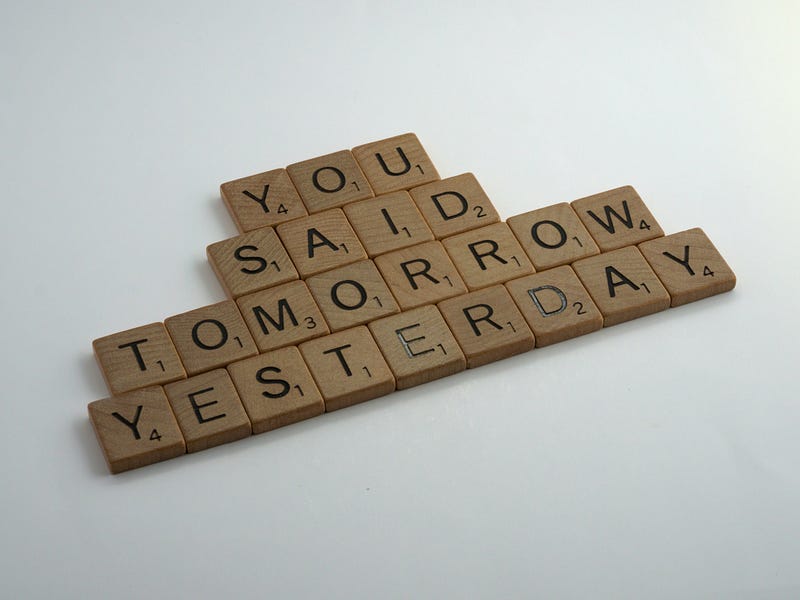
The title of this article is a quote from a client of mine in my day job. The man in question is one of the richest men in my local area. He owns a lot of property, most of which are old farmhouses, that require a lot of maintenance.
He is in the farming trade himself and an extremely hard worker. He has made his fortune this way (with a bit of luck thrown in).
The title seems to be his life motto. He said it after quite an extensive conversation with me about a large number of repair issues, rent reviews, and re-letting issues within his portfolio.
The motto left me with a flavour of how he leads his life to success. Essentially, JFDI (“Just F**king Do It” in case you are wondering).
It’s Very Easy To Procrastinate
It’s easy to put things off when you are tired. I have been terrible for the last two months in a row. I had a great week one in January, then it’s been a sliding scale since:
Too much wine, not enough exercise, too much fast food, not enough sleep, too much high stress at the office.
It is affecting my mood with my family, my ability to create, and my ability to earn well. Essentially, it’s a whole bunch of bad habits.
6 Types Of Procrastination
According to Dr. Linda Sapadin (Author), there are 6 different categories of procrastination and everyone will have individual traits that weigh towards a particular category.
More about Dr. Sapadin’s work is available HERE.
I have reviewed these traits and I urge you to use this opportunity to consider which category you sit within:
Perfectionist
The task has to be spot on before it’s finished. There is no room for error.
These are all common things that you may hear from a perfectionist. You would usually find that they are excellent when it comes to detail, being able to focus on intricacies that make up a much bigger picture, however, where they would come unstuck is in the final execution.
There is a risk for perfectionists that they are never able to finish a task and move on to the next as they are not happy with what they have in front of them as a tentative “finished product”.
I read an excellent tip for perfectionists to consider:
Try intentionally making one mistake each day…
Food for thought, right?
Worrier
Worrying about things can be useful as it allows you to highlight urgent and important matters.
However, worrying is also just stressful.
Worrying is probably one of the reasons I am up right now writing this article.
People worry on so many different levels. For my wife, it would be human-to-human interaction (particularly with the risk of confrontation). Mine would be more focused on what I might have done wrong with something and the potential consequences.
There are lots of tips to help with worrying, all easily available on Google. My personal favourites are to spend time writing or playing music. Others maybe meditation or exercise.
Mindfulness is becoming more and more relevant in our busy lives and it’s important to have something or someone to offload onto.
Defier
It turns out I know some defiers.
If you are a defier you typically like to work against the grain. If you are tasked with something, you may find the premise of the task, in your view, silly or unreasonable and in doing so, rail against its completion.
I think we all have some defier in us, some more than others, however, it is key if you are one to consider other viewpoints. This may bring your thought process back on track.
Dreamer
The dreamers are those that would prefer to spend the day considering what they would do if they won the lottery, as opposed to the focus on “here” and “now” and what that could do to benefit them.
Often, it may be a little unrealistic in their reality.
It is fair to say, however, that dreamers can often be the people with the big ideas that lead to long-term success.
If you fall into this category, it’s important to make sure that you find a way of writing down those dreams, then revisiting them with a sensible head. Some may be gems that can be focused on and made into that very success, yet remember this would need patience and work ethic.
Crisis Maker
This term stands for those who thrive under pressure. I am sure that some people couldn’t think of anything worse, however, others push on, pull their socks up, and get their heads down when the going gets tough.
This is great, but the pre-build-up procrastination is the problem. Is it done unless it’s a crisis? Unless it’s urgent?
My piece of advice for these procrastinators would be to take a leaf out of Stephen Covey's book, “The 7 Habits of Highly Effective People”.
Covey uses a template for focusing on important tasks instead of urgent tasks, in order to avoid crisis moments. I would recommend reading.
Over-do-er
Hands down, I am an absolute overdoer.
I love keeping busy, saying yes, being the man to help, and absorbing information to improve my knowledge.
I am keen to have multiple successes: husband and dad of 3 kids, home renovator, dog owner, real estate agent, letting agent, writer, musician, side hustler.., the list goes on… I am definitely one of the busiest people I know and this is to my detriment.
You end up hitting a wall.
As a result of this wall, my plans for an article per week went totally out of the window after some busy periods at work. I had a bit of a mental crash and could think of nothing to write at all. I have felt this way since early January and only just coming out the other end of it.
It’s disappointing to lose the first quarter of the year but something had to give.
Some considerations:
- Learn to say no
- Plan ahead well
- Make time to reflect
- Include rest time
Conclusion
I think it’s natural in life that your to-do list never comes to an end. As long as your heart is beating, there is something to be done.
Procrastination is usually a huge factor in the prevention of getting on and doing. The more that you know about yourself, the better.
Sometimes, it might be a hassle but nonetheless, we’ve just got to do it.
Thank you for reading. If you have the opportunity and you enjoyed, I would really appreciate it if you subscribed to my work, or better still if you love what you see on Medium, follow my link to join :)


