
It’s About Time

In hindsight, I can see the meeting was flawed from the start. No agenda — or goal for the D & I initiative — was projected on the screen at the front of the conference room. No discussion guidelines had been jotted on the whiteboard. No skilled facilitator was on hand to remind us that this was a safe space where all could speak freely and should listen respectfully.
The subject line on the meeting request had simply read “Diversity & Inclusion.” D & I had recently been added as a core value and every employee at the software company was expected to show some effort in that direction.
I knew something about D & I.
I was a White woman married to an Asian man — the mother of biracial children. I’d experienced the joys of being part of a diverse family. I’d also experienced the challenges: the dirty looks, the pointed fingers, the reluctance to serve us, and people’s confusion over my teenage son’s exuberant “Afro” hairstyle — and his parentage.
As the last colleagues to arrive settled into their chairs, my manager, a dark-haired woman in her early forties, called the meeting to order. She asked if anyone wanted to start the conversation. There were no volunteers. The silence continued — awkwardly long.
In my two decades at the company, we’d been expected to avoid talking about politics. But I wanted to support my manager and my example related to D & I, so I took the chance and began.
“Back in the 2016 election cycle, I read an article in The New York Times. The reporter spoke with several White men at a restaurant in the South — Mississippi or Alabama — I don’t remember which. What I do remember was their answer when asked who they supported for president. None of them was voting for Hillary Clinton. When asked why, one of the men said, ‘Because diversity doesn’t include us.’”
When I read that article, I believed the man who replied had misunderstood Clinton’s message. But I could see why he wouldn’t vote for a candidate he felt didn’t have his wellbeing at heart.
Now I glanced around the table at my colleagues. “I think diversity should apply to everyone, including White men.”
“No, it doesn’t!” exclaimed my manager and a colleague sitting next to her, in unison.
No one asked me to explain my reasoning. If they had, I might have pointed out that the U.S. was now, in mid-2019, halfway through Donald Trump’s divisive presidency. It seemed obvious that we needed to be more — not less — inclusive if we were going to heal the rift he took such pleasure in exacerbating. Explaining would have involved another big risk, as I suspected some of the people in the room were Trump voters.
I liked and respected both of the women who’d protested, but I didn’t agree with them. So I persisted. “It will never work until everyone is included in the conversation.”
No one said anything. The silence from the White men in the room was deafening. My fellow writer — a redhead in his 30’s who I worked with all the time — sat to my right, his face frozen.
I glanced around the conference table. I knew everyone. They were good people — my team. What was going on?
Did everyone else get a memo that this meeting was going to be a minefield? I wondered.
In a workplace where I’d always felt comfortable voicing my opinion, in a conference room that had seen many a spirited discussion, it suddenly appeared that there was an approved way to talk about things. And my comments didn’t fit the template.
Why, I wondered, does it always have to be about us and them?
Finally, a colleague, a White man who established his bona fides by mentioning that he had two moms, spoke up. I was so stricken by that point that I don’t remember what he said — just that it was supportive and I was grateful.
Later, back in my office, I tried to figure out why the meeting had been such a train wreck. Was it because my manager, who has a disability, and the other colleague who disagreed, a lesbian and a woman of color, had different viewpoints based on their life experience? Did they think that I was supporting White male privilege? Only a few co-workers knew about my biracial family, and no one who attended the meeting had known me long enough to understand where I was coming from.
I’d started work at the software company in 1998, at age 45, a generation older than most of my colleagues. I’d already worked in publishing in Manhattan and as a paralegal in Los Angeles and Seattle.
Most of my co-workers — and some of their parents — had been children in 1968 when I participated in sensitivity groups at my high school’s Human Relations Committee meetings. Gathered in a circle, my classmates and I — female and male — shared our feelings and vulnerabilities, invariably discovering how much we had in common, regardless of whether we were “straights” or “counterculture.”
That same year, as a 16-year-old high school junior passionate about equality, I gave a talk about civil rights titled Are You for Real? to parents at a PTA meeting. My school, Shorecrest, located in a Seattle suburb, was 99.9% White. As the chair of interschool exchange, I collaborated with an inner-city school, bringing 15 students, many of whom identified as Black Panthers, to Shorecrest after two days of consciousness-raising there. I was the girl who talked our principal into allowing girls to wear pants to school for the first time, who helped organize a Student Forum where students from different backgrounds could discuss current events, who sewed black armbands and handed them out to classmates and teachers on the day of the Vietnam War Moratorium in the fall of 1969.
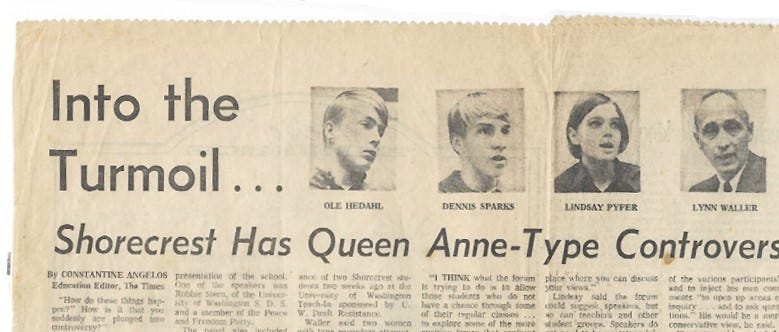
Even at that tender age, I was known for speaking up when others were afraid to. I, like so many of my generation, wanted radical change. I wasn’t interested in tearing things apart — blowing things up. I just wanted our world to be better — fairer.
At the University of Washington, two areas of study helped shape my beliefs about diversity and inclusion — Cultural Anthropology and Women’s Studies. Back then, nearly a half century before the awkward D & I conversation at work, I’d encountered the same unwillingness to include men in the conversation, and had an equally frustrating time trying to explain my reasoning.
*****************************************************************
It happened on a gray November day in 1973. I’d ducked into It’s About Time — the women’s bookstore on the Ave, in the heart of Seattle’s University District — grateful for a respite from the interminable drizzle. I was searching for a recommended pamphlet to round out my research on ways the American English language perpetuates sexism. I’d logged the obvious offenders: “mankind” instead of “humankind”; “he or him” to represent both male and female; “lady lawyer”; and “woman doctor.” I was looking for other, less obvious, examples.
I was greeted by the bookseller, a reed-slim woman her mid-thirties wearing a sober navy turtleneck and mouse gray corduroys. As I waited for her to finish helping another customer, I gazed, transfixed, at the hot pink and orange mandala pattern adorning on the socks peeking out of her wood and leather clogs. I became conscious of raindrops dripping onto my back from the lowered hood of my khaki anorak. Surveying the feminist posters that adorned the walls, I visualized the one my freshman roommate and I had hung on our dorm room door: An upside-down baby chicken with the caption “Women Are Not Chicks.”
While the bookseller searched for my pamphlet, I told her a bit about my major. She nodded approvingly. We talked about Margaret Mead. We talked about Zora Neale Hurston and Ruth Benedict. Then our conversation veered in an unexpected direction, to “the way things used to be.”
“When women are back in charge,” she declared, “when we get back to our roots, things will be so much better.”
Like some second-wave feminists, she seemed to have embraced the idea of “the primitive matriarchy,” a concept espoused by anthropologists like Lewis Henry Morgan and Robert Briffault. The theory, as I later wrote in my journal, “held that all societies were originally matriarchies.”
Not wanting to offend her, I didn’t say, “A lot of women have bought into The Matriarchy without knowing much about it.”
What I said was, “The Matriarchy was Lewis Henry Morgan’s idea. He believed that all cultures developed along one set path. He didn’t allow for cultural differences, different forms of government, religion, commerce, or subsistence modes — let alone different attitudes toward women’s biological roles.”
One of the reasons I’d chosen to study Anthropology and Women’s Studies together was because they were clearly so connected.
“I think, over time, there’ve been societies in which women’s status ranged from low to high — in some they were mere chattel and in others they held significant power.”
“So . . .?” challenged the bookseller.
“So what if, instead of wanting one gender to be in charge, we looked at gender roles in a more humanistic way?” I tried. “Provided men with examples of how life would be better — how everyone would benefit?
“It’s not worth talking to men about the movement,” the bookseller said. “I’ve given up trying.”
“I haven’t.”
Recently I’d been invited to speak at several Seattle area high schools about women’s roles in history and rethinking traditional gender roles.
I tried the same pitch I’d given the high schoolers. “Men are oppressed, too.”
The bookseller’s jaw dropped and she threw up her arms in an “Are you kidding me?” gesture.
“Don’t get me wrong,” I appeased. “I’m not denying the myriad ways women have been oppressed. But cultural expectations of men are sexist, too — in ways they don’t even recognize yet. Pressure to succeed and provide and compete and “be masculine” limits their expression in a big way.”
“Cry me a river!” she huffed. “I don’t even want to be around men.”
“I’m just saying it’s time for women to take what’s theirs and demand that men do the same — in terms of dignity, self-expression, learning, and growing. We all need to help each other.”
Just then, the phone rang at the front of the store. The bookseller hurried to answer it. As she leaned over the counter to pick up the receiver, she called, “Forget it! “The spoils of the Patriarchy are way too good for them to ever give up.”
Whoa, I thought. The high school kids were way more open-minded.
There was clearly a friend on the other end of the line. The bookseller launched into a description of what I’d said in an outraged voice, loud enough for me to hear.
Looking back, I understand her frustration. I knew plenty of men in those years who thought the women’s movement was a joke — who dismissed feminists as a bunch of unattractive bra burners. Among the periodicals on the kitchen table at the student house where I lived — with Rolling Stone, Oui magazine, The Seattle Times, and The Daily (the UW student newspaper)— was National Lampoon. Feminism was a favorite target. I still remember the spoof of women’s self-defense training, depicting a row of young women wearing in white karate gis and stern expressions, in identical martial poses, brandishing rolling pins. And the send up of Our Bodies, Ourselves, the Boston Women’s Health Book Collective’s manual on women’s health and sexuality titled Our Bodies and None of Your Business.
Then there was the male roommate who enjoyed taunting me by reeling off strings of crude names for women’s genitalia — and eliciting outrage — until I learned to shrug and ignore him.
So I could relate to the bookseller’s fatigue. But I wasn’t willing to give up. Yanking my hood over my hair, I laid 55 cents on the counter to cover the brochure and tax, then ducked out the door onto the Ave.
*******************************************************************
In the decades since my conversation with the bookseller at Its About Time, there’d been myriad cultural changes and advances for women. At the software company, women were program managers and developers, researchers and designers, writers, data scientists, marketers, lawyers, and field engineers, and served on the executive leadership team. They weren’t represented in anywhere near equal numbers as men, but they weren’t primarily secretaries and support staff, either — as they’d been when I got my first “real” job in New York in the 1970s. Progress had been made.
In the ensuing years, I’d been blessed with two sons and — recently — a grandson. I knew from experience that boys, like girls, are born innocent. I harbored no illusions that men and women are the same; we’re all products of nature and nurture. Still, I firmly believed that everyone is worthy and no one deserves to be treated as “less than.”
The D & I kickoff meeting was emblematic of the shift from the tolerant culture that had endured on our team for years. Two events contributed to the change: a big “reorg” and the hiring of a new manager for our work group.
Our larger team, responsible for multiple well-known work productivity applications, had been combined with a second large team, responsible for a well-known operating system and its associated apps. Before the teams were fused — like a marriage arranged by parents who didn’t take time to consider whether it would be a good match — I’d always felt confident that my colleagues and I were headed in the same direction with the same goal in mind: To do a great job for our billions of users across the globe.
Our team had many senior writers, valued for their technical knowledge and passion for their products, as well as their writing skills. The vibe was collegial. We worked independently, were confident in each other’s expertise, and spoke honestly about issues we encountered.
The other team had many writers who were younger, newer in role, and eager for promotion. These new colleagues had previously sat in one big, open space and clearly put a premium on the social aspect of work — work culture.
In the reorg scrum, the other team quickly snagged the most influential leadership roles. My team abruptly become members of a disorienting culture whose rules and traditions remained unexplained. Our performance was judged by standards that hadn’t been articulated. People no longer felt safe speaking up, asking questions and challenging assumptions.
Before the reorg, the emphasis had been on our customers. Now it involved fitting in with co-workers who kept up a steady, non-work-related patter on the Teams channel, who were touted by management as being so creative and dynamic, whose careers had been nurtured by management in an almost parental way. Those of us who’d brought creativity and dynamism to our roles for years were suddenly merely Senior (aka superannuated).
My new manager was hired around the same time as the reorg. I felt comforted knowing that she’d worked on our team some years back. She was smart, talented, and took her role as a manager seriously. But later, after diversity and inclusion became a focus at the company, I discovered that she held beliefs that would bring her into direct conflict with me.
I was blindsided when I heard during a 1–1 with her that comments I’d made during a presentation in the weekly writers’ workshop I led had caused certain attendees to report me. I’d shown numerous examples of issues I’d found in text that email users would interact with onscreen — and explained the problem with each. One, a survey, included text that could be considered sexually suggestive, which was inappropriate for the audience. Another example contained confusing instructions and legal text written by someone who’d drafted it without checking with the legal department.
Apparently, the attendees who reported me were offended because I mentioned that the sexually suggestive text had been written by a junior PM and that legal and clarity problems had been introduced by a new designer. (I didn’t mention these examples together.) They felt I was saying that people who are new in their role have nothing to offer.
I hadn’t said that and was dismayed to hear that my comments had been perceived that way. My intention had been to empower the group, not disparage them. In fact, after showing my examples, I’d said, “We’re the gatekeepers — the voice of reason. So if you see something that looks wrong, be sure to say so.” But that’s not what they heard. It was never my intention to malign or put down people who were newer in their role — just the opposite.
When I asked my manager who’d been offended, so I could apologize in person, my request was denied. I was told I should apologize to the entire group at the next writer’s workshop. This didn’t feel right to me, because several weeks had passed and the people who’d complained might not attend.
I considered the situation a misunderstanding. But my manager viewed it as much more. It seems I’d committed “microaggressions” against a disadvantaged group I hadn’t known existed (people newer in role).
I never learned who’d reported me, so I could reach out to them directly and clear the air. If those who’d taken offense had spoken to me in person — the time-honored process for handling misunderstandings at the company — the situation could have been a healing experience, both for me and the people who’d been offended. I would have explained my intentions, apologized, and asked them to suggest a better way to phrase things in the future. Hearing how my words made them feel would have left a lasting impression on me. And they would have learned an important skill: how to explain their grievance to the person who offended them, talk it over, and create a culture of trust. But it didn’t work out that way.
When I questioned the way things were being handled, my manager said I wasn’t listening — didn’t have a “growth mindset.” I was listening. I just didn’t agree.
Other comments I made took on an outsized importance, as well, and were framed as microaggressions: conjecturing that the last name of an engineer who had sent me an email might be Thai or Cambodian; referring to my own years of experience in the midst of a brave intercession on behalf of my marginalized team; being honest about my frustrations in a meeting that had been set up for exactly that purpose.
I was mystified by my manager’s rigid approach to D & I, which didn’t allow room for mistakes — at least where I was concerned. There was no benefit of the doubt, no “innocent until proven guilty,” no explanation that would set things right. In a few short months, my work group had morphed into one I didn’t recognize. Nor did I recognize the person I was made out to be: callous, uncaring, “clueless about diversity and inclusion.”
Kenji Yoshino, Professor of Constitutional Law at NYU and Director of the Center for Diversity, Inclusion, and Belonging, whose training on Allyship and Covering was mandatory for employees in my organization, points out that people are going to make mistakes — even the most conscious practitioners. “We have to be willing to let them without writing them off. We have to be willing to talk with them, if they’re open to talking, to try to defuse the situation and heal the rift.”
Had I been mistaken about the goal of the D & I initiative? I’d assumed it was meant to build bridges, to create more understanding, to make sure every voice was welcome, heard, and respected. Or was it a quest for ideological purity and an opportunity to marginalize those who’d been privileged in the past — a kind of tit for tat? If the latter, we were in for more polarization.
Neither my manager, her managers, nor my younger colleagues knew anything about my D & I history. In addition to my efforts for equality before they were born, in the mid-2010s I’d volunteered for four years with College Access Now at an inner-city high school in Seattle. I helped juniors and seniors from very diverse backgrounds, including Asia and Africa, with college and scholarship applications, essays, and FAFSA forms. I spent extra Saturdays with one senior, a gay young man originally from Central America, who had been badly burned in a house fire as a child. He wasn’t able to receive federal financial aid because he was undocumented. (His mother hadn’t known she needed to renew his legal medical visa.) With my help, he was awarded two private scholarships, including a sizeable one from the Pride Foundation.
I’d helped hundreds of colleagues with their text over the years, had spoken up on behalf of my co-workers when others were afraid to speak, and advocated for our users multiple times a day.
But now assumptions had been made about my level of alertness to social issues — and it had been judged insufficient. My manager told me I needed to take classes on D & I to learn how to be a better ally and not to say things to “trigger” people.
Triggers are in the eye of the beholder. One person’s trigger might not even register on another person’s radar. Yes, it’s important to be sensitive to other people’s feelings and to be an ally — actively resist statements and actions that reflect systemic racism, misogyny, homophobia, and religious bias. But can we really anticipate or be responsible for everyone’s personal vulnerabilities? Or be expected to?
I was willing to take classes. But I’d begun to feel unsafe — to worry that I could say anything — something innocuous, or a fact — and be reported again. Every year, in the software company’s annual poll, there’s a question that says: “I can be myself in my work group.” For the first time, my answer was a resounding “Disagree.”
I was ordered to attend a workshop where actors played roles that illustrated various power dynamics in the workplace: spoken and unspoken bias. It was surprising to discover, as I talked in a breakout group with people from teams across the company, that my organization’s approach was far more ideological than others — and that my views about D & I were far more broad-minded than many of my fellow attendees’. Some in the group were uncomfortable, for example, with the idea that employees who identified as LGBTQ could be open about their orientation in the workplace. I had to wonder whether, if I worked in a different organization, my “microaggressions” would have even appeared on the radar.
My manager’s sense of political correctness was so muscular and her attitude so inflexible— something I’d never encountered before. Only later, after I left the company and began researching diversity and inclusion, did I find articles and blog posts my manager had written online about the inherent untrustworthiness of men and the inherent racism of White people. It turns out that she’d been sexually assaulted — had experiences that undoubtedly shaped her world view.
This raises questions: Who’s the right person to make judgments about diversity and inclusion in an organizational setting? And what’s the best way to handle offenses, real and imagined?
While writing this article, I discovered that the inflexible mindset I encountered on my team is widespread, particularly in universities and corporations. And it’s damaging (and sometimes ruining) careers. There was the professor of a business communication course at the University of Southern California who was removed for giving the example of a ubiquitous Chinese word (the equivalent of “um”) that sounds like a racial slur in English but isn’t in Chinese and is likely used billions of times a day. Donald G. McNeill, Jr., a long-time science and health writer for The New York Times, resigned under pressure after being accused by high school students of making racially insensitive remarks on a 2019 trip to Peru (read his account to get the context). Lives and reputations of longtime employees at Smith College were damaged after an incident where a student claimed to have been racially profiled, though a later investigation showed no bias. A law student in Scotland discovered she was in danger of expulsion for saying women have vaginas and another law student ignited a firestorm when she quoted from a 1993 Supreme Court case in which one of the defendants used the “n-word” after warning others on the call in advance that she was going to use a racial word and it was a quote.
I’ve always believed that there’s room in our society for people of different backgrounds, lifestyles, and beliefs. So I’m alarmed by this new brand of fundamentalism, this one version of the truth that allows for no shades of gray — one that everyone is expected to adhere to. I’m especially disturbed by people’s willingness to write others off before getting the full story, to troll them or “cancel” them if they appear to stray from ideological purity — fail to use the exact same words the true believers do.
In the days after George Floyd was murdered in 2020, employees in my organization rushed to post pledges on the Teams channel to “sit with my privilege” or to read a certain book (The New Jim Crow or Me and White Supremacy or White Fragility or The Autobiography of Malcolm X), or listen to a podcast, or watch a movie, or buy a yard sign proclaiming their beliefs, or donate to Black Lives Matter or the Minnesota Freedom Fund. The posts were sincere. I downloaded several books myself.
I was heartsick about this injustice, just as I’d been heartsick in 1968 when Martin Luther King was assassinated, and furious in 1992 when Rodney King was viciously beaten by the LAPD. I’d been outraged by the unjust deaths of Trayvon Martin, Tamir Rice, Michael Brown, Freddie Gray, Philando Castile, Eric Garner, Breonna Taylor, and others. I was glad people were finally waking up to the racism so embedded in our culture, the systemic oppression, and were taking responsibility for educating themselves. I was heartened by how diverse the protesters had been.
But what bothered me about the way members of our mostly White org hurried to respond was the undercurrent of coercion, as if people felt pressure to show how “woke” they were — how seriously they were taking the situation. It reminded me of the way Chinese during the Cultural Revolution had to be vigilant about demonstrating their revolutionary zeal. I visited China in 1977 and saw first-hand how cadres at communes felt compelled to blame bad harvests on the Gang of Four (no one could blame Chairman Mao, whose policies they carried out), how kindergartners at a Children’s Palace practiced archery by aiming at targets decorated with faces of the Gang, how the young tour guide who asked me for help crafting her first English travel presentation had to be careful to couch her commentary in the appropriate revolutionary jargon.
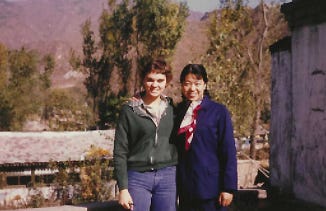
More powerful and effective at changing hearts and minds, in my view, were the company-sponsored presentations and trainings that showed the real-life experiences of marginalized people and ways employees could step up to create a more inclusive workplace and society.
There was an especially illuminating online meeting where Black employees (fewer than 5% of the demographic at the company) volunteered to discuss their experiences. One woman, the daughter of a White mother and a Black father, described being placed in a remedial kindergarten class with four other Black children solely on the basis of color — and how none of the classmates whose mothers didn’t insist they be moved to regular kindergarten classes ended up graduating from high school. Black male colleagues talked about coming to the software company from a vibrant, traditionally Black university and feeling like a stranger in a strange land. Or pulling out of the garage of the company’s temporary housing in a posh development, being pulled over by a White policeman, and following the steps Black parents teach their children in such situations: lower all the windows and tell the officer what you’re planning before you reach into your back pocket for your license or into the glove box for your registration.
A colleague gave a moving presentation about his child’s transgender journey, with photos and data that showed how much more positively transgender kids fare if they’re supported by their parents. The child, now a young adult, was present and fielded questions.
Another co-worker, a can-do woman who appears vibrantly healthy, spoke about living and working with a hidden disability, sharing medical imaging that showed the extent of the problem.
But despite the D & I classes and presentations, things weren’t getting better for me. I’d always considered myself pretty politically correct, but being accused of committing microaggressions — of being “clueless” — had the opposite effect. Because of the way my situation had been handled, hearing the term microaggression made me feel — as I joked to my husband — “like committing a macroaggression.”
Then, a couple of days before I gave notice — after an accusation of tone deafness because certain colleagues assumed that my reply to an email that didn’t mention George Floyd showed I wasn’t sufficiently upset about his death — I participated in a workshop titled “Interrupting Microaggressions,” led by Ralina L. Joseph, a professor at the University of Washington. The workshop helped clarify what constitutes a microaggression, the issues the term was invented to highlight, and how allies can call attention to them.
Professor Joseph explained — and I was glad to hear — that people sometimes use the word microaggression to refer to any perceived slight, but that, actually, the word has a more specific meaning. It was coined by Dr. Chester Pierce, a psychologist who consulted on Sesame Street, in 1970. He viewed microaggressions as “Subtle blows delivered incessantly, directed toward an individual or group because they’re marginalized, which assure that a person of the inferior status is ignored, tyrannized, terrorized, and minimized.” They’re brief, everyday, verbal, behavioral, or environmental indignities, intentional or unintentional, which communicate hostile, derogatory, or negative slights, invalidations, or insults. They’re constant and cumulative, reminders of second-class status, which can impact physical and mental health and work productivity. Often, the perpetrator is unaware of delivering them.
After attending Professor Joseph’s workshop, I could see how some of the people who attended my writers’ workshop could have felt “less than” as a result of my comments. But newer hires were not a “marginalized group” at the company, in my experience. They were the chosen few, who’d been given a prized opportunity in the software world.
When I was a new hire myself, I’d been expected to ask around, ferret out the information I needed. It was pretty much sink or swim. I scrambled to ramp up: memorized the voluminous style manual on my long bus ride to work and sought guidance from company experts. One was an old-school editor, a real curmudgeon. But I would never have thought to complain about his grumpy responses, which could easily have been interpreted as “Don’t you know anything?” I was just grateful for the help.
This doesn’t make my colleagues’ feeling of being marginalized any less legitimate. It just explains why I wasn’t aware that my comments would sting on the day I made them.
Looking back, I can see that we were all just people trying to get by, in a company and society where everything was changing so quickly. But still, harm was done. D & I initiatives should bring people together instead of perpetuating rifts — or creating new ones.
Time and again, when a fraught situation arises, leaders fold out of fear of being branded racist, homophobic, transphobic, or whatever. Instead of creating an opportunity for people to talk to each other, to explain where they’re coming from, and find common ground, they leap to respond to accusations before thoroughly investigating.
*****************************************************************
I’ve thought long and hard about the events that triggered my departure from a job I loved — at a company I’d given my all for more than two decades.
I’ve learned to be more careful about the way I say things. I’ve learned that one person’s casual comment is another person’s “trigger.” I’ve learned that efforts by good people can be misunderstood, and that efforts to make things more equal can go awry.
Though it can be uncomfortable, I continue to educate myself about D & I and consider my experience from different angles to try to shed light on what I could have done better — and how management could have handled the situation better.
And I have these thoughts: What if, when confronted with a situation, we made a practice of checking our biases? If we resolved to take a step back and listen — really listen — to the speaker’s intentions and experience, if they’re willing to share? If we gave them a chance to explain where they’re coming from, instead of branding them racists or terrorists or ageists or snowflakes or
What matters is that we heal our workplaces and our society. It’s not okay to marginalize other people or make them the enemy to make ourselves feel powerful. We have to be better than that.
I’m not suggesting overlooking past injustices; just that, to move forward, we need to start looking for what we have in common as human beings rather than focusing on our differences, and be willing to have a dialogue.
It will get messy. People will make mistakes. We will fall down on the job. But we can get back up again.