Italy’s next prime minister probably isn’t fascist, but American conservatives should be more careful before embracing her politics
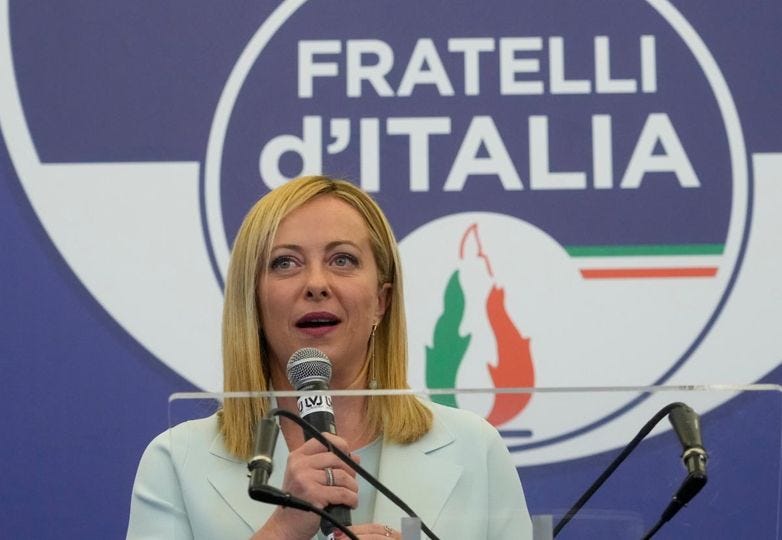
Some comments are in order on the Italian elections a few days ago which will probably lead to Giorgia Meloni becoming the head of the Italian government. The election this past weekend was the most recent in a wave of recent European elections in which hard-right conservative parties made surprising victories in some surprising places, and that is drawing applause from some American conservatives along with angst from American (and European) liberals. Unfortunately, some American conservatives, particularly those in the developing “National Conservative” wing of the American conservative political spectrum, are looking to these European developments and drawing what may be bad lessons from them.
Mainstream American media, following their European counterparts, are raising an alarm that Italy is making a turn to the hard right or far right. Some are citing the roots of Meloni’s party, Fratelli d’Italia (“Brothers of Italy”) which is generally considered the heir of Benito Mussolini’s political movement, as not only “far right” but “fascist.”
Most of the time when people accuse conservatives of being “fascist,” they don’t know the meaning of the word. Too many merely use the word “fascist” as a slur to attack conservatives who support the military and police, are populist, and advocate nationalism and patriotism.
That accusation can’t be so quickly dismissed with Meloni. The heritage of her party is actual fascism, and more specifically, the post-war Italian Social Movement led by men such as Giorgio Almirante who had served in Mussolini’s government.
Meloni claims, and her actions in recent years give good grounds for her claim, that Italians, including her party, have long ago consigned fascism to the history books. To her credit, she has taken strong action against members of her own party who have recently praised fascist leaders from the World War II era. She has personally repudiated her earlier praise for Mussolini and his legacy. In that regard, she’s followed the lead of Marine Le Pen in France who, to her credit, has repudiated some pretty horrible statements by her own father, the founder of the National Front.
But it’s not hard to find statements Meloni made earlier in her career that give real concern.
What concerns me most about the Italian election is not what will happen in Italy, but rather an American response to the Italian election which shows a naive willingness among American conservatives to believe that European populism is a carbon copy of American conservative politics. That simply isn’t true.
When a conservative Christian magazine I regularly read and respect, and whose founders I once knew fairly well decades ago when I was more involved in ecclesiastical politics than I am now, praised Meloni’s declaration that she is a Christian without looking further, we have a real problem.
Obviously, I don’t know Meloni personally. I have not met her and doubt I ever will. There’s no reason she would care what a small-town American reporter thinks. I’m not an Italian citizen (though under Italian law I could apply for Italian citizenship based on my ancestry), which means I can’t vote for her, or against her. She needs to spend her time convincing Italian citizens to vote for her, not Americans like me.
More to the point, I don’t make statements about people’s personal faith, or lack thereof, without spending a great deal of time reading what they have written and (preferably) speaking to them one-on-one — and even then, I try to be careful. We don’t know the hearts of other people, but we can look at what “fruit,” using biblical terminology, they produce.
Is it likely that a leading conservative Christian magazine in America would be praising the Christian faith of an American politician who is openly living with a man as an unmarried domestic partner, and has a child with that man? Now granted, Meloni’s marital status is not necessarily a problem in Italy, where it’s almost expected that a rich and powerful man will have a drop-dead gorgeous woman on his arm, and that woman may well not be his wife. Silvio Berlusconi’s notorious womanizing wasn’t a barrier to his role as a previous Italian prime minister.
I don’t claim to understand modern Italian politics well enough to fully understand the rise of the Brothers of Italy political party. What I do know is that Meloni heads a party that views Christianity as part of Italian culture, and not necessarily as a matter of personal faith. In a modern Italian context, that’s a very strong anti-Islamic and anti-immigrant statement. Historically in Italian politics, a public declaration of Christianity was also a repudiation of the anti-religious and anti-clerical attitudes that were closely associated with much of modern Italian political life following the reunification of Italy. There are reasons why Mussolini himself, as he was trying to reach out to conservatives and traditionalists in Italy, chose to be baptized as an adult and join the Roman Catholic Church. That marked an important part of his political development as he moved away from the anti-clerical socialism with which he was raised in his family and moved toward a more moderate position that allowed him to attract the political support from Italian traditionalists that was necessary for him to become Italy’s leader.
While Meloni’s advocacy of Christianity may well be more cultural than a matter of personal faith, that’s not a minor issue in a nation that has become very secular, and often quite anti-clerical and anti-religious. She advocates traditional Italian culture, and for her, Christianity and motherhood are parts of that tradition.
It’s important to give credit where credit is due. Meloni will be Italy’s first female prime minister in a country where conservatives often have a very traditional view of women’s roles. Meloni’s status as a female leader of a right-wing party flips some of the traditional patriarchal views of the Italian right, and of Italian culture, on their heads. Liberals in Italy are finding it quite difficult to figure out what to do with a woman who doesn’t fit into many of the stereotypical expectations for women in Italian culture, and especially conservative Italian culture that values traditional views of women in social life. Anyone who knows me very well knows I have zero problem with strong women in conservative leadership, and perhaps Meloni will help make it more acceptable for the Italian right to have women in political leadership.
But that leads to another point: American conservatives need to understand that “traditional culture” in much of Europe looks very different from “traditional American values.” Her political party advocates for a much stronger role of the government in the economy and other areas of civil life than most American conservatives would feel comfortable with seeing in America. While her party may well have gotten rid of the worst aspects of its past in Mussolini’s fascism, it is not a libertarian party by any definition, and its brand of conservatism would be unacceptable to many American conservatives. Mussolini began his career as a socialist. He developed “totalitarianism” as a concept in European politics of the early-to-mid 1900s, and some of what is considered normal in Europe would be considered “statist” or “governmental overreach” by virtually all American conservatives. It’s not realistic to expect a party with those roots to reject its history for an American-style view of free enterprise and government non-interference in private lives and business practices that simply isn’t part of the modern European experience.
What Meloni does bring to the table — and to the extent she has a voter mandate, this is it — is a strong rejection of the most recent example of Italian government overreach. Italy was the first Western country to be severely hit by the COVID19 pandemic, due in large measure to its commercial ties with China that are far greater than most countries of Europe. As a result, huge numbers of Italian hospitals were overwhelmed by COVID19 at a very early stage before the pandemic hit most of Europe and long before it hit America. Many patients died due to lack of ventilators and intensive care beds, and the Italian government imposed some of the strictest regulations in any Western country on its people to try to control the outbreak of disease.
It no longer matters whether the Italian government’s actions were right or wrong. What matters is that Italian government leaders, confronted with what reasonable people then believed could be another Black Death sweeping its death-dealing scythe across Europe, came together in a multiparty “unity government” and appointed a respected and technocratic prime minister with the consent of nearly the entire Italian political spectrum. That government imposed restrictions that, in hindsight, are now regarded by many Italian conservatives as hasty and extreme.
What was the one significant political party that refused to join that coalition government? Meloni’s “Brothers of Italy.” As the only significant political party in opposition, Meloni and her party have benefited from widespread conservative anger directed against that unity government and its policies.
How much of the Italian voter support for Meloni is actually less for her and more a rejection of the policies of the previous government? That’s a very good question to which there are not yet good answers.
What we can say with more confidence is that when Americans talk about the rising popularity of conservatives in Europe, we need to understand the deep divide between different definitions of “conservative” in Europe and America. Populism in Europe has parallels in America, but many differences as well.
Caution is prudent before praising what’s happening in Italy, or for that matter, in Hungary and other places that have become darlings of many in the modern American conservative world.
I understand the desire of many in the “National Conservative” movement to look to men like Victor Orban of Hungary, and now Meloni of Italy, as examples of people who are rejecting European liberalism and moving in a more conservative direction. Those who want to read more about this movement should read this article in First Things magazine on the National Conservatism Conference earlier this month in Florida. I have significant concerns about this movement and its tactics, even though I strongly sympathize with the intent of its leaders. The link is here: https://www.firstthings.com/web-exclusives/2022/09/natcon-against-the-black-pill?
A major part of the problem is that when European conservatives want to “conserve” their history, they can legitimately point to a history of official state support, not just for Christianity in general, but often for specific state churches. That simply is not our American history. If maintaining original intent of the Constitution means anything, it means respecting the First Amendment and its specific rejection of official religious establishment on the national level, combined with respecting free exercise of religion. Yes, we can point to the earlier history of colonial churches that were officially established, but 1620 was not 1776. Our public officials swear their loyalty to the US Constitution, not the Mayflower Compact or any of the various colonial ecclesiastical establishments, a few of which survived into the early 1800s.
However, there’s an even more serious problem. As the situation with Meloni’s live-in domestic partner (who is himself considerably less conservative than her) indicates, many of the European conservatives being promoted as models for American conservatives just aren’t that conservative by American standards. Meloni, despite the demonization of her in the European press, might have trouble winning a Republican primary in many of America’s redder states.
The London Evening Standard has a particularly telling article, following press coverage elsewhere in Europe, asking if “Italy’s new far-right leader [is] the ‘most dangerous woman in Europe.’” Reading the article, at this link, is helpful in learning more about her biography and her views: Giorgia Meloni: is Italy’s new far-right leader really the ‘most dangerous woman in Europe’? | Evening Standard
Many readers in the Ozarks will look at this article and say, “What’s wrong with this? She sounds like a lot of conservative Republicans we know who came from broken homes, grew up tough as nails because they had a hard life, and used grit and guts to rise to political power — and her political positions sound a lot like typical conservatives.”
I don’t dispute that many of the positions for which she’s being criticized in Europe as “far right” sound like normal conservative Republican politics in an American context. The purpose of citing this article is not to agree with the newspaper’s demonization of Meloni, but rather to explain why she’s being attacked as “far right” in Europe.
The problems many American conservatives will have with her are not that she’s “far right,” but more that she’s not conservative enough by mainstream American conservative standards.
Europe isn’t America — which is my main point in this commentary — and there’s no point in making the perfect the enemy of the good. An American conservative worldview is very different from much of Europe due to a long history of much greater acceptance of government involvement in private lives and in the commercial world.
Certainly Italian conservatives are better on many things than Italian liberals, who are at best Eurocentrist bureaucrats and technocrats, and at worst are outright socialists. The problem is that European multiparty parliamentary politics don’t translate well into an American context, and we need to think carefully before publicly praising people who are identified as conservatives in Europe.
Yes, it’s good that Italy is turning away from socialism and that many voters are angry with state intervention in their lives. Meloni may well have been the least bad choice on the ballot.
Still, the enemy of our enemy is not always our friend — and the Brothers of Italy carry baggage of real fascism that almost no other major Italian or other European political party carries.
Time will tell what to make of her and her party now that it has the opportunity to govern rather than merely complain about what others do in government.