
The Lord of the Rants, Part 3
A History Of The Dark Arts: Charlatans, Con Artists And Snake Oil Salesmen
5 reasons why people get scammed and how you can protect yourself

From the first organized human society to medical quacks to financial meltdowns, there have been grifters, shills, and marks. Here’s how to avoid becoming another score.
#1. Every good scam is built upon a kernel of truth, and embellished by layers of misdirection to cover up the big lie.
The lie, of course, is that the con artist is going to end up with the bag of cash, while the mark receives something of little to no value.
I’ve been writing for years about content marketers selling nothing of value except hope by describing them as snake oil salesmen.
Until now, I never realized there was a reason snake oil became such a powerful symbol for con artists.
In its original form, snake oil was an effective treatment for arthritis and bursitis.
Between 1849 and 1882, thousands of Chinese workers arrived in California, first to seek their fortunes in the gold mines, and later to help build the Transcontinental Railroad as indentured labor.
They brought the oil of the Chinese water snake with them, which is rich in the omega-3 acids that help reduce inflammation.
Excerpt from A History of Snake Oil Salesmen:
The workers would rub the oil, used for centuries in China, on their joints after a long hard day at work. The story goes that the Chinese workers began sharing the oil with some American counterparts, who marveled at the effects.
As word of the healing powers of Chinese snake oil grew, many Americans wondered how they could make their own snake oil here in the United States. Because there were no Chinese water snakes handy in the American West, many healers began using rattlesnakes to make their own versions of snake oil.
This opened the door for America’s master of early scam artists, Clark Stanley.
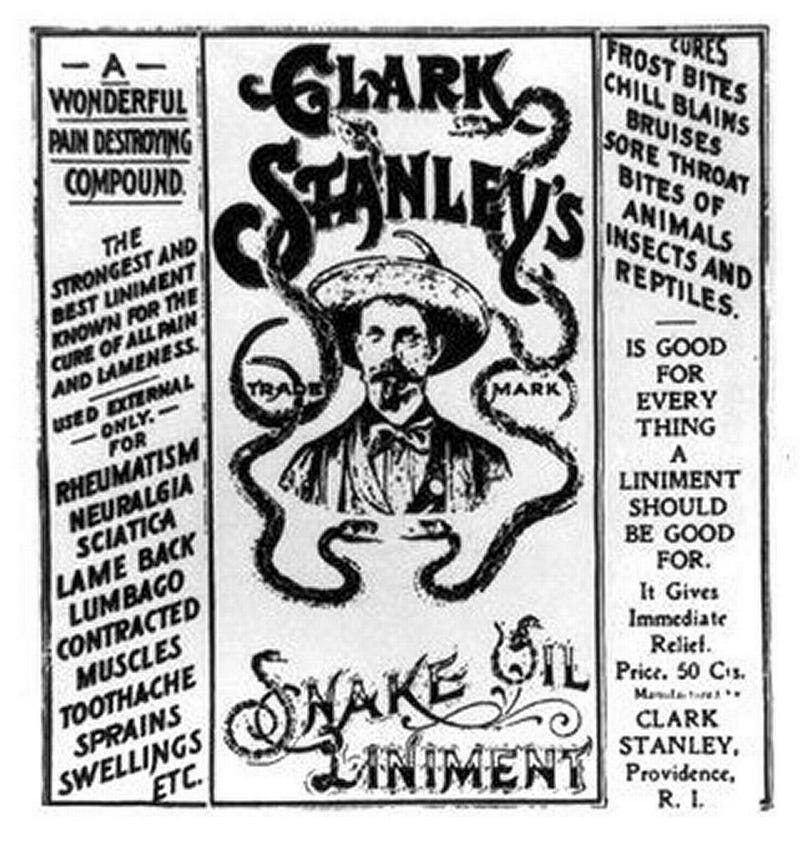
This set the stage for entrepreneur Clark Stanley, aka The Rattlesnake King. In an 1897 pamphlet about Stanley’s life and exploits, the former cowboy claimed he had learned about the healing power of rattlesnake oil from Hopi medicine men. He never publicly mentioned Chinese snake oil at all. Stanley created a huge stir at the 1893 World’s Exposition in Chicago when he took a live snake and sliced it open before a crowd of onlookers.
There were only two problems with Stanley’s claims. First, rattlesnake oil contained only one-third of the vital acid of Chinese water snake oil. Secondly, Stanley’s Snake Oil didn’t contain any snake oil at all.
The Pure Food and Drug Act of 1906 sought to clamp down on the sale of patent medicines and it was that legislation that led to Stanley’s undoing. After seizing a shipment of Stanley’s Snake Oil in 1917, federal investigators found that it primarily contained mineral oil, a fatty oil believed to be beef fat, red pepper, and turpentine. That’s right — Stanley’s signature product did not contain a drop of actual snake oil, and hundreds of consumers discovered they had been had.
If you’re buying a product that looks real, be on the lookout for some form of switch where you get stuck with a lemon.
#2. Even the best-planned scams can’t work without finding the right target — is that you?
Every good mark is a person who wants to believe in hope and miracles.
We have made heroes out of people who went forward, even though they knew their quest would ultimately fail. We have immortalized characters like Don Quixote, an old, probably delusional knight who dreams the impossible dream.
Our need to dream the impossible dream makes us vulnerable to the people who profit from selling hope and little else.
The more desperate you are, the more likely you will be a ripe target.
#3. This common psychological trait makes you more vulnerable, so beware.
The default setting of human beings, conditioned through innumerable cycles of evolution, is to believe in the honesty of others.
Without trust, the first societies could not have developed. From the American Psychological Association:
Research has consistently shown that people’s ability to detect lies is no more accurate than chance, or flipping a coin. This finding holds across all types of people — students, psychologists, judges, job interviewers, and law enforcement personnel (Personality and Social Psychology Review, 2006).
“There really is no Pinocchio’s nose,” — Judee Burgoon, Ph.D., a professor of communication at the University of Arizona.
Even if we were able to develop more skill at identifying liars, what if they believe in what they’re selling?
Or what if they are sociopaths who don’t display any of the emotional tells of liars who might have a conscience? I’m glad you asked because there are three ways we can determine if we’re being asked to buy snake oil:
Our only protection is to separate the messenger’s credibility from the product they’re selling.
Rule #1: The seller’s only source of credibility is their claim of making a lot of money.
Rule #2: The seller ignores easily researched, common scientific knowledge.
Rule #3: The seller offers nothing tangible other than their ability to sell.
#4. Psychological studies have revealed that it’s not the scam artist who cons you.
You need to learn to identify the person who will get you to believe the con.
One of the most famous social psychology experiments ever was conducted by Stanley Milgram. From the Wikipedia article:
They measured the willingness of study participants, men from a diverse range of occupations with varying levels of education, to obey an authority figure who instructed them to perform acts conflicting with their personal conscience. Participants were led to believe that they were assisting an unrelated experiment, in which they had to administer electric shocks to a “learner.” These fake electric shocks gradually increased to levels that would have been fatal had they been real.[2]
The study participants knew they were in a university-sponsored psychological study. They were asked to do things they would never do in real life and showed “varying degrees of tension and stress” as they carried out their instructions. But they believed the other actors involved in the con: the research assistant, and the person in the other room screaming in pain.
If you don’t know that “objective” third party well, this is the person who has to be scrutinized and verified.

#5. For the scam artists throughout history, every improvement in communication and information technology gives them greater power to probe you and find weaknesses.
We are aware that people have tried to profit through false advertising for over 2,000 years like those “pious” money-changers chased out by Jesus.
Civilization evolved because people could trust each other; as a result, we have very little skill at being able to spot liars. And psychological studies have shown us how a seemingly honest third party — the shill — can convince people to do things they would never do in a vacuum.
The only thing we can do is see the evidence after the fact and then try to punish the offenders.
Here is a shortlist of scams in recent American history and the scope of the damage they caused.
- The traveling medicine man, 19th century: he went from town to town, picking off individual marks. He couldn’t stay in a town for an extended time, or people would realize his cure was worthless. Without modern communication, he could only scam the people with whom he came into direct contact.
- Clark Stanley, the Rattlesnake King, late 1900s: he used numerous newspaper articles and a presentation at the 1893 World’s Fair to publicize and distribute his bogus products at pharmacies throughout the country.
- Charles Ponzi, 1920s: the Italian con artist found an early form of arbitrage by profiting from the lower prices for postage in post-WWI Italy. He created a public stock company to fund his scheme and worked in big cities. Using positive newspaper articles, and a favorable verdict in a libel suit, Ponzi ended up costing investors $20 million.
- Enron, 2000: this energy corporation leveraged national media and its credibility as a publicly traded company on the New York Stock Exchange to scam investors, resulting in a $40 billion lawsuit after the company’s stock price plummeted to less than $1 after hitting an all-time high of $90.75 the year before. They filed the largest corporate bankruptcy in US history up to that date at $63.4 billion in assets.
- Bernie Madoff, 2008: ran an investment organization/Ponzi scheme for over 40 years, costing investors between $12 and $20 billion.
While Ponzi schemes and corporate fraud affect people with money to invest, there is a virtual buffet of scams attacking every person in the country.
With the help of online anonymity and sophisticated means to steal people’s identities, credit card fraud losses amounted to $14.7 billion, and phone scams cost Americans $10.5 billion in 2018.
By 2019, nearly half of all calls to mobile phones will be fraudulent, according to a report from First Orion, a telecommunications firm that analyzed over 50 billion made to tens of millions of mobile subscribers to their call protection service.
We now live in an economy where the old maxims of going to school, hard work and playing by the rules no longer apply. The amounts quoted above don’t include scams where a useless service is sold to people, such as real estate get-rich-quick seminars, for-profit schools promising non-existent jobs, and the uncounted billions of dollars people waste on self-help “gurus” and TV evangelists.
We’re at a stage in post-industrial society where even tangible job skills can become a inspiration for scammers.
When there are millions of Indian programmers available to create a website, do coding, and help you with SEO, are those private schools selling a certification in HTML programming offering a valuable skill or just the idea that people can have a lucrative new career in computers?
It seems like finding a good career these days is the new definition of doing the impossible.
Every new “opportunity” in the gig economy is just some smart tech bro who figured how to take a slice out of the pie of an established industry by leveraging social media.
Uber drivers might be able to earn a little extra money to make ends meet, but they now assume the risks and expenses (gas, repairs, insurance, accidents, wear, and tear) that used to be covered by taxi cab companies.
The bottom line is that Uber drivers make less than cab drivers used to make, while a smaller number of cab drivers are working fewer hours.
The only people making real money are the company founders and early investors.
We are swimming in a sea of bullshit, and that doesn’t include what comes out of the White House, talk radio, and the blogosphere.
When people can no longer trust the news or agree on what constitutes a fact, the very fabric of society is at risk.
Our country needs a significant change in political leadership, armed with the will and understanding of social media to curb the excesses of our 21st century-cyber version of the Wild West.
Until then, I hope readers will become aware of the fact that your desperation increases the likelihood you will fall victim to the scam du jour.
If something sounds too good to be true, it probably is.²
If you enjoyed this article, you might like this:

Here’s to better writing, as unbelievable as that may sound.
FOOTNOTES:
¹A History Of ‘Snake Oil Salesmen’ by Lakshmi Gandhi, NPR.com:
²It’s tough to find a bright spot with this kind of subject. No wonder people want to self-medicate with drugs, TV, and dreams of getting rich quick. We all need a rest sometimes to come back strong in the battle to break through the walls holding us back.


