
It Takes 10 Minutes to Turn Your Writing Into a Business
Wanna make money writing? Start with a business plan.

Have you heard of the Business Model Canvas? It’s a simple matrix created by Alexander Osterwalder, that helps you evaluate your business’ viability in under 10 minutes. And if you want to earn money writing, you need to start treating it as a business — because it is. I will guide you through filling out this canvas and using it to make your writing business profitable.
Filling out the canvas
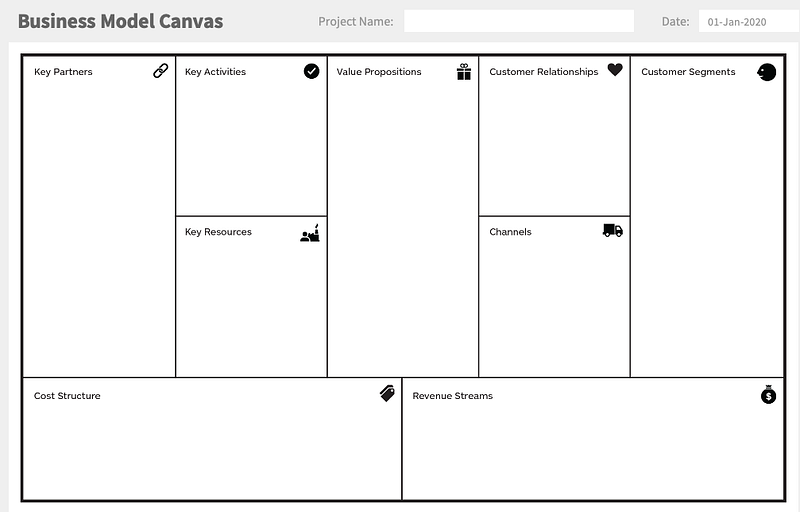
Value proposition
What is your value proposition? What problem are you solving?
“Books” or “blog posts” are not value propositions. However, “actionable advice to help writers make money from their craft” is an excellent value proposition. It’s specific and clearly brings a solution to a problem. Other examples of writers’ value propositions could be:
- philosophical essays to open people’s minds
- lively storybooks to educate children about LGBTQ+ families
- actionable self-development advice to better the readers’ lives
Key activities
What activities are you engaging in every day to grow your business?
Writing, obviously, but what else?
As a freelancer, you might cold email prospects on Upwork, for example. You could also spend time managing your social media platform, or interacting with your readers. Some additional examples:
- Research
- Learning or taking writing classes
- Editing
- Reading
Key resources
What do you need to perform these activities?
If you are a screenwriter, a key resource could be a screenwriting software like WriterDuet or Final Draft. A computer is also a key resource, essential to perform the activities related to your business. Books are a resource as well. My key resources as a writer are:
- Drama Queen (screenwriting software)
- Canvas (graphic design platform)
- Stage 32 (a community for film professionals)
- Books
- Computer/Internet
Make a list of your own key resources.
Cost structure
The resources we need to work naturally bring us to the next category: the costs. Based on your resource list, make another list featuring all of your business expenses. For instance:
- Canvas: $12/month
- Books: $35/month
And so on.
Key partners
Who are you working with?
This one is tricky. For Medium writers, Medium is a key partner. You are working with the platform’s customer service if something goes wrong with your account, so you engage in a relationship. The Partner Program is called like this because it’s a partnership between Medium and its writers.
If you run a newsletter or any kind of media, your key partners might be your sponsors or guest writers.
Customer relationship
This part is about how you develop and maintain a relationship with your customers (aka readers). I run a newsletter so email is a way to develop a relationship with my readers. In addition, I often interact with them on Twitter and Discord.
How about you?
Channels
What channel(s) are you using to get your value proposition into your readers’ hands?
Newsletter writers might use Revue or Substack. Fiction writers might use Amazon to sell their books. Bloggers might use Medium or Twitter.
How do you distribute your work?
Customer segments
Who are your readers? In other words, what is your niche?
Be specific here. Your niche might be self-development enthusiasts, wannabe writers, content creators, dog lovers, etc. You might also target several niches or customer segments, which is okay — just write them down.
Revenue streams
This is the most important part for any business: how do you earn (or plan to earn) money?
Writers can earn money in various ways. Fiction writers sell books or ebooks. Newsletter writers sell sponsorships. You could also sell a creative writing course, make money on Medium, or as a freelance writer.
Come up with two to three solid revenue streams — but no more. Remember that each revenue stream is a commitment: selling a course means that you have to create it. Selling a book means that you have to write it. Selling sponsorships for your newsletter implies cold emailing potential sponsors.
Keep it simple for now, and you can still add more revenue streams later.
Use the canvas
Congrats on filling out the canvas. Now, let’s use it to evaluate the viability of your writing business. Take a good look at your canvas and watch for any of the following red flags:
Your costs are higher than your revenue
You have to fix that. Go back to the cost section and see if you can remove anything that you don’t really need to run your business. Think of revenue streams you could add. Freelance work? Tutoring? There must be something.
You have more than three customer segments
Focus, focus, focus. If having only one customer segment is boring to most multi-passionate creators, having more than three is impossible to sustain. Think 1 value proposition = 1 customer segment.
You might be offering a writing course for writers AND fiction books for fantasy readers. Two value propositions, two customer segments.
Your value proposition isn’t attractive enough
Your value proposition isn’t at the center of your canvas for nothing. It’s the most important part of your business model, along with the revenue streams. The two factors influence each other. If your value proposition isn’t attractive enough, your revenue stream is likely to dry.
Reconsider your niche. If you can’t come up with a clear and interesting value proposition, it might be because 1) you’re not “niche” enough or 2) you aren’t answering a real problem.
You have too many key activities
It’s best to do one activity right than ten activities poorly. Are you putting enough time and energy into every one of your activities? Are you reaching your goals? If not, consider removing at least one of them.
You don’t have much in the “customer relationship” category
Cultivating a relationship with your customer is essential to succeed. In order for them to feel close to you and invested in your career, you must share what you’re up to and maybe tiny bits of your personal life with them. Pick at least one channel to do just that.
You could create a Facebook group or a Discord server to interact with your fans live or set up a weekly newsletter to share your updates.
You have too much in the “channels” category
To succeed, remember that a content creator must deliver value. And to deliver value, you must focus. It’s okay to have multiple interests and serve multiple niches, but if your value gets scattered across too many channels, you are wasting your time.
There’s no need to use Facebook, Instagram, TikTok, Twitter, and whatnot. Just pick one, and deliver everything there. Your followers will feel like you are giving them tremendous value, and you won’t waste your time and energy managing multiple platforms.
Conclusion
So, you assessed your entire writing business, fixed what wasn’t working, and it looks viable now. Great! Pin the canvas on your wall, and come back to it often. This will keep you focused and motivated. You are now the CEO of a viable writing business. Congratulations!
Want to support me? Buy me a coffee. Alternatively, you can follow me on Twitter for more writing advice and cool stuff.