
It is on Earth, not on the Moon, Where the Actual Problems Are.
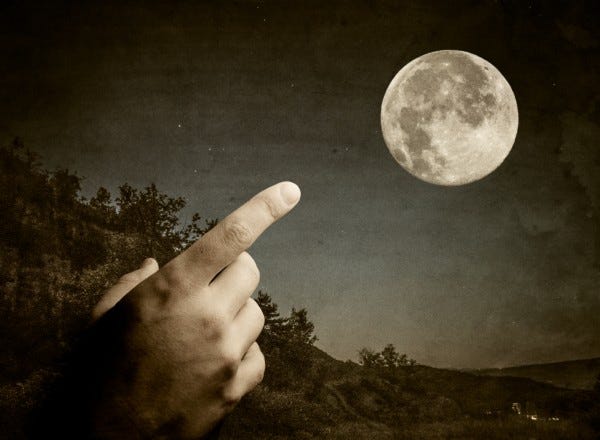
But, if you look at the Moon, do not forget from where the finger points.
The problems of the poor people also affect the rich. Economies, countries, persons are three legs of a single bench. But what is being poor? Who is an economically poor person?
Let go to define it. It is a personal definition, of course. Nor academic, neither linguistic.
─A poor’s definition according to the economy: It is a person with no money nor goods.
─A poor’s definition according to social justice: It is a person without rights.
─A poor’s definition according to both disciplines: It is an injustice and immorality. It is a human and social tragedy.
Why write now about these things if I am still not vaccinated.
Coronavirus pandemic is an onslaught of individual and collective existence. It seems that many humans, men, or women, takes precedence for themselves. For example, when it comes to distributing and applying vaccines: “Me first.” But it is more common listening to it as a kind of language among the countries. A diplomatic bullet. A moral anomaly that some call vaccine nationalism. But it is one more human stupidity.
A pandemic is something ─a great disaster─ that affects everyone. It is a historic hit. As a rule, a problem of planetary dimension needs looks at with planetary eyes. Either all or none. Like in the Titanic. From the most humble and anonymous immigrant to the ship captain.
As a life’s behavior, I love to meet persons who look beyond their navels. People that draw society’s attention to these things while seeking collective solutions. Or, at least, they try to raise awareness among those of us who are less committed. We can name them “The Fingers” because they point to the issues that matter.
A short paper about vaccines’ health expenditure prompted me to write this one. The authors consider the countries by their incomes. They divided them into four groups according to income level (World Bank report, 2021).
I have prepared a figure by simplifying the Total Health Expenditure (THE) percentage. I show the four income groups. They are low, low-middle, medium-high, and high income. I also highlight two representative countries for each group. I have selected the one with the lowest and the highest population in each income group.
The data consider the average price per flu vaccine (i.e., they are indicative). The actual marketed COVID-19 vaccines range from 3 dollars to more than 60.
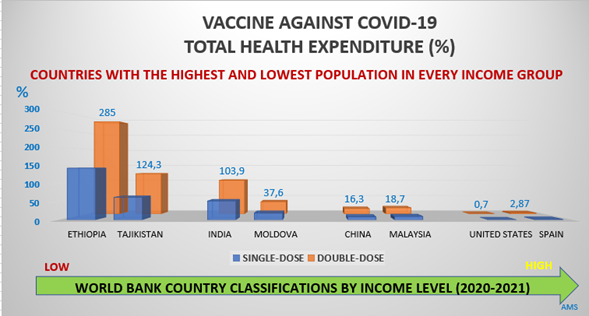
Here is my translation of the previous figure.
Low-income countries are poor because of many circumstances. Not because they like it. Graph’s left side shows countries that will ruin more by paying for vaccines. It can occur with a single-dose (navy blue) or double-dose (brick orange).
The differences between rich and poor are, once again, brutal, unbearable. Let us see what percentage vaccines represent in the total health expenditure. Percentages are low in some cases. But total expenditure in each place is many millions of dollars:
─ United States (328 million inhabitants) expenditure will be 0.7%. My country, Spain, with around 47 million inhabitants, will spend 2.8%.
─To its left, China (1.400 million inhabitants) will spend 16.3% and Malaysia (32 million inhabitants) 18.7%.
─ Further to the left, India (about 1.4 billion inhabitants) will spend 103.9% and Moldova (2.6 million inhabitants) 37.6%.
─ Ethiopia (112 million inhabitants) will spend 285%. And Tajikistan (over 9 million inhabitants), 124.3%. It is a considerable amount for their starving economies.
The percentage of total health expenditure is tremendous in low-income countries (Ethiopia, Tajikistan). Very high in the low-middle income group (India, Moldova). And high in the upper-middle-income group (China, Malaysia). T.H.E. percentage is low in the high-income group (Spain) or meager in the United States. It is yet another sign of the abysmal difference between economies and their health care.
Microbes Without Borders.
Viruses, like bacteria, do not respect borders. The “most aggressive” coronavirus variants swarm in South Africa (a variant of concern/V.O.C. B.1.351) and Brazil (V.O.C. P.1). But they are already everywhere. What about India (New variant B.1.617)? Time will tell.
Let us return to the matter at hand. One can say, paraphrasing the Apollo 13 astronauts (1970): “World, we have a problem.” As NASA history tells, astronaut Jack Swigert said: “Houston, we’ve had a problem here.” The historic episode happened on the Moon. And in Houston too. Yet, the sky’s matters did not worry people from other places like Rwanda, Haiti, or Ethiopia. They did not worry about sky conflicts: Apollo, other Olympian gods, and the Moon.
I add this excellent report from Bloomberg, who usually do their reporting very well. They corroborate, with greater authority than I do, what I have said before.
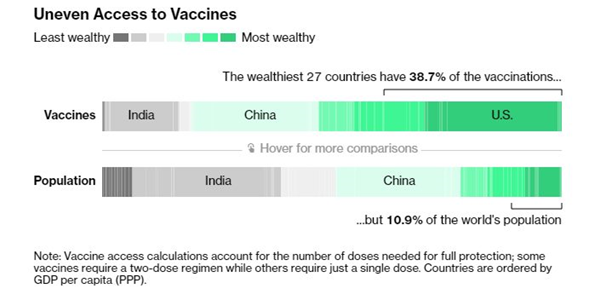
There exists a harsh reality. One hundred and fifty-six countries roll out 910 million doses of vaccines (April 19, 2021). At a rate of 16.3 million doses per day, the lion’s share of the pie goes to the wealthy (38.7%, in 27 countries). That accounts for only 6% of the world’s population (Figure 2). On the insufficient shore, Zambia (Africa), for example, gets less than 0.1% of the vaccine pie.
How lucky some of us have been to have been born in a comfortable part of the world. Even with all its daily stupidities.
We, Humanity, have the problem now and here. And we will continue to have it later if we do not already do something. Big political-health international corporations, prominent philanthropists, and everyone must look for global solutions.
It is better to do something than only look at the finger.
What to do? Free vaccines’ patents as proposed by People’s Vaccine Alliance? Lower its cost? Invest in situ for mass production? The only thing we cannot do is not to do anything. The problem is not exclusive to the developing countries but global. It is like a pandemic. In some way, it is a pandemic of inequality.
The chronic poor, like misery professionals, is so poor that they have nothing. They have not even problems. The eagerness to live, the work of life go forward in them looking for an uncertain future. They do where they can. Their existential compass depends on the uncertainty of the prow.
The law of chaos and the butterfly effect underlies many disasters’ origin. A water leak in Macondo can become a planetary deluge. So, we can remember the great Roman dramatist Terence (The Self-Tormentor). He said: “I am a man; I hold that what affects another man [the pandemic] affects me.” The poor’s problems are the rich’s issues. So, they matter.
To remember.
─ We must vaccinate everyone from New York (U.S.A.) to Freetown (Republic of Sierra Leone, Africa).
─ To vaccinate yesterday (Israel, U.K., U.S.A.) is better than tomorrow (many, many countries). Following the “better it already was than it will be” rule. But it is much better to vaccinate tomorrow than not vaccinate.
─ Every vaccine platform (mRNA, modified adenovirus, viral particles, other) is valid. And quite safe. One clot among hundreds of thousands, or millions, of some vaccines may be an alarming grain. COVID-19 is a well-known clots barn.
P. S: There were around 700 million SARS-CoV-2 infected people globally (December 2020). Now, ending April 2021, we are already many more.


