It Is Not Time To Get Excited About The World Opening Up.
There are many things we can easily walk away from in life, but a pandemic is not one of them. At the onset of the global lockdown a friend of mine had to stay indoors for two straight weeks, and the first time he stepped out to have the sun kiss his face, he took a selfie and posted it on almost all his social media handles. At that point, I wished there won’t be more to our opening up than just walking out the door of your houses.
We can walk out of a room, and we can easily walk away from a conversation, but for a pandemic that threatened our lives, livelihood and the smooth functioning of a society we had thought will forever function smoothly, it will feel like a trauma. The pandemic has different impacts on governments, organizations and individuals, and as a result would mean different things to all. Governments and organizations are already taking some strategic steps to best position themselves for a post pandemic world, they understand that things are not going to remain the same.
Many writers have written to emphasize the fact of a new normal after the crisis. In his viral article titled Prepare For The Ultimate Gaslighting, Julio Vincent Gambuto warned of a possible attempt by corporations to get us to relax and act as if this never happened. But it will be very disadvantageous for us to buy into any of such message, this is a special point in our history, and we can’t pretend this never happened.
In addition to the excitement of getting to leave the walls of our homes, which we may have suddenly grown too familiar with, we’ll have to confront uncertainties. The realities after a pandemic is hazy and unpredictable, but we have to ride through it. Every one of us will, and it will look different for all of us. We need to understand what’s waiting for us out there. It will help us prepare better. When the global siege is finally over we will be faced with a reverberation, a twist in the tale of life.
Work In A Post Pandemic World:
Some organization have been able to get their employees to work from home, but that’s not the same for all workers as many have lost their jobs since the pandemic. In the U.S alone, millions have been put out of work and have had to file for unemployment benefits. And this is no different from what is reported in other countries. People are being relieved of their work duties.
We had to stay home to stay alive, but not just for ourselves, but for the society at large. Staying home keeps you from contracting the virus, and it equally keep you from spreading it. The mantra for the past months has been that the less we moved, the less the virus travelled. So we had to make the humanitarian sacrifice of stalling our movements. We practiced sportsmanship at a global scale. However, in the process, because our society is so dependent on economic activities —which involved the movement of people and goods— the halting and slowing down of work related activities meant less money, both for governments and organizations, and less money meant employees can no longer be paid. In the spirit of sportsmanship and internationalism, we sacrificed our jobs, the very thing our survival seem to depend on.
When we open up, the million of laid out workers will walk out the door of their homes, and when they do the reality won’t just be that the sun will caress their faces, but they will also have to face the reality of having lost a means of livelihood. It’s crazy how for a moment you find yourself employed, doing a job you think all your life depended on, even to the point of letting it form your identity, just for you to lose all of it, all of a sudden, in a global glitch there’s nothing you could have done to prevent.
Remote working will be the new normal after this. Organizations have been able to avoid grounding equipping their employees to work remotely; videocomferencing platforms and organizations websites have seen an exponential rise in traffic as work and other related activities were forced to move to the virtual, digital world without a breaking of the social distancing code. And also, as we experience a rise in the use of automated, work related technologies, AIs that could do better jobs, easier and faster than humans, the realities this will have on the global market place will be such that to survive and thrive in the world post covid-19, both individuals and governments have to work together to ensure we avoid a continual wave of unemployment.
In a Forbes article, Simon Chandler emphasized, "...so we need to get ready now, not only by re-skilling people, but by giving them the financial means to survive in a world without traditional 9-5 work".
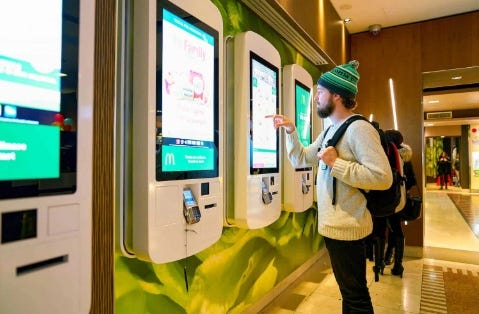
A report by Forrester says that company’s are seeing automation as increasingly urgent in the context of risk mitigation and strategic investment. According to Forrester’s Leslie Joseph, "As companies have recovered their revenues and reopened their supply chains, they have increasingly invested not on rehiring the workforce but on automation and on reducing their dependence on manpower”.
No doubt, we will be opening up to the realization that the crisis just opened us up to a new reality. We won’t be opening up to people getting reemployed and having their lives back. With the move for "reducing dependence on manpower", the economy of the post crisis world will present a new normal where it concerns employment and economic activities.
Education In A Post Pandemic World:
It is estimated that about 1.725billion learners are affected as a result of school closure in response to the current crisis. This is so as there is a near-total closure of schools worldwide. More than 90% of the world’s students population is said to be affected.
I’ve had a firsthand experience of the impact of this on school children. On the 11th of June I was taken aback when two little boys, about 8 years of age walked into my store to ask if there is any job they could do. These kids are supposed to be in school, but for more than 4 months now they’ve not had a lesson in a classroom.
It is reported that fewer than half of students in the US regularly participate in online classes by their schools. Many students have the inclination to want to miss classes, and now with the lockdown, it will be increasing difficult to get them to learn online, in an environment that is next to uncontrolled. Regardless, in the U.S, just as in other parts of the world, their is the issue of an inability of disadvantaged students not being able to handle the data cost of spending long hours taking online classes. There’s also the problem of infrastructure deficiency in third-world countries for schools to take their teachings online.
Had the pandemic happened intermittently, we would bounce back with ease and weather off the effects; like schools have some during earthquakes and floods. But for the long stretch in time, the pandemic is posing a very big educational challenge. The scale of challenge, and the work that needs to be done to catch children up academically, even socially, is very huge.
Educators are coming up with different solutions to help mitigate the effect students being away from school for this long. There’s the suggestion for summer sessions; an early start in the fall, or perhaps having some students repeat a grade when they finally return to classrooms.
We’ll be facing the problem of getting students up to date with missed academic works, and time lost. School provides an essential platform for learning to take place, but with the wide closure of schools, children and youths are deprived of opportunities to learn and grow. Cognitively, students are still at lost. In a rather disheartening report, Kindergarten children in the US will lose 67% of their literacy ability during this pandemic.
When we open up, there will be work hanging on the shoulders of both teachers and parents in ensuring a mitigation of the wide range of impacts the pandemic must have had on our students.
This is not the time to merely wish for an opening up, it will happen whether we wish for it or not; now is the time to plan for it. As corporations are already making strategic plans to be better positioned for a post pandemic world, it is the duty of individuals to understand global trends, learn in demand skills to be equally better positioned.