FOOD CRISIS
It Has Started: People Are Stealing Food from Supermarkets
Food crisis, economic crisis, inflation, hunger. All back in Portugal. But has it ever stopped being like this?
A few weeks ago, a student of mine asked me a strange question. “If you don’t have kids, who will you leave all your money to?”
If some readers may have been left thinking that I found the fact of the pressure of motherhood odd, my shock actually related to the second element.
I don’t remember what I replied to him. I probably said cliché phrases like “when I die, I care little who gets the money.” And then, I continued teaching the class.
But the question kept bothering me.
It did because this question showed a whole different perspective of opposing realities. My student is a millionaire. He grew up that way. He doesn’t seem to feel what it’s like living from paycheck to paycheck. It’s just something that does not cross his mind.
But this reality is the one of most Portuguese. Saving or accumulating wealth is a privilege. As such, only accessible to a small part of the population.
Life is difficult. It has become almost a universal phrase.
But we, the Portuguese, have been living in an endemic crisis since the earthquake of 1755. We still seem to be recovering from that shock. Just when we start to have some hope, there is always something, like the earthquake, to destroy everything. So we come back to the watchword: Crisis.
But in many so-called first world countries, it’s a big shock to them, this thing called a crisis. It’s a surprise that they are no longer able to accumulate wealth. And in big economies, there are already people who are also living from paycheck to paycheck. Once again, I reiterate that this has always been a typically Portuguese reality.
But if the low salaries, which barely reached the end of the month, were a problem, all this became much more unsustainable with this huge monster called inflation.
Imagine what it is like to have to live in 2022, in a European country, with a monthly salary of 740 euros. Or imagine being an elderly person with a 500 or 300 euros pension.
For example, these are the amounts that my in-laws receive. My father-in-law is in a retirement home, and all his pension money goes there, with only 300 euros left in their home.
My in-laws are not alone in these statistics. According to the Portuguese newspaper Expresso, about two million Portuguese (20% of the population) live on less than 554 Euros per month.
Already in the cities, there are apartment rents in that amount. Apartments are getting worse and worse with higher and higher values. I’ve talked about it here before.
I have always wondered how families, with children or even without children, manage to live. How can they even buy food and feed themselves? In essence, survive. But lo and behold, today’s news gives me an answer that doesn’t surprise me.
Food theft is increasing exponentially.
And those who think that perhaps people are stealing caviar… think again! No. They are mostly old people and parents who steal essential food items like bread, potatoes, cans of tuna fish, and olive oil.
These are cases that should make any sensitive soul feel sad.
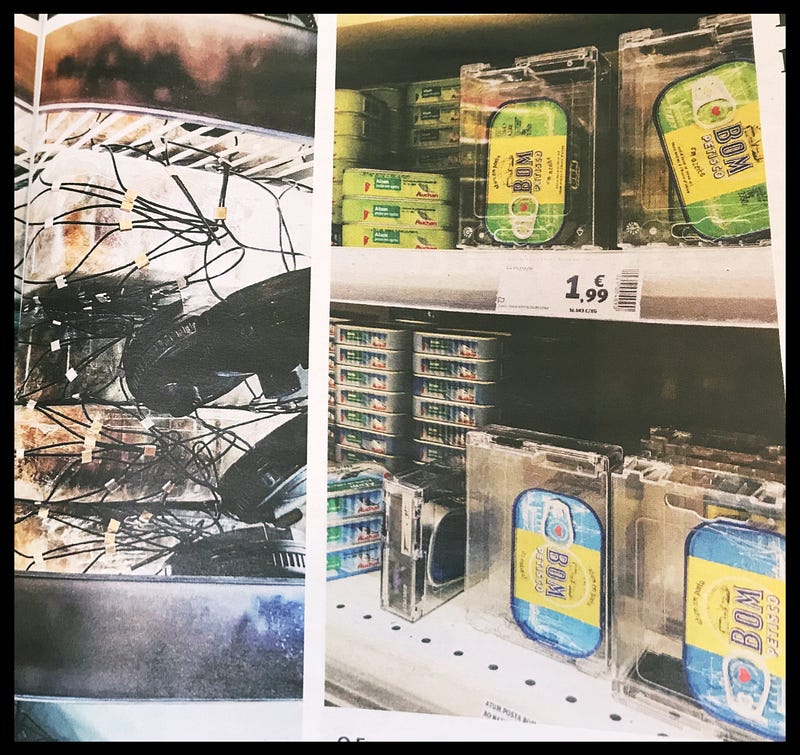
But the big supermarket chains are already solving the problem. It’s very simple, really. They are now investing in padlocks and alarms and putting tuna cans inside a padlock.
Now, faced with a huge social problem, here is the solution: protect the big food chains, not the people.
Of course, I know that it is not the social responsibility of private groups to do this. But, too bad it isn’t.
My husband got furious about this. He immediately started calling names to the idiots who decided to spend more money on alarms than on lowering the prices of essential goods.
He started angrily saying that in a just world, it would be the supermarkets who could talk to their customers, the ones who give them money and practice lower prices.
But of course, it’s a beautiful but utopian vision, and like any utopia, it stops there. It’s utopian because we live in a capitalist system, and as long as that lasts, these ideas just hang around in the world of ideas.
I went off to do a kind of social research on the subject. And how much easier it is to do it using social media and looking at the comments.
Perhaps, one day, we will study how primitive those who comment are. Most comments criticized not the phenomenon behind this but the fact that there are thieves, you know, “making Portugal become like a Venezuela.” You see, it’s an easy and stupid road to take.
And, of course, the targets were always the same. Immigrants, minorities, etc. Even though the news said it’s seniors and parents who steal, the ones attacked were always the same.
And, sure, within all the hatred, there came the usual phrases like “people don’t want to work.” A misplaced phrase. People work, but their money is not enough to even eat. This is the reality.
Every week the prices of food increase. But the same is not true for wages.
For someone outside this reality and trying to understand the differences, let me give you some examples. A can of tuna, which now has anti-theft alarms, costs two euros.
My mother, who earns the minimum wage, earns less than 3 euros an hour. The same can of tuna in January of this year cost 1.17 euros. Not even a year has passed, and it costs almost twice.
According to the same source, since February in Portugal, foods such as meat and fish have increased by 20%. And these are official statistics. I know that many supermarket chains are practicing way much more.
So here it is, the crashing of the middle class.
The middle class is getting poor, and the poor are getting miserable, and as miserable, they are left with despair. Stealing food is just another sign of the dangerous road we are all heading down.
It is the obvious sign of an unjust, unbalanced society. It reflects capitalism at its most evident state, where the rich who pay rents of two thousand euros live in the same city (and think this is a bargain), and where in big cities slavery is back again.
Cases of Timorese people coming to Portugal deluded by promises of work and ending up living on the streets are increasing. But that would be just another of many issues in the chaotic world in which we live.
In the meantime, we need a lot of things. Many would say that food is the main thing. And I agree.
During moments like these, it is hard for us to think. Emotions jump into the public space. Hate, violence, and irrationality come into play.
Still, despite the difficulty, it is in these moments that art and culture are necessary. We must understand and seek our humanity.
It is essential for us to feel empathy again and thus put ourselves in the other’s shoes.
When I read the sad news, I immediately remembered Vittorio de Sica’s 1948 Italian classic “Ladri di Biciclette.” An exemplary film of Italian neo-realism of the post-second war period, which tells the sad story of a father who wants nothing more than to support his son.
Yes, he has to steal bicycles to guarantee a job. His bike has also been stolen. He wanders through Rome to find a solution. Stealing a bike too? Perhaps. But he doesn’t want to steal. He does it out of necessity.
And we, out of necessity, should see this movie! Art is timeless. It was made in 1948, but its message is still current.
Hello, I’m Araci, a female writer from Portugal. I like to write about my country, Portugal. But I also enjoy pop culture, American culture, and cultural differences. I hope you’ve enjoyed this article!
You can also find more about me here:
If you have enjoyed this article, maybe you would like to buy me a coffee here https://ko-fi.com/joanaaraci. I don’t drink coffee that much, but food is getting ridiculously expensive, and I need to put it on the table.
There are other ways to help me out:
Are you considering joining Medium for only 5$ a month? Your membership fee directly supports me. This way, you are helping me out while you’ll also get full access to every story on Medium.
If so, consider doing it through my referral link.
Thank you for reading me.