It Doesn’t Matter if Free Will Exists
50 shades of choice

There is a reason that free will is one of the most debated concepts in philosophy. All evidence points to its absence. Every part of science, save fringe studies, have found that the natural world is deterministic. Causes have effects. The past dictates the future. Yet, we can’t help but feel its existence.
The argument against free will takes many forms, but it essentially boils down to one: we do not choose our genes or our environments. Yet, our decisions are influenced by one or the other, or both.
Isolated studies have shown that we make decisions in our unconscious rather than conscious minds. And the implications are interesting. If our unconscious minds make decisions, and we use our reasoning facilities to retroactively justify them — rather than deliberated as we have always thought — then free will suffers yet another blow to its credibility.
But it’s a little more complicated than it looks on the surface. In an example penned by Kurt Keefner in an essay responding to Sam Harris’ Free Will, he describes a young man trying to choose a college. There are orders of conscious deductions happening to settle upon the right college. How far is the college from home? What is its academic reputation? Proximity to cultural resources? The list goes on.
These kinds of deliberations happen in the conscious mind. Thoughts may spring from the unconscious, but ultimately they are consciously deliberated. In such a case, free will seems to definitively exist.
But if one examines how these types of decisions actually occur — thoughts popping from the unconscious — it gets a little messy. Are these thoughts weighted with bias from the start? Do we not all already know — deep down — what we want before we “decide”? Or, from the perspective of the young student, is a college attractive based on an impression safely tucked away in the unconscious?
Cognitive biases are not something to overlook. There are 124 of them and that’s only decision-making, belief and behavioural biases. There are still social biases and memory biases to add to the list. It’s almost as if humans are not meant to be rational.
The real question is whether being slaves to our unconscious is proof of the absence of a free will. I would argue not. All it shows is how tortuous humans are.
As Keefner argues in his essay, abstractions, like “the mind”, are exactly that: abstractions. Fabrications created to help us discuss various subjects. In reality, there is no true separation. The mind cannot be separated from the brain, nor the brain from the body. It is one organism. Indeed, conscious and unconscious thoughts are only separated in language and awareness.
Further, arguments for or against free will rarely cover degrees of it. Instead, it’s almost always a binary toss-up existence or not. In reality, things are never as clear cut. The world exists on a spectrum, betraying the simplicity that humans have arbitrarily prescribed to it.
A great way to illustrate degrees of free will is with the development of a human. Would one say that an infant of 9 months has free will? Sure, it can decide to crawl to one side of a cot or reach out lovingly to its mother. But even those actions are hard-wired to a degree. They are natural impulses that have evolved over millions of years to ensure survival.
Consider then, a 2-year old infant. It could decide to climb up on a shelf, in defiance of those same survival instincts, or throw a tantrum when a basic — or desired — need is not met. It chooses to respond but is it free to? One would be quick to use leniency in both situations. After all, the child has not yet developed its neocortex and, with it, the ability to reason. It is, in the truest sense of the word, unreasonable.
And what about a teenager? The complexity of choice, and the decisions they lead to, increase by orders of magnitude with age. But the teen’s mind is still very much a slave to the limbic systems: the parts of the brain that control emotions and reactions. It’s no wonder that teenagers feel so removed from the rest of us — they exist in the twilight between reason and emotion.
What of free will then? How does the ability to choose fit into this arduous development of the self?
Well, it fits very nicely. It is also neatly mapped to the development of a person’s mind as they move into adulthood as described by Maslow.
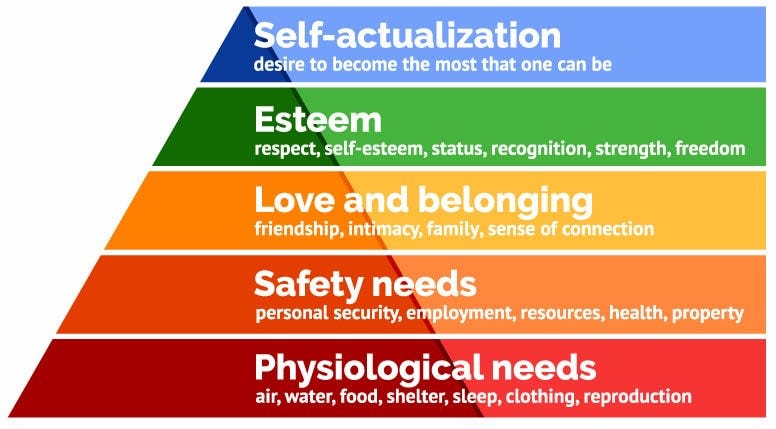
As one moves up the hierarchy, the ability to use free will increases. Or, rather, the awareness of that free will increases. One could even say that free will expands proportionately.
Take a homeless man, for example. “Why doesn’t he collect bottles and make money that way?” or “surely, he can get some kind of job,” we would often hear people say. But it’s easy to be creative when your basic needs are being met.
It’s a simple matter of priority. In their situation, the overarching priority is physiological needs: food, water, and shelter. Basic survival. The reptilian brain’s realm, which is not responsible for reasoning, deduction, innovation or consciousness.
As one moves beyond these needs, and through the various levels of the brain, one develops a greater awareness for one’s ability to choose. It’s no surprise that the limbic systems, responsible for emotions, correspond with the middle of Maslow’s hierarchy, or love and belonging.
Through this lens, it doesn’t matter whether free will does exist or not. It matters how aware we are of it. Because it is only through awareness that we can truly use it.
I know I have a lot more reading to do. One of the consequences of free will being such a hot debate amongst philosophers is an extraordinary amount of literature on the topic. But, in the limited amount of research I have done, I haven’t found anything that has approached free will with degrees of awareness.
Likely, I am just unaware of it.
Before you go…
I’ve set a goal to grow to 1,000 subscribers before the end of August. If you’d like to help, and receive some of these articles straight to your inbox, please consider subscribing to our free newsletter.