
Israel: Playing the Victim since 1948
Two kinds of victim myths that Zionists tell

Zionists tell two kinds of victim myths. The first are ancient Jewish myths of being slaves in Egypt, captives in Babylon, and exiles driven from Judea by Rome. Those myths are just-so stories that hurt no one — they were created to explain why the nomadic people that the Egyptians called Habiru settled down in Canaan, then had their religion modified by the Persian Empire, then spread through much of the Roman empire.
The new Zionist victim myths are different. They were created to justify harming millions of Muslims — and, ultimately, millions of Jews as well, because every theft of land that the United Nations gave the Palestinians makes everyone who conflates Judaism and Zionism blame Jews for what Zionists do.
What follows is revised from an earlier article:
Six old Jewish myths
Schlomo Sand, an Israeli Emeritus Professor of History at Tel Aviv University, destroys six Jewish myths in Israel deliberately forgets its history. (I have numbered the points for the reader’s convenience.)
1. Moses could not have led the Hebrews out of Egypt into the Promised Land, for the good reason that the latter was Egyptian territory at the time.
2. And there is no trace of either a slave revolt against the pharaonic empire or of a sudden conquest of Canaan by outsiders.
3. Nor is there any trace or memory of the magnificent kingdom of David and Solomon. Recent discoveries point to the existence, at the time, of two small kingdoms: Israel, the more powerful, and Judah, the future Judea.
4. The general population of Judah did not go into 6th century BC exile: only its political and intellectual elite were forced to settle in Babylon. This decisive encounter with Persian religion gave birth to Jewish monotheism.
5. Then there is the question of the exile of 70 AD. There has been no real research into this turning point in Jewish history, the cause of the diaspora. And for a simple reason: the Romans never exiled any nation from anywhere on the eastern seaboard of the Mediterranean. Apart from enslaved prisoners, the population of Judea continued to live on their lands, even after the destruction of the second temple. Some converted to Christianity in the 4th century, while the majority embraced Islam during the 7th century Arab conquest…
6. The smokescreen of national historiography hides an astonishing reality. From the Maccabean revolt of the mid-2nd century BC to the Bar Kokhba revolt of the 2nd century AD, Judaism was the most actively proselytising religion. … Judaism spread across the Middle East and round the Mediterranean…
Jewish proselytizing in Europe explains why “more than 80 percent of the maternal lineages of Ashkenazi Jews could be traced to Europe, with only a few lineages originating in the Near East.”
Seven new Zionist myths
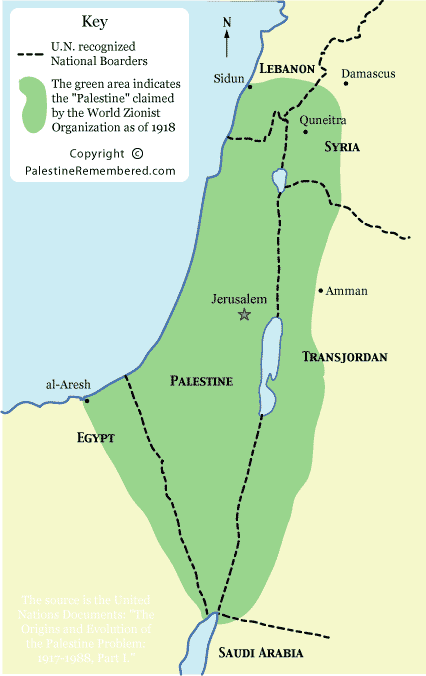
Zionists made their myths to hide an ugly truth: from the beginning, when Theodor Herzl, the father of Zionism, began writing about creating a Jewish nation, the Zionist dream included ethnic cleansing.
Myth #1: Zionists were willing to accept the United Nations plan to create two countries in historic Palestine.
This map shows the borders that the earliest Zionists wanted for Israel:
Theodor Herzl admitted he would drive out other ethnic groups:
“We shall try to spirit the penniless population across the border by procuring employment for it in the transit countries, while denying it any employment in our own country… expropriation and the removal of the poor must be carried out discreetly and circumspectly.” — Theodor Herzl, 1895
Since Herzl mentions “the poor”, his words may sound like he planned on class war instead of a culture clash, but the majority of natives in the sites being considered for a new Israel were poor. Herzl wanted to starve them out by preventing them from finding work. He dreamed of a Jewish ethnostate with a token non-Jewish population that would contribute economically while being too small to have any political power — much like Israel today.
Herzl’s followers shared the dream of ethnic cleansing:
“We have forgotten that we have not come to an empty land to inherit it, but we have come to conquer a country from people inhabiting it, that governs it by the virtue of its language and savage culture.” — Moshe Sharett (who would become Israel’s first president), 1914
“After the formation of a large army in the wake of the establishment of the state, we will abolish partition and expand to the whole of Palestine.” — David Ben Gurion (who would become Israel’s first prime minister), 1937
“Between ourselves it must be clear that there is no room for both peoples together in this country. We shall not achieve our goal if the Arabs are in this small country. There is no other way than to transfer the Arabs from here to neighboring countries — all of them. Not one village, not one tribe should be left.” — Joseph Weitz, head of the Jewish Agency’s Colonization Department, 1940
On November 29, 1947, the Zionists formally accepted the U.N. partition plan, but it was an open secret that they did not plan to abide by it.
“Every school child knows that there is no such thing in history as a final arrangement — not with regard to the regime, not with regard to borders, and not with regard to international agreements.” — Ben Gurion, War Diaries, 12/03/1947 (following Israel’s “acceptance” of the U.N. Partition of 11/29/1947)
On March 10, 1948, Zionist leaders adopted Plan Dalet and began ethnically cleansing Palestine. Ultimately, 750,000 Palestinians were driven from their homes in the Nakba.
The desire for a greater Jewish Israel lives on in the constitution of the Likud Party: “Between the sea and the Jordan there will only be Israeli sovereignty.”
Myth #2: Zionists were outnumbered by Arab armies in 1948.
The Arabs knew they were too weak to win.
“Because we have a small and ill-equipped army, we cannot stand up to the Zionist forces if they should suddenly decide to launch a strike at Damascus. We would be reduced to gathering together the Bedouin tribes to fight against them.” — Adil Arslan, an intimate of the President who represented Syria at the UN during 1948
The Zionists knew they had every advantage.
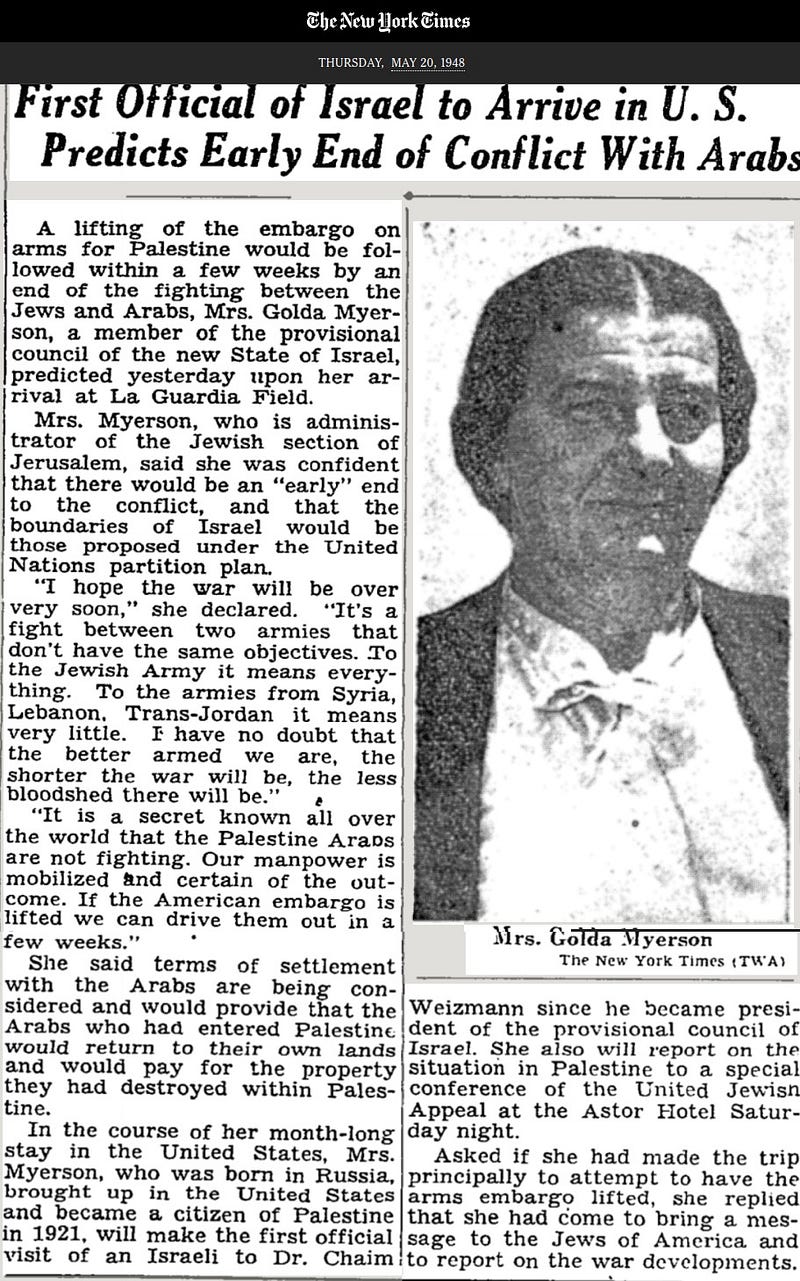
Many historians have confirmed this:
“Morris debunks the myth of the emerging State of Israel as David facing the Arab Goliath in the 1948 war. Put bluntly, “the Yishuv had organized for war. The Arabs had not.”2 Despite seemingly overwhelming demographic advantages, the Arab states were not prepared for conflict. Jewish forces consistently outnumbered Arab armies — often by a factor of two-to-one — enjoyed better access to arms, maintained shorter supply-lines, and were far more experienced than their opponents having fought against and alongside British forces under the Mandate and during World War II, respectively.” — Paul Chamberlin, Review of 1948: A History of the First Arab-Israeli War, by Benny Morris (Yale University Press, 2008)
“[Jordan’s King Abdullah] promised [the Israelis and the British] that his troops, the Arab Legion, the only real fighting force among the Arab armies, would avoid fighting with Jewish settlements…Yet Western historians record this as the moment when the young state of Israel fought off “the overwhelming hordes’ of five Arab countries. In reality, the Israeli offensive against the Palestinians intensified.” — “Our Roots Are Still Alive,” by the Peoples Press Palestine Book Project.
Recommended: In 1948, Jewish Forces in Palestine outnumbered Palestinian and Arab Fighters
Myth #3: Palestinians fled because Arab leaders told them to flee.
While some Palestinians may have been advised to flee lest they be massacred like the villagers at Deir Yassin and Safsaf, Arab radio advised them to stay home.
“The BBC (British Broadcasting Corporation) monitored all Middle Eastern broadcasts throughout 1948. The records, and companion ones by a United States monitoring unit, can be seen at the British Museum. There was not a single order or appeal, or suggestion about evacuation from Palestine, from any Arab radio station, inside or outside Palestine, in 1948. There is a repeated monitored record of Arab appeals, even flat orders, to the civilians of Palestine to stay put.” — Erskine Childers, British researcher, quoted in Sami Hadawi, “Bitter Harvest.”
Myth #4: After Palestinians fled for their lives, Israel had the right to take their homes and prevent their return.
“Both the 1907 Hague and the 1949 Geneva Conventions (to which Israel is a signatory) provide for the right of return of displaced persons to their homes following the cessation of hostilities. The provisional government of Israel (through responsibility for its army and the Zionist paramilitary forces which preceded it) was fully bound by the rules of humanitarian law when Zionist forces tried to establish a state through military means.” —Badil, Palestinian Refugees and the Right of Return in International Law
Though Israel is a signatory to the 1949 Geneva Conventions, it continues to deny the right of return to the people it dispossessed.
“The fact that the Arabs fled in terror, because of real fear of a repetition of the 1948 Zionist massacres, is no reason for denying them their homes, fields and livelihoods. Civilians caught in an area of military activity generally panic. But they have always been able to return to their homes when the danger subsides. Military conquest does not abolish private rights to property; nor does it entitle the victor to confiscate the homes, property and personal belongings of the noncombatant civilian population. The seizure of Arab property by the Israelis was an outrage.” Sami Hadawi, “Bitter Harvest.”
Many Jews were rightly horrified by the treatment of the Palestinians.
“We will have to face the reality that Israel is neither innocent, nor redemptive. And that in its creation, and expansion; we as Jews, have caused what we historically have suffered; a refugee population in Diaspora.” — Martin Buber, 1949
Myth #5: Arabs were never willing to recognize Israel.
Arabs were willing to recognize Israel as early as December, 1948.
“[The U.N.] convened a peace conference in Lausanne, Switzerland in the spring of 1949. Before the conference, the U.N. General Assembly adopted a resolution that in effect replaced the November 1947 partition resolution. This new resolution, Resolution 194 of December 11, 1948, accepted [U.N. Mediator] Bernadotte’s triangular basis for a comprehensive peace: an unconditional return of all the refugees to their homes, the internationalization of Jerusalem, and the partitioning of Palestine into two states. This time, several Arab states and various representatives of the Palestinians accepted this as a basis for negotiations, as did the United States, which was running the show at Lausanne…Prime Minister David Ben Gurion strongly opposed any peace negotiations along these lines…The only reason he was willing to allow Israel to participate in the peace conference was his fear of an angry American reaction…The road to peace was not taken due to Israeli, not Arab, intransigence.” Israeli historian, Ilan Pappe
Myth #6: Egypt started the 1967 War, so Israel had to occupy more land to be safe.
Israel launched the 1967 War. Two Prime Ministers of Israel admitted that:
“I do not think Nasser wanted war. The two divisions he sent to The Sinai would not have been sufficient to launch an offensive war. He knew it and we knew it.” — Yitzhak Rabin, fifth Prime Minister of Israel
“In June 1967, we again had a choice. The Egyptian Army concentrations in the Sinai approaches do not prove that Nasser was really about to attack us. We must be honest with ourselves. We decided to attack him.” — Menachem Begin, sixth Prime Minister of Israel
Israel wanted that war because its leaders wanted more land.
“Moshe Dayan, the celebrated commander who, as Defense Minister in 1967, gave the order to conquer the Golan…[said] many of the firefights with the Syrians were deliberately provoked by Israel, and the kibbutz residents who pressed the Government to take the Golan Heights did so less for security than for the farmland…[Dayan stated] ‘They didn’t even try to hide their greed for the land…We would send a tractor to plow some area where it wasn’t possible to do anything, in the demilitarized area, and knew in advance that the Syrians would start to shoot. If they didn’t shoot, we would tell the tractor to advance further, until in the end the Syrians would get annoyed and shoot. And then we would use artillery and later the air force also, and that’s how it was…The Syrians, on the fourth day of the war, were not a threat to us.’” — The New York Times, May 11, 1997
Israel succeeded, but history has shown that stealing land has only made Israelis less safe. Better plans were rejected because they called for Israel accepting its older borders. For example:
“Senator [J. William Fulbright] proposed in 1970 that America should guarantee Israel’s security in a formal treaty, protecting her with armed forces if necessary. In return, Israel would retire to the borders of 1967. The UN Security Council would guarantee this arrangement, and thereby bring the Soviet Union — then a supplier of arms and political aid to the Arabs — into compliance. As Israeli troops were withdrawn from the Golan Heights, the Gaza Strip and the West Bank they would be replaced by a UN peacekeeping force. Israel would agree to accept a certain number of Palestinians and the rest would be settled in a Palestinian state outside Israel. The plan drew favorable editorial support in the United States. The proposal, however, was flatly rejected by Israel. ‘The whole affair disgusted Fulbright,’ writes [his biographer Randall] Woods. ‘The Israelis were not even willing to act in their own self-interest.’” — Allan Brownfield,“Issues of the American Council for Judaism.”
Myth #7: Hamas will not accept a two-state solution.
Hamas has indicated it would settle for a viable state of its own.
“I’ve met several times with Hamas’ leadership. And I think they are willing to accept Israel to exist peacefully within the ’67 borders or some modification of those borders. But the first step has to be to bring Hamas and Fatah together so they can have another honest election. That is a major premise, and I think the 67 borders between the two with some modifications will lead to a two-state solution. Netanyahu now, I believe, has decided unequivocally to move to a one-state solution, which every one of his predecessors in the prime ministership have condemned as a disaster for Israel. And I think Israel is now moving toward a disaster for itself, in insisting that all the way from the Jordan River to the Mediterranean Sea has to be Israeli control. That is a mistake for Israel.” — Jimmy Carter, 2013
See also:
Haaretz: Haniyeh: Hamas Willing to Accept Palestinian State With 1967 Borders
Guardian: Hamas presents new charter accepting a Palestine based on 1967 borders