avatarRob Brooks

Free AI web copilot to create summaries, insights and extended knowledge, download it at here

4492

Abstract

joyed higher attractiveness ratings. The opposite was true when beards were common.</p><p id="c9c7">We used this premium on novelty to explain the <a href="https://theconversation.com/fear-not-the-hipster-beard-it-too-shall-pass-24715">rise of the ‘hipster beard’</a>, and to reassure the non-hipster population that 2014 was ‘<a href="https://www.murdocklondon.com/uk/themurdockman/have-we-reached-peak-beard">peak beard</a>’. True to our prediction, the bearded hipsters haven’t disappeared, but since 2015 they have dwindled, like a crowd reluctantly oozing its way home after a <a href="https://official.tameimpala.com/">Tame Impala</a> gig.</p><h1 id="1aae">Beards for blokes?</h1><p id="ddb4">Beards do signal status and formidability to other men. When men strike angry expressions, they <a href="https://academic.oup.com/beheco/article-abstract/23/3/481/221987">look more aggressive</a> if they are wearing a beard. People also <a href="http://www.australasianscience.com.au/article/issue-december-2015/survival-sexiest.html">rate them</a> as more masculine, socially dominant, older, and of higher status.</p><p id="2ead">In apes and monkeys, male secondary sex traits are mostly used to signal dominance and status. Across <a href="https://www.sciencedirect.com/science/article/abs/pii/S1090513815000276">154 primate species</a>, those species that live in large social groups with hierarchies of social dominance tend to have the most conspicuously ornamented males, and those males are the ones atop the hierarchy.</p><p id="2359">According to <a href="http://www.australasianscience.com.au/article/issue-december-2015/survival-sexiest.html">Dixson</a>, beards may well signal the qualities that underpinned dominance and status for our hunting and gathering ancestors:</p><blockquote id="6818"><p>In large groups where we’re surrounded by strangers, we need a quick, reliable way to evaluate someone’s strength and quality. Secondary sexual traits … do just that. And traits such as beards could increase a man’s courting potential by enhancing manliness and helping him stick out from the crowd, in essence acting as his badge of status.</p></blockquote><p id="502e">Intriguingly, when we looked at <a href="https://www.sciencedirect.com/science/article/pii/S1090513816303038">hundreds of Facebook profile photographs</a> of men from 93 cities in 37 countries, we found that men in larger cities were more likely to have beards. Other facial hair fashions, like moustaches and goatees, were also more common in big cities.</p><h1 id="444e">Why shave?</h1><p id="e84e">No other male primate removes its most prominent signal of dominance and status. Even if they could, a gorilla would never dye its silver back-patch black. A mandrill would never hide its colourful snout.</p><figure id="c553"><img src="https://cdn-images-1.readmedium.com/v2/resize:fit:800/1*Zuuh8wyteT-9rs0uSdxZUQ.jpeg"><figcaption>Photo by <a href="https://unsplash.com/@joshsorenson?utm_source=unsplash&amp;utm_medium=referral&amp;utm_content=creditCopyText">Josh Sorenson</a> on <a href="https://unsplash.com/s/photos/shave?utm_source=unsplash&amp;utm_medium=referral&amp;utm_content=creditCopyText">Unsplash</a></figcaption></figure><p id="4070">Why, then, do so many men spend valuable time and money removing their most prominent signal of masculinity?</p><p id="2b63">One possibility is that it begins with men who struggle to grow a beard. Unable to compete, they shave away the evidence so that their puny beards don’t undermine their bids for status. A clean-shaven face is a <b>disguise</b>.</p><p id="5327">The other possibility is that men shave to dial down the jockeying for status and respect. Contemporary societies require extraordinary co-operation of a kind our ancestors living in groups of 100–200 never really faced. That kind of cooperation might be more difficult if every man’s face is a billboard for competitive aggression.</p><p id="bff7"><b>Subordinating</b> one’s personal ambitions for the good of the group is an unusual type of explanation for an evolutionary biologist like me to propose. We don’t typically gravitate toward explanations that rely on the “good of the group”. Typically self-interest is expected to win out.</p><p id="d7a0">The key to this explanation is how well the group works when men subordinate themselves. A group that makes shaving the norm might find that they waste less time on blokey argy-bargy, and more time on the business at hand. That busine

Options

ss could be running a small business or an empire.</p><p id="b664">The Romans provide an early example. The senators who ran the Republic, and later the Emperors, were ambitious to their core, fuelled by rivalry and acutely tuned to status. And yet they oversaw the most complex society that history had yet known.</p><p id="d12a">From Scipio Africanus (206 B.C.E.) to the ascent of Emperor Hadrian (117 C.E.) <a href="https://en.wikipedia.org/wiki/Beard#Rome">no consul or Emperor</a> wore a beard, except in mourning. The norm held that men who chose not to shave were slovenly and squalid. Young Romans only earned the right to don the <i>toga virilis</i> and be considered men upon their first encounter with the razor.</p><p id="1b8c">Could it be true that shaving made it just a little easier for fierce rivals to cooperate? If shaving gave Romans an edge, then little surprise if the nations they subjugated and those with whom they cooperated adopted the custom.</p><figure id="0068"><img src="https://cdn-images-1.readmedium.com/v2/resize:fit:800/1*uBdDAQWplrRzO-HudiqIgQ.jpeg"><figcaption>President Benjamin Harrison. Bureau of Engraving & Printing. Wikimedia Commons, Public Domain.</figcaption></figure><p id="68a9">For more than a century, American politicians have avoided the beard. Not since Benjamin Harrison (1889–93) has a bearded man been elected President. To be sure, the beard was out of fashion for most of the 20th Century, but could a bearded man be elected today?</p><p id="f390">Both Congress and Senate are chock-full of men, but the beard tends not to feature. <a href="https://www.vox.com/2015/9/10/9303239/congress-facial-hair">In 2015</a>, around about the time of ‘peak beard’, only four in the House of Representatives and nobody in the Senate sported a full beard. Admittedly two Senators wore moustaches, and plenty of Congressmen had moustaches and goatees.</p><h1 id="3b67">What about those isolation beards?</h1><p id="a016">Getting back to the isolation beard: is it really a thing?</p><p id="e01d">According to Twitter, it is. #IsolationBeard, #CoronaBeard, and #LetsGrowTogether are all trending. Daily selfies are being uploaded, revealing the incremental growth as people social distance from their shavers. <a href="https://www.inquirer.com/health/coronavirus/coronavirus-covid19-beard-safety-should-i-shave-masks-20200407.html">Advice</a> abounds on how to wear a mask over a beard, and the proper way to ensure good beard hygiene.</p><figure id="a387"><img src="https://cdn-images-1.readmedium.com/v2/resize:fit:800/1*_E0Su0bFEjPnsz5cxs6McQ.png"><figcaption></figcaption></figure><p id="d719">I asked my followers if they are growing a beard, and why. A quarter of them were making the best of the opportunity to try whilst nobody else is watching. Some hadn’t noticed they hadn’t shaved. And more than half the sample just couldn’t be bothered.</p><p id="5754">The fact that men normally do bother exposes the fact that shaving is costly. It takes an effort, one that many of us are willing to make for those we see outside of our homes.</p><p id="c496">I think, however, that there’s more to this beard season than lazy isolation-induced ennui. When the going gets tough, the men stop shaving. As <a href="undefined">Jacqueline Detwiler</a> <a href="https://forge.medium.com/growing-a-beard-during-tough-times-has-psychological-benefits-7d4a92f11bdd">wrote</a></p><blockquote id="fc2a"><p>Growing a beard while homebound and avoiding the coronavirus … is an act that has powerful psychological and social effects. In both history and Hollywood, beards stand for toughness, strength, adventurousness, and even aggression. And now is a perfect moment to play dress-up with all those qualities.</p></blockquote><blockquote id="515a"><p>It’s the grooming equivalent of planting a subsistence garden and buying an ax.</p></blockquote><p id="b2e7">The last ‘peak beard’ happened in the aftermath of the Global Financial Crisis. As the economy tanked, full-blown facial hair came out of nowhere, reaching levels not seen since the 1870s.</p><p id="920c">By all informed predictions the COVID-19 pandemic is a much bigger deal. When we finally emerge from our homes after goodness knows how many months, expect to see half the adult population looking like grizzly bears waking up from hibernation.</p><p id="20b1">Time will tell if those beards will stay, and if they will get in the way of rebuilding cooperative societies.</p></article></body>

Isolation Could Drive Us Back to ‘Peak Beard’

Why are beards resurging in 2020? History teaches us that men cooperate best if they shave. They stop shaving when times get tough.
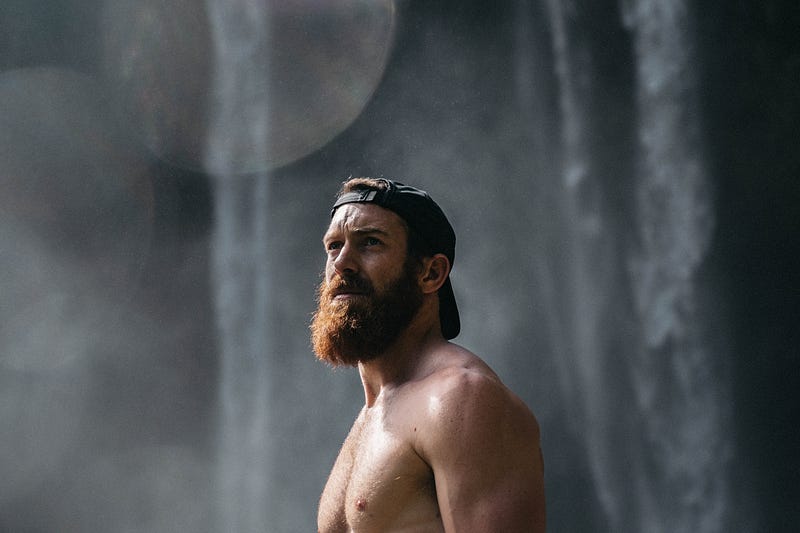
The trendy look, post-isolation? Photo by Jakob Owens on Unsplash

Two weeks into work-from-home isolation and a trend has slid into my Zoom meetings. Men I have never seen with so much as a one-day growth are now sprouting beards. Maybe not the big bushy beards beloved by hipsters. At least not yet. But normally clean-shaven types have been letting things go.

Don’t go asking the bearded blokes awkward questions. It is worth remembering that the people who need to explain themselves here are the ones with razors in their hands. At least in the context of human evolution.

Facial hair represents what biologists call a ‘secondary sex trait’. Unlike the primary sex traits — genitals, eggs, and sperm — they aren’t necessary for sex and reproduction. They develop after sexual maturity and differ between females and males.
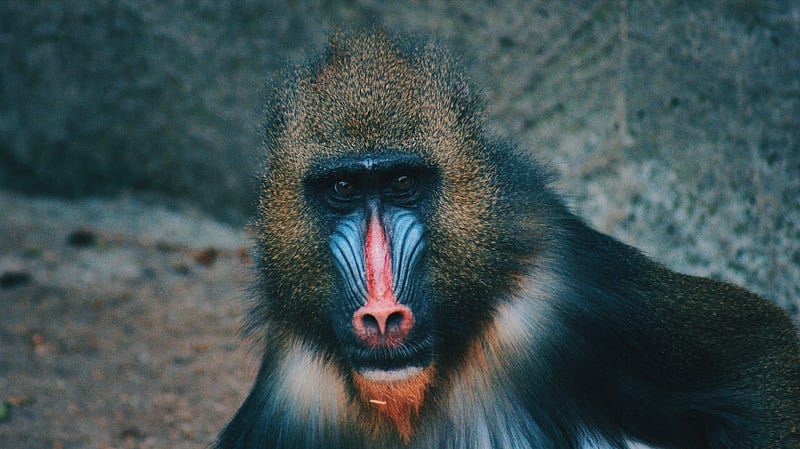
The spectacular secondary sex traits of the Mandrill include a mane, beard, and colourful facial skin. Photo by Jessy Hoffmann on Unsplash

Secondary sex traits in the animal world include moose antlers, peacock tails, and the colours of the superb fairy-wren. Charles Darwin established, way back in 1871, that secondary sex traits function either to attract mates, or to aid in fights over territories, resources, and, ultimately, mates.

Beards to attract mates?

So do men grow beards to attract mates, or as some kind of non-verbal signal to male competitors? Despite plenty of confidently-splained folk theories, the scientific research is more nuanced and sometimes equivocal.

Over the last decade or so, I have been lucky enough to work with Dr Barnaby Dixson, unequivocally the world expert on the evolution of human beards. Most of the studies I am about to discuss were led by him, and I contributed to some of them.

According to these experiments, having a beard does not make men more attractive to the average woman. Nor, for that matter, does a beard entice the average same-sex attracted man. Depending on the study, either clean-shaven men or men with about 10-day stubble tend to be more attractive.

Before anybody reaches for the clippers, remember that nobody goes home with a statistical measure at the end of the night. Dating and mating aren’t about appealing to the average, but rather about being attractive to individuals. Plenty of individuals find men with beards attractive, and wouldn’t look twice at a cleanskin. Others cringe at the look or feel of facial hair.

Some people aren’t looking for a particular look. Instead, they’re searching for something different. In one experiment, our student Zinnia Janif showed women series of faces that either contained many bearded men and few clean-shaven ones, or lots of shaved faces and few beards. She then asked them to rate the attractiveness of a group of standard faces. When beards were initially rare, they enjoyed higher attractiveness ratings. The opposite was true when beards were common.

We used this premium on novelty to explain the rise of the ‘hipster beard’, and to reassure the non-hipster population that 2014 was ‘peak beard’. True to our prediction, the bearded hipsters haven’t disappeared, but since 2015 they have dwindled, like a crowd reluctantly oozing its way home after a Tame Impala gig.

Beards for blokes?

Beards do signal status and formidability to other men. When men strike angry expressions, they look more aggressive if they are wearing a beard. People also rate them as more masculine, socially dominant, older, and of higher status.

In apes and monkeys, male secondary sex traits are mostly used to signal dominance and status. Across 154 primate species, those species that live in large social groups with hierarchies of social dominance tend to have the most conspicuously ornamented males, and those males are the ones atop the hierarchy.

According to Dixson, beards may well signal the qualities that underpinned dominance and status for our hunting and gathering ancestors:

In large groups where we’re surrounded by strangers, we need a quick, reliable way to evaluate someone’s strength and quality. Secondary sexual traits … do just that. And traits such as beards could increase a man’s courting potential by enhancing manliness and helping him stick out from the crowd, in essence acting as his badge of status.

Intriguingly, when we looked at hundreds of Facebook profile photographs of men from 93 cities in 37 countries, we found that men in larger cities were more likely to have beards. Other facial hair fashions, like moustaches and goatees, were also more common in big cities.

Why shave?

No other male primate removes its most prominent signal of dominance and status. Even if they could, a gorilla would never dye its silver back-patch black. A mandrill would never hide its colourful snout.
Photo by Josh Sorenson on Unsplash

Why, then, do so many men spend valuable time and money removing their most prominent signal of masculinity?

One possibility is that it begins with men who struggle to grow a beard. Unable to compete, they shave away the evidence so that their puny beards don’t undermine their bids for status. A clean-shaven face is a disguise.

The other possibility is that men shave to dial down the jockeying for status and respect. Contemporary societies require extraordinary co-operation of a kind our ancestors living in groups of 100–200 never really faced. That kind of cooperation might be more difficult if every man’s face is a billboard for competitive aggression.

Subordinating one’s personal ambitions for the good of the group is an unusual type of explanation for an evolutionary biologist like me to propose. We don’t typically gravitate toward explanations that rely on the “good of the group”. Typically self-interest is expected to win out.

The key to this explanation is how well the group works when men subordinate themselves. A group that makes shaving the norm might find that they waste less time on blokey argy-bargy, and more time on the business at hand. That business could be running a small business or an empire.

The Romans provide an early example. The senators who ran the Republic, and later the Emperors, were ambitious to their core, fuelled by rivalry and acutely tuned to status. And yet they oversaw the most complex society that history had yet known.

From Scipio Africanus (206 B.C.E.) to the ascent of Emperor Hadrian (117 C.E.) no consul or Emperor wore a beard, except in mourning. The norm held that men who chose not to shave were slovenly and squalid. Young Romans only earned the right to don the toga virilis and be considered men upon their first encounter with the razor.

Could it be true that shaving made it just a little easier for fierce rivals to cooperate? If shaving gave Romans an edge, then little surprise if the nations they subjugated and those with whom they cooperated adopted the custom.
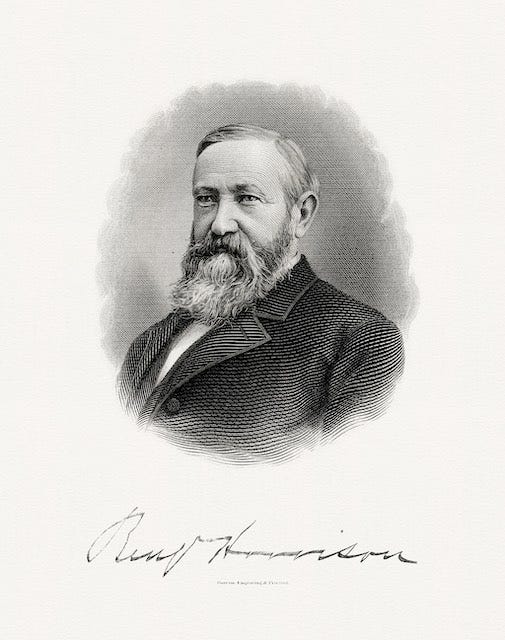
President Benjamin Harrison. Bureau of Engraving & Printing. Wikimedia Commons, Public Domain.

For more than a century, American politicians have avoided the beard. Not since Benjamin Harrison (1889–93) has a bearded man been elected President. To be sure, the beard was out of fashion for most of the 20th Century, but could a bearded man be elected today?

Both Congress and Senate are chock-full of men, but the beard tends not to feature. In 2015, around about the time of ‘peak beard’, only four in the House of Representatives and nobody in the Senate sported a full beard. Admittedly two Senators wore moustaches, and plenty of Congressmen had moustaches and goatees.

What about those isolation beards?

Getting back to the isolation beard: is it really a thing?

According to Twitter, it is. #IsolationBeard, #CoronaBeard, and #LetsGrowTogether are all trending. Daily selfies are being uploaded, revealing the incremental growth as people social distance from their shavers. Advice abounds on how to wear a mask over a beard, and the proper way to ensure good beard hygiene.
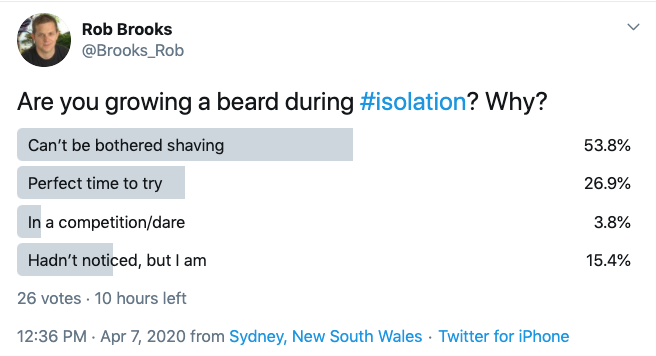
I asked my followers if they are growing a beard, and why. A quarter of them were making the best of the opportunity to try whilst nobody else is watching. Some hadn’t noticed they hadn’t shaved. And more than half the sample just couldn’t be bothered.

The fact that men normally do bother exposes the fact that shaving is costly. It takes an effort, one that many of us are willing to make for those we see outside of our homes.

I think, however, that there’s more to this beard season than lazy isolation-induced ennui. When the going gets tough, the men stop shaving. As Jacqueline Detwiler wrote

Growing a beard while homebound and avoiding the coronavirus … is an act that has powerful psychological and social effects. In both history and Hollywood, beards stand for toughness, strength, adventurousness, and even aggression. And now is a perfect moment to play dress-up with all those qualities.

It’s the grooming equivalent of planting a subsistence garden and buying an ax.

The last ‘peak beard’ happened in the aftermath of the Global Financial Crisis. As the economy tanked, full-blown facial hair came out of nowhere, reaching levels not seen since the 1870s.

By all informed predictions the COVID-19 pandemic is a much bigger deal. When we finally emerge from our homes after goodness knows how many months, expect to see half the adult population looking like grizzly bears waking up from hibernation.

Time will tell if those beards will stay, and if they will get in the way of rebuilding cooperative societies.

Science
Live
Beard
Men
People
Recommended from ReadMedium