
Isaac Newton Discovered Gravity While in Quarantine
Solitude and self-isolation is the time for deep thinking.
Isaac Newton was an incredibly smart guy. A genius, who changed the views on our world with the laws of gravity, discovered that colors are a property of light, and invented calculus along the way.
Truth to be told, he is also said to have had a terrible personality. He didn’t go along with most other people and was described as rude, untrusting, and petty. He preferred to spend his time in solitude with his own intellectual thoughts. But in that kind of self-company, who can blame him?
Newton’s work during isolation
The following quotes are from “The Ascent of Gravity: The Quest to Understand the Force that Explains Everything” by Marcus Chown.
In August 1665, bubonic plague was raging in London. So great was the dread of contamination that in Cambridge, 55 miles to the north-east, the university was closed.
Just like in our Corona-times, the University was closed. Toilet paper was not yet invented in 1665, so Newton did not have to worry about that.
Newton, twenty-two years old, unremarkable, unknown, made the trek, by foot, by horse-drawn cart, back to his family farm in Woolsthorpe. There he remained secluded for eighteen months, during which time he not only discovered the universal law of gravity but changed the face of science.
18 months? Okay, that’s a bit longer than I expect University to be closed this time … but still, 18 months working from home, in which he frameshifted the whole scientific view of the Universe. I bet he didn’t have access to the internet. And since he didn’t have any romantic relationships, he didn’t have small mini-Newton’s begging for his attention either.
‘My greatest friend is truth,’ Newton had written. At Woolsthorpe, while the horror of plague stalked England, Newton began to seek that truth. ‘Voyaging through strange seas of thought alone,’ he would become the pre-eminent mathematician in the world. He would discover the laws of optics and colours, the mathematics of ‘calculus’ and the ‘binomial theorem’. But, most significantly of all, he would find the universal law of gravitation.
Be like Newton. Seek that truth! You might think that it’s too late to discover the secrets of gravity, but not to worry. Newton’s discovery was only the beginning.
Einstein and beyond
In 1915, Albert Einstein once again changed our view of gravity, by introducing us to the general theory of relativity. While Newton described gravity as an attractive force between to objects, Einstein said that gravity is nothing but a consequence of the curvature in spacetime.
In the famous words of John Wheeler: “Matter tells space-time how to curve. And warped space-time tells matter how to move.”
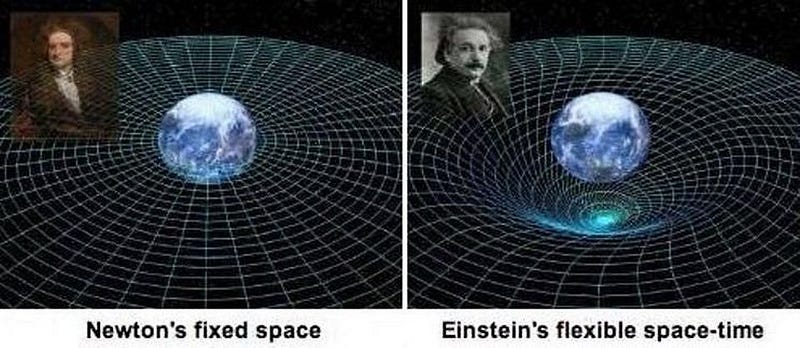
Einstein changed our view on the Universe, from fixed space and time as absolute values to spacetime being a single 4-dimensional structure, which is disturbed by existing matter. We might think of Earth orbiting the Sun in a circular or elliptical path, but in reality, Earth travels in a straight line through a spacetime curved by the mass of the Sun. Gravity is the result of this curvature.
So are we done with gravity now? All good? No, wait, there is more to discover … you still have a chance to come up with something new in your time of solitude.
Unsolved issues with gravity
Quantum mechanics has given us a deeper understanding of our world’s fundamental building blocks, describing it by particles and particle fields. Gravity seems to be the black sheep, that doesn’t quite fit in the rest of the quantum theory to describe the world.
We have four fundamental forces: Gravity, the weak force, the strong force, and the electromagnetic force.
Those last three forces are now described as interacting particles — or the force carriers — that are exchanged between matter particles.
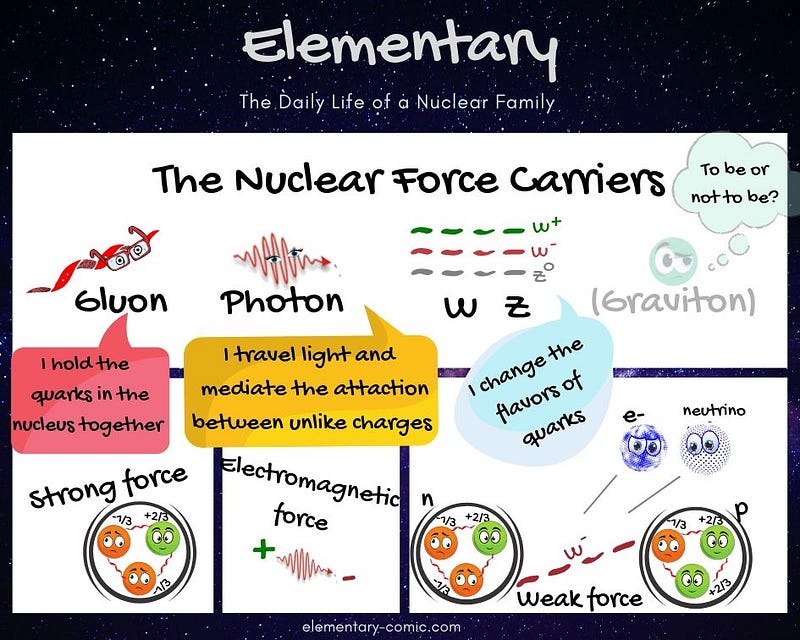
But gravity? We don’t know whether a graviton exists and hence whether gravity can be described with quantum mechanics and united with the other three forces. It’s one of the biggest challenges of our times, which so far has resulted in the string theory as the closest thing to some kind of answer.
The game is on.
So if you need something to do in your social distancing and isolation, you might throw yourself into the unknown of physics, solving the mysteries of quantum gravity. But beware: it turns out that the rules are strict.
Physicists are not, it turns out, free to invent any old theory they like. Far from it. Their theory must be consistent with both special relativity and quantum theory. In fact, so ridiculously tight is this constraint on reality that the overwhelming majority of theories that physicists come up with are instantly ruled out. ‘This is why it is so hard to find a deeper, more fundamental theory,’ says Arkani-Hamed.


