
Is Your Marketing Strategy Really a Strategy?
A strategy fails because it’s not defined and communicated well

A three-year marketing strategy used to work. It likely won’t work today because of how quickly things change. Rapid change is the only constant.
You used to print out directions or write them down to get from point A to point B. Now, a journey to your destination is more like what Google Maps offers where it recalculates if you make a wrong turn or if you stop for gas or grab a bite to eat.
Marketing strategy is not the same as it used to be because things change quickly. Such change includes the rise of new competitors and new technologies entering the marketplace. Your strategy needs to recognize and react to these changes.
If you don’t have a marketing strategy that’s defined and communicated well, your marketing will eventually fail.
Marketing is now responsible for transforming organizations. Marketing has become the tip of the spear for where businesses are going. Marketing is becoming more like sales, and sales is becoming more like marketing.
In addition, everyone thinks they know and understand marketing so, if you are not careful, your marketing strategy can quickly go off the rails.
Almost every organization has some level of dysfunction ranging from poor leadership, conflicting goals and initiatives from different lines of business, a resistance to change if things are going well, a lack of resources, and silos where teams don’t communicate well with each other.
It’s no wonder that only 26% of senior managers strongly agree their key performance indicators (KPIs) are aligned with their organization’s strategic objectives, according to an MIT Sloan School of Management survey.
Additionally, 85% of executive leadership teams spend less than one hour per month discussing strategy and 50% spend no time at all, according to Harvard Business School. 95% of a company’s employees don’t understand their company’s strategy.
What’s the Definition of a Strategy?
Before you can reap the rewards of your marketing strategy, you must define what a strategy is. That’s at the heart of the problem. People think about strategy in different ways.
Some people think you must analyze today, expect changes, and plan how you’ll succeed. Others believe the future is too tough to predict (who would have thought the global pandemic would have hit in 2020?) so they prefer to evolve their strategy organically.
Michael Porter, a Bishop William Lawrence University Professor at Harvard Business School, believes the need for a strategy to define and communicate a company’s unique position is imperative. This strategy should determine the resources, skills, and core competencies needed to continue to create a competitive advantage.
A strategy is about how a company creates and captures value within its industry and beats the competition to meet the needs of the marketplace and its stakeholders.
What Is the Strategy Missing?
Some companies are too focused on short-term thinking from quarter to quarter, so it’s tough to focus on the long-term. Other companies see strategy as a roadblock. Some organizations, especially the smaller ones, believe they don’t have time for strategy, they just have to “go, go, go.”
Companies confuse strategy with goals and priorities. That’s not a strategy.
For example, growing revenue by 30% or implementing a new marketing automation system is not a strategy. It’s a goal, not a strategy.
What Is a Marketing Strategy?
A marketing strategy is tied to the business strategy. It’s your formula for winning in the marketplace against your competitors. Ideally, it’s a marketing strategy on a page. This page should include:
- Strategy timeline (insert how long, such as six months or one year)
- Strategy statement (one to two sentences summarizing everything)
- The current state of marketing (bullet points with statement)
- Top five marketing initiatives (one sentence for each initiative)
- Five underlying beliefs and assumptions (discusses the culture of the organization and how marketing is viewed internally)
- State of marketing in X (X stands for how long you stated in the timeline section)
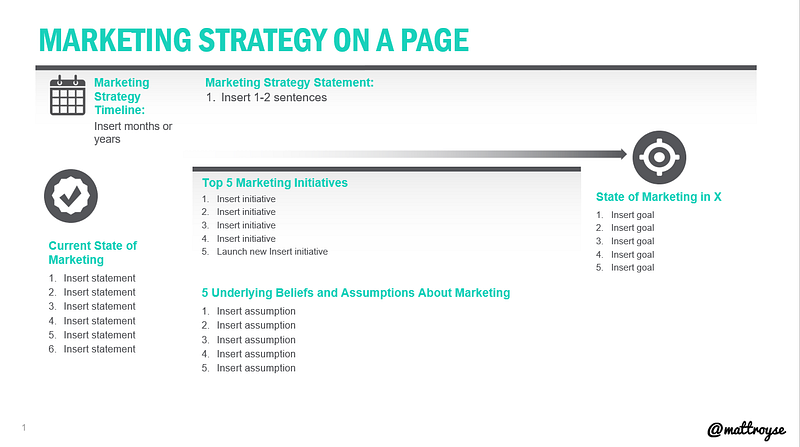
Once this strategy on a page is developed, it’s only as good as it can be successfully articulated, communicated, and executed.
Does your company truly understand what your marketing strategy is and how it helps your company? Do your employees know how you are going to reach potential customers and convince them to do business with you?
Your strategy should capture the customers you are serving, the value your products and services provide, and why you are a better choice than your competitors.
A strategy is as much as what you will not do, as much as what are you going to do. Good marketing leadership knows when to say no and know when to say yes. Marketing has limited resources, so it needs to be strategic on where to place its bets.
A marketing strategy should communicate the value marketing provides your organization.
Questions to Ask As You Develop Your Strategy
To get you asking the right questions about your strategy, ask yourself:
- Who is our ideal customer?
- What are the demographics (age, income, education, etc.)?
- What’s the psychographics (lifestyles, behaviors, interests, beliefs, values, etc.)?
- What’s the technographics (tools, equipment, software, hardware, etc.)?
- Who “sits” on the buying committee at our ideal customer?
- What problem or “job to be done” are we solving?
- What makes us uniquely qualified to solve this problem or job?
- Why is our company different?
- Why should potential customers care?
- What parts of the organization need to change to support the strategy?
- What are the top initiatives we need to launch to support the strategy?
- What are we consciously deciding not to do?
- What does success look like six months, one year, or two years from now?
- How is the marketing strategy going to be measured?
- Who needs to support the marketing strategy internally?
- What part of the marketing culture needs to change?
- Do we need to hire new marketing talent from outside or up-skill those we currently have?
How to Make Your Strategy Happen
Often marketing is perceived as an organization that is concerned with vanity metrics such as social media followers that you can measure but don’t have a direct correlation toward business success. Your strategy needs to have “teeth” so chief financial officers can understand the customer lifecycle. You need to know if the money is being spent wisely so you need to speak the language of dollars and cents.
Your strategy needs to be transparent and honest on where it stands today and what it will take to get to a future state. The strategy should include as many employees as possible because they are more likely to buy-in to the strategy if they helped develop it. The timeline should be realistic. Marketing’s role is to plant and nurture the “crops” so sales can harvest the crop and sell it to the buyer.
Bringing It All Together
Your marketing plan is only as good as it is defined and communicated. So, just like good writing, avoid jargon like “leverage our synergies.” Be as specific as possible, tell the marketing story, paint a vision for the future, and decided how the marketing strategy will be measured.
Make sure as many employees help develop the strategy so they know where you are going. Everyone thinks they are a marketing expert and knows what marketing should do. Embrace the feedback so you can tell if your marketing strategy is working or not.