
Is Your Brain Really Just a Supercomputer?
Where neuroscience does — and doesn’t — meet AI
In Netflix’s hit choose your own adventure Black Mirror special Bandersnatch, the characters, who are inside a simulation (which you, the watcher, control) become self aware and come to the realization that they don’t actually have free will.

One of the characters, Colin Ritman, makes this powerful statement when exposing the simulation to the main character, Stefan:
It’s all code. If you listen closely, you can hear the numbers.
Pretty creepy. But this is nothing new. People in our world have been suggesting we’re in a simulation pretty much as far back as technology has been around and growing.
In fact, a common statement regarding deep learning algorithms is that they are modeled after the human brain. So it follows, if the brain can essentially be reduced to a numerical code, to a series of on and off switches, who is to say we wouldn’t be able to someday upload an exact copy of someone’s brain into some machine and run a life simulation with it?
The brain consistently runs on algorithms much like those in computer programs
I studied both data science and neuroscience in college. I had a deep interest in both subjects and always attempted to draw parallels between them.
In the human brain there exist a series of loops similar to those in a computer program. Hormones and neurotransmitters have varying effects on these loops, often functioning as signals which tell the brain to switch actions on or off.
One example of this is how the brain regulates body weight (particularly body fat) and appetite.
The hypothalamus, a region in the brain located just below the thalamus, is responsible for maintaining homeostasis and regulating a variety of autonomic processes in the human body.
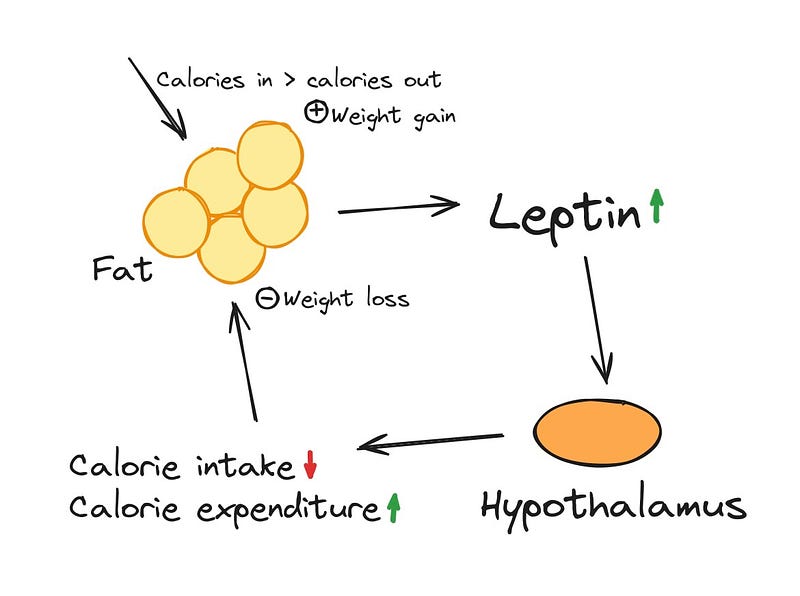
Here’s how it regulates body fat:
- First, the individual intakes a certain number of calories. A percentage of those calories are burned for energy to perform necessary physiological functions, digestion of foods, and physical activity.
- Any excess calories not used by the body are stored as energy in adipose tissue (body fat).
- Body fat releases a signaling hormone called leptin.
- The hypothalamus has leptin receptors and is constantly receiving bodily feedback as to how much body fat an individual has.
- More leptin inhibits appetite, so higher levels of body fat result in lower appetite.
- Conversely, low levels of leptin increase appetite in order to reestablish normal body fat levels.
Let’s translate this into pseudocode so you can get a better idea of the parallels between this biological process and a computer program:
while(true): // Body is constantly in some state of energy balance

  if(calorie_intake > calorie_expenditure):
    excess = calorie_intake - calorie_expenditure
    // function call
    store_excess_as_adipose_tissue(excess)

  while(true): // Body fat secretion of leptin is also constant, and
               // is involved in the energy balance process
    leptin_level = adipose_tissue_release_leptin()
    call_hypothalamus(leptin_level)

// Hypothalamus receives leptin level and acts accordingly
function call_hypothalamus(leptin_level):
    If leptin_level < normal:
     Increase_appetite_and_calorie_intake()
     Decrease_energy_expenditure()
    Else if leptin_level == normal:
     Maintain_appetite_and_calorie_intake()
    Else:
     Decrease_appetite_and_calorie_intake()
     Increase_calorie_expenditure()
Of course, this system runs into bugs all the time — such as leptin resistance (A subject for another article).
Back to neural nets
Francois Chollet, creator of the popular deep learning library Keras and author of Deep Learning with Python, states this in his book:
The term “neural network” refers to neurobiology, but although some of the central concepts in deep learning were developed in part by drawing inspiration from our understanding of the brain (in particular, the visual cortex) deep learning models are not models of the brain. There’s no evidence that the brain implements anything like the learning mechanisms used in modern deep learning models.
Now, I don’t know if I’d say that there’s no evidence, but I understand why he would say this. He’s writing to an audience of data scientists, to people who want to learn about machine learning algorithms and programming, not to computational neuroscientists or researchers. If the average person was told that deep learning algorithms worked like the brain, they’d probably take that inch and stretch it miles.
The answer to this question, do deep learning algorithms work like the brain? requires a lot of nuance. You can’t fit all that in a book geared towards teaching deep learning algorithms in Python, nor should you —it’s not necessary.
Much of the literature comparing neural networks to the human brain refers specifically to Convolutional Neural Networks, or CNNs. CNNs, most commonly used for image recognition, are said to imitate the human visual cortex.
Here are some of the ways that CNNs and the brain are similar:
- CNNs are able to correctly classify images at a rate comparable with human vision [2].
- CNNs classify images by passing them through layers, each layer processing different parts of the image, such as lines, curves, etc. The visual system also learns via a hierarchical structure, with outputs of certain cells becoming inputs to other cells, processing increasingly complex features [6].
- When CNNs and animals are shown the same image, the activity of CNN units can be used to predict actual neuronal activity. This shows that there is a similarity in structure and function [2].
On the other hand…
- Making slight tweaks to images, such as occlusions or blurs, can severely decrease CNN performance, whereas humans are generally pretty good at classifying images despite image degradation. This indicates that the brain has mechanisms by which it compensates for degradation which CNNs lack [2].
- Many of the features that make neural networks similar to the visual system need to be explicitly built into these algorithms. One MIT study of over 11,000 neural networks found that they only produced actual brain cell-like activity when they were given constraints that aren’t found in biological systems [1].
The exact complex mechanisms by which the brain executes its algorithms is still not fully understood. Nor can they be replicated with current technology.
Critics of the “brain as a computer” metaphor bring up some valid points. The visual system doesn’t work by itself. It is fully connected to other parts of the brain, integrating complex inputs and producing complex outputs. CNNs obviously don’t have this feature. They simply start when they’re told, execute an engineered process, and then stop.
Even the brain as a whole is not a standalone machine — it is constantly getting feedback from the environment, from the central and peripheral nervous system and the entire human body. It’s been evolving for millions of years. And it’s plastic — people have been able to function normally despite losing parts of their brain supposedly dedicated to specific functions [5].
The brain as we know it today just doesn’t seem to operate with a whole lot of clear logic — at least not in the same way our current computers do.
But, fascinating progress is being made.
In a 2019 study, researchers were essentially able to reconstruct images they showed to people by measuring their fMRI activity and “translating” it into hierarchical features of a deep neural network [4].
And although their reconstructed images weren’t perfect, this does suggest that they were able to successfully map human brain activity onto computer representations.
I’ve always thought that one day, we will be so good at mapping the brain that, given the right equipment, we will be able to read neuronal activity while a person is dreaming and play what they’re seeing on a screen.

And while there’s so many ways that technology could go wrong, I don’t think it’s that far fetched to imagine that we could see it in our lifetimes.
Is your brain a computer?
In a metaphorical sense, yes. In an analogy sense, also yes. But in a literal sense, not yet. The computers we have today don’t function like our brains and vice versa.
The brain is essentially a piece of alien technology. We are still trying to figure out how it works. Once we do, I have no doubt that our computers will be modeled after it and work similarly.
Is this a good thing or a bad thing? Well, that’s for you to decide.
Thanks for reading
Sources
[1] A. Trafton, Study urges caution when comparing neural networks to the brain (2022), MIT News
[2] G. Lindsay PhD, Deep Convolutional Neural Nets as Models of the Visual System: Past, Present, and Future (2020), Journal of Cognitive Neuroscience
[3] F. Chollet, Deep Learning with Python Second Edition (2021), Manning Publications
[4] G. Shen et al, Deep image reconstruction from human brain activity (2019), PLoS Computational Biology
[5] M. Cobb, Why your brain is not a computer (2020), The Guardian
[6] R. Aung, Do convolutional neural networks mimic the human visual system? (2021), Michigan Student Artificial Intelligence Lab
[7] University of Washington, Body Weight Regulation (n.d), University of Washington Courses


