
Hoodwinked by Media Marketing Lies
Is what we see, hear or believe actually true?
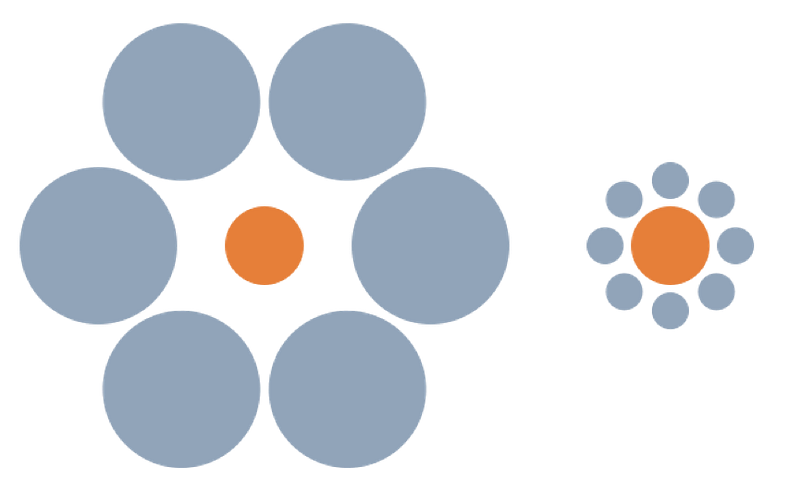
If whole countries can be hoodwinked by media marketing lies, how easy do you think it is for an advert to tempt you into buying an idea, product or service?
You and I certainly think what we know is true for much of what pops into our minds. But do we check our facts? I’m going to stick my neck out here and say that millions, possibly even billions, of people seldom check their facts.
There are those in power with deep pockets who intentionally seek to subvert public thinking by the use of nudges and or lies in the lead up to elections, for example. The majority failed to fact check. Instead, they chose to believe the lies because they were unhappy — years of austerity will do that — plus they were being promised a better life.
The citizens of the UK and the US, who wanted to believe the government ignored journalists and experts who did their research and knew their facts because they were not saying what they wanted to hear. But that’s my opinion and another story.
Illusions designed to trick us
Let’s take a look at Ebbinghaus’s Illusion in the header image, which circle is bigger do you think?
The centre-circle with the small petal-like circles looks much bigger than the other which has big petals. Your brain tells you the little circle with the big petals is bigger than the one with the little petals, right? We are not seeing what is real.
Turns out both circles are the same size. Turns out our minds don’t think in terms of what’s absolute or universally valid or even real!
We can only make decisions based on relative information or what we know. When we look at something, we compare it to what we know (a relative reference point), not what is actually true.
Think of the petals as the reference points we see. The petals look big, the circle must big. The petals are small, the circle must be small. The petals create an illusion that we believe to be true.
In Have Millennials Been Given a Raw Deal? I mentioned the measuring stick or reference point that we use to compare ourselves to celebrities, that measuring stick is also a reference point. And an illusion we chose to believe.
Reference points and how they may harm your life
Judging the quality of your life by the reference point of a celebrity is, firstly, irrelevant. Comparing yourself to your peers on social media to feel superior or for fear of missing out (FOMO) and feeling inferior is, equally, irrelevant. Even though it may feel super relevant at the time.
Secondly, I realise social comparison is a millennial habit but, like smoking, it is really bad for you. Comparing yourself is going to make you feel depressed or smug because you think you’re worse or better off than someone. Our reference points can be deceptive and dangerous to our health.
We judge what happens in our lives, good or bad, by irrelevant reference points.
To give you some more examples of how other people think and the reference points they use, we’re going to look a little deeper into the measuring sticks some Olympic athletes used after finishing a race.
Reference Point 1
Michael Phelps is the most decorated Olympian in history. The photo in the link was taken at the Brazilian Olympics in 2008. He looks happy.
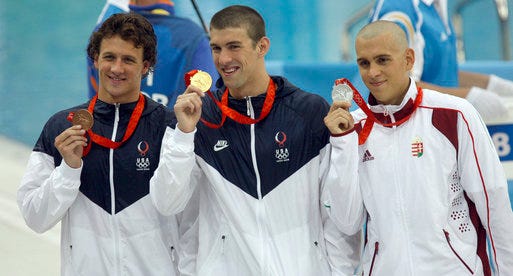
Now take a look at Laszlo Cseh to the right of Michael Phelps on the medal podium. From the absolute position, the silver medal winner should be pretty happy, wouldn’t you agree? But he got silver so maybe he’s not as happy as Michael. In the photo, he’s looking as though smiling is difficult for him.
So the bronze winner, he’s got to be really unhappy, hasn’t he? Ryan Lochte’s smile is more radiant than Michael’s! What’s going on here?
Reference point two
Victoria Medvec and her colleagues claimed that each swimmer had a different reference point at the most conspicuous moment. Laszlo was a second, one second from gold, so he’s probably kicking himself and it’s showing on his face. Lochte’s joy is from having made it onto the podium; he could so easily have missed his chance.
The Medvec et al study was based on photos and the analysis of the video footage of the Olympic winners. Independent people viewed the medal winners when they knew their position and when they were on the winner’s podium. The results showed the most joy was when the silver and bronze winners first found out their position, but there was a lower happiness rating by the time the athletes reached the podium. In both instances, the silver winners are a lot less happy than the bronze.
When you think you should have won gold but had to make do with silver, you’re beating yourself up with disappointment. But when you think you might not even have won a medal, your joy is much greater than the silver medal winners.
We’re not all Olympian level athletes though, so our reference points are going to be very different. Or are they?
In my articles Do You Really Need That £40,000 Salary and Does Materialism and Being Perfect Make Us Happy? We found our reference points weren’t reliable.
Reference points are illusions
The reference points I used in my career were based on what grade my father had achieved and what my peers were earning. I wanted to do better than my dad and peers or at least earn the same as them.
By the age of thirty-two, I had progressed farther than my dad in the same company but my happiness was shortlived. I was diagnosed with depression.
Years later, I realised I had been depressed because I’d achieved everything I wanted to and I thought there was nothing left for me to do. Without even realising it that age-old existential question, ‘what’s the point of life?’ got me down to the extent of being signed off sick for six months.
The drugs worked and I found a renewed verve for my career and earning yet more money.
However, by the age of forty-one, I had worked my way up to £40,000 from £7,000 at the age of eighteen. But the lack of a position in the company I’d given my all to, combined with being in denial over the death of my step mum for five years, ended up making me ill again.
I was paid to leave and my new life began.
Life rarely works out the way we think it will
For example, other people’s opinion of my poetry tells me they are either being kind or they think I am a poet. Whereas, the competitors running the men’s 400m in 2008 were placed on the podium based on their very precise times to run the distance.
Most situations in real life will, of course, present situations which are a mixture of opinion and ability evaluation. ~ Leon Festinger 1956
Takeaways
What we can see or have seen sways our decision-making process. Please bear this in mind when you are comparing yourself to someone inappropriate.
If you are young and just starting out, you could do a lot worse than seeking the opinion of people who you respect and admire. Being part of your life and having experienced life, they may have some valid points to share before you make an important life-decision.
I’d always been very sure of my decisions, based on what I knew, right up to the part where they go horribly wrong. Miswanting Results in Not Wanting What we Like.
Ironically, earning about £12,000 last year made me very happy. I rented a fully-furnished flat, I didn’t need to buy anything new. I realised buying stuff weighed me down when all I wanted to do was travel light.
I discovered less is indeed more. A perfect example of counterfactual and satisfaction thinking. It took me two decades to reach this conclusion.
Now you know to avoid being hoodwinked by multimedia lies by checking your facts, you can save yourself a lot of time and disappointment.
As I’m in my fifties, I’ve forgotten a lot and loathe being wrong.
Although I know the information I want to recall is in my memory, it’s really far back under decades worth of knowledge.
Several times, if I was in no particular hurry, a word or a name which had been on the tip of my tongue for three or four days would suddenly pop out!
My brain, running in the background, can take days to access the correct snippet in my random-access memory or I can Google facts from reputable sources.
You can fact check, read reviews, and save yourself money and heartache.


