
Is This Secret Fear Holding You Back? Here’s a Powerful Way to Overcome It
Stop defending your self-identity. It has only the meaning you give it.
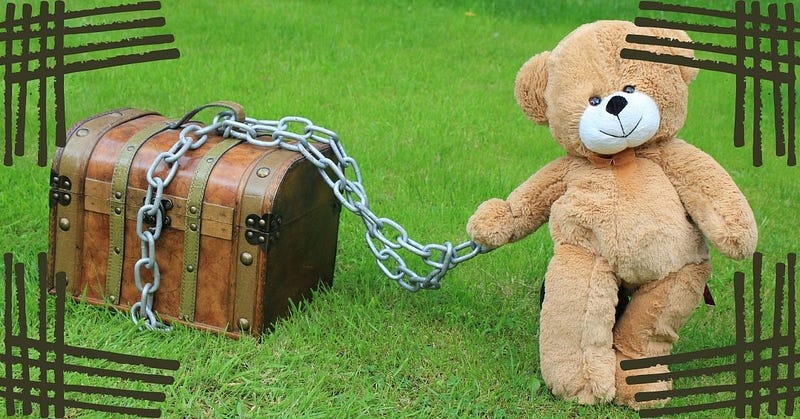
Are you stuck?
You just aren’t able to get things moving in your life?
Or things start to move, and out of nowhere, a brick wall shows up?
The problem is most likely fear. You’re probably familiar with fear of failure and fear of success.
But there’s another fear, that’s wormed its way so deep into your psyche, you never knew it was there.
It’s fear of losing your self-identity.
What is self-identity?
Your self-identity consists of the semi-permanent traits and skills you believe you have. I say semi-permanent because while you can change them, it takes effort on your part.
Imagine someone who had a hard day at work and came home exhausted. This person would not see being tired as part of their self-identity. But someone with Lyme disease might well see being tired as part of their self-identity. At least until they’re cured.
Belief is not fact
It doesn’t matter how often we have been told a certain thing by our parents, teachers, or peers. Even if it is true, if we don’t believe it, it does not become part of our self-identity.
The flip side is that we may also believe things that are not true. There are many people with undiagnosed learning disabilities such as dyslexia or ADHD. Their parents or teachers may have told them they were stupid. They believed that label, and it became part of their self-identity. But they may be brilliant individuals.
Interactions confirm our self-identity
We show our self-identity through our interactions with the world. It is how we solidify our more vague feelings about ourselves.
For example, you may feel that family is important. But what if this comes into conflict with another value? Which of the two values is more important?
Your self-identity is affected by your choice. You choose which aspect of your self-identity is most important in that context.
Let me illustrate this with a story.
“Family man” or “proud homeowner”?
On the last full day of a visit to my parents, the bathroom in the basement of their house backed up. Raw sewage flooded the basement-level bedroom.
No one had stayed in that room since we discovered the house had radon issues decades before. It was full of stuff, which needed to be removed and either rescued or disposed of. The walls had to be torn out, because the sewage had soaked into the drywall.
The professionals arrived the next morning. They had just started work when I needed to leave for the airport. I figured I’d call an Uber, and my father would stay to oversee the work. But he insisted that he and my mother drive me to the airport, and leave the workers on their own.
To my way of thinking, saying good-bye in the driveway versus at the curb of the airport made no difference. And there was a clear emergency at home.
He felt could more easily hand off responsibility for his house than for his daughter.
“Family man” was more important to his self-identity than “proud homeowner”.
Self-identity and being stuck
So how does this relate to being stuck?
We have defined our self-identity for ourselves. It has no more intrinsic meaning than a sheet of newspaper.
The person who sold the newspaper valued it as a source of income. The person who bought it valued the newspaper as a transmitter of ideas and information. Then, it was devalued as trash. If a breeze blew it out of the trashcan and down the street, it could be considered an eyesore and inconvenience. If someone picked it up to use in an art project, say by turning it into papier-mâché, it might be valued as artwork.
The newspaper itself has no intrinsic meaning, only the meaning it is given in context.
Our self-identity is the meaning we give ourselves, based on our context in the world. As such, we are always in danger of being proven wrong. And if there’s one thing people hate, it’s being wrong.
Defending our self-identity
There are different ways to arrive at our self-identity. We may have studied and experimented to learn it for ourselves. We may have accepted the identity we were given by our parents, teachers, peers, and society. Most of us are probably a mix of both.
Regardless of the way we arrive at our self-identity, once we have it, it’s ours. We think of it as who we are. A threat to our self-identity is a threat to our very self.
If someone challenges our self-identity, we usually react with anger. Even if they’re trying to say we’re better than we think we are!
At the core of that anger is fear. Fear that, perhaps, we are wrong about our self-identity.
How many gang members are serving time for killing someone who “disrespected” them? Their self-identity was of someone who deserved respect. They feared that they did not really deserve respect. This made them kill someone to “prove” that they really did deserve respect.
Compare this to the Dalai Lama, leader of the Tibetan government in exile. The government of China “disappeared” his chosen successor when the boy was only 6. Then they appointed their own successor. This is clearly disrespect. Yet the Dalai Lama’s reaction was to advocate a peaceful dialogue between China and Tibet. He has no fear that he is not worthy of respect.
Explore the context of your self-identity
You may be feeling stuck because you have a need to defend some aspect of your self-identity.
So, to overcome this fear, explore the context. I’m not saying to embrace the idea that your self-identity could be wrong. That’s going to be very difficult for most people. But you can at least consider if it applies in a more limited context than you’d thought.
Let’s use my father as an example, again. His core self-identity was being a family man. Family includes being both a husband and a father. On another visit home, my mom was at the ER when I needed to leave for the airport. As a “devoted husband” he would stay with her. As a “devoted father” he would take me to the airport. He could not do both.
He ended up staying at her side while I took an Uber to the airport. This decision caused him much agony. He felt that he was failing to be a good family man, by not being a devoted father.
When it is impossible to be in two places at once, being with the person who needs you more is caring for your family. Far from failing to care for me, he allowed me the opportunity to show how much I cared for him and my mom.
Since I also hated leaving her at the ER, this greater context also helped me feel I was still being a “good daughter”. I was supporting my dad in a difficult situation, by taking an Uber.
Conclusion
If you’re feeling stuck, the problem may be fear of losing your self-identity.
Consider how your self-identity is reacting to the area where you’re stuck. Is there some aspect of your self-identity that you fear is not quite as strong as you want it to be? Could moving in the direction of what you want bring that to light?
You can strengthen your self-identity, by changing and improving your behavior. Then there will be no reason to question it.
Or you can redefine the context for that aspect of your self-identity. Admit that something else is more important, in this limited context.
Without fear, you lose the need to defend, and can move forward. You’ll no longer be stuck.
Ready to have a better tomorrow?
I’ve created a guide to help you increase your confidence and improve your life. If you follow these tips, you will level up your life very quickly!


