
Is this a Writing Hack or Just an Awesome TIP?
I found myself a great way to outline and layout my stories!
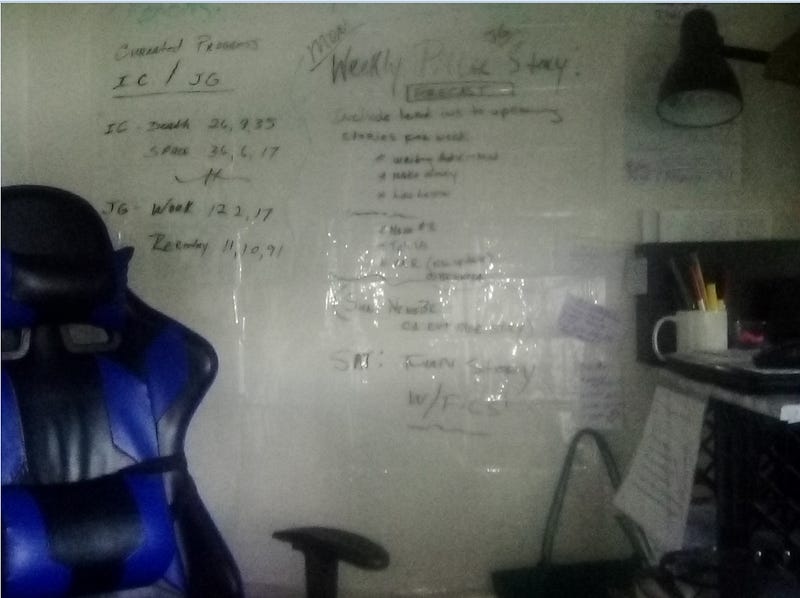
If you look at the photo I’ve posted with this story, right away you notice my wall and the various notes I’ve written (or rather scrawled) all over it.
This wall has been instrumental in the last 10–15 stories I published, and I’ll tell you how.
I don’t know if you can call it a writing hack or if it’s just a really good tip on how to outline and layout the stories you plan to write and publish.
Let’s chop it up for a moment and see what I mean.
Compiling drafts you can start writing and completing is good
One thing you will eventually begin to learn if you’re a new writer, is that there is never just ONE good way to do things.
Even when you find a method or system that works perfectly for you, not only is there another way that works equally as well, but there is also probably a better way that works.
For instance, I’m a huge fan of starting my stories on the Medium dashboard, and compiling a lot of drafts that I can easily get started writing on every day. I wrote a story, explaining my daily process of working through those drafts, and it’s definitely worth giving a read.
The title is: How to Work Through Your List of Drafts and Publish Stories Much Faster and I wrote it after I had published 270 stories.
Although I continue to use this method on a regular basis, I’ve also added another element to the process. The wall in the photo above.
It helps to have a visual outline in front of you while writing
Most writers, worth their salt, already know the value of having an outline. Many of us still do things the old school way, by creating outlines on paper, and even on the computer.
I used to scribble out mini outlines on post it notes, and eventually convert those notes to drafts. Then I switched to simply dumping notes (partially organized) into my draft files (as explained in the story I wrote).
Now, with the help of my wall, I can write out a complete outline that’s easy to view, internalize, and modify, right up until the moment I start writing.
There’s something gratifying about having all that space to lay your thoughts out effectively. It’s not the same as writing things down on a piece of paper, or typing it on the computer.
I know many of us watch crime shows, so you can probably relate to what I’m about to share. Just picture that huge wall the cops always have set up, so they can write and post all the theories and evidence they have about a specific case.
This process helps them connect the dots and make progress on their investigation, from beginning to end. That’s exactly what it does for me and my stories also. I can visualize the story from start to finish.
Makeshift Dry Erase Board
For those of you who might have been wondering, of course I’m not writing directly on the wall. I had the idea to get a dry erase board, but I wanted a really big one, instead of the several small ones that I already possess.
When I started pricing the boards, I decided I didn’t want to spend the kind of money they were asking, so being the queen of improvising, I put my thinking cap on.
What I purchased was a CLEAR plastic shower curtain liner for $3.99 and cut it to fit the area of wall I needed it for. I actually meant to grab the clear shower curtain, and not the liner, because the curtain was thicker. When I got home, I noticed my mistake, but it was okay, because the liner worked fine, plus I saved 3 bucks.
The only other expense were the push pins that I attached the curtain to the wall with, and the package of dry erase markers. I spent less than ten bucks in total for this useful little hack.
NOTE: If you decide to try this, please be sure to get a clear shower curtain or liner, and not a white one. The white doesn’t work as well because the surface won’t be smooth enough, plus the colors leave a bit of a stain when you clean it, which is problematic if you want to use the wall a lot.
I can’t stress enough, how good it feels to use my wall outline when I’m working on a story for two or three days, making edits and adjustments as I go, until I’m finally ready to start writing it. The dry erase markers make it all so simple and painless.
Then, once I’m done writing and publishing the story, there’s also another feeling of exhilaration that comes with erasing everything, and having a blank wall for the next story. Now I know how they feel on CSI.
I used my wall when I wrote and completed these 4 stories for the Medium Writing Challenge:
- How Does an Edible Landscape Help You Grow Food with Limited Space?
- The Daily Death of the Morning Glories
- My Difficult Reentry Back Into the World
- Everything I Never Learned about Work and Being a Good Employee
Final Thoughts
The above information about my new method for planning my stories was to make a point. Sometimes, it’s good to try new ways of accomplishing your writing and other online tasks.
In fact, when you think about it, this advice can actually be applied to whatever you’re doing in life, online or off.
That doesn’t mean that we should make ourselves crazy, running around, always trying to find a better way to do something, at the risk of not doing anything at all.
If you have a method that works for you and you’re content with it, there is nothing wrong with that. If you consider trying something new, there is nothing wrong with that either, but do the following:
- Try it once, twice, or even three times, to give it a fair chance of working.
- Notice if whatever you’re doing is making you more productive or if trying to learn a new method is turning out to be counterproductive for you.
- Don’t be afraid to discontinue the new method, and resume what you know works for sure.
- Don’t allow the experience to prevent you from ever trying something new again.
Justiss Goode stories: choose from my over 300 titles (by category)
Not a Medium Member yet? Join now with my referral link: https://justissgoode.medium.com/membership
Do you want your stories to automatically post on Twitter for FREE? You can start in the next 5 minutes! POST AUTOMATIC TWEETS (affiliate link)


