
Is There Life on Venus?
The truth about Venus came as something of a shock. Well into the space age astronomers believed that the planet had a climate similar to the tropical regions of Earth. Many envisioned a jungle world swarming with exotic life. Others imagined deserts stretching across Venusian continents, or warm shallow seas filled with swamp creatures.
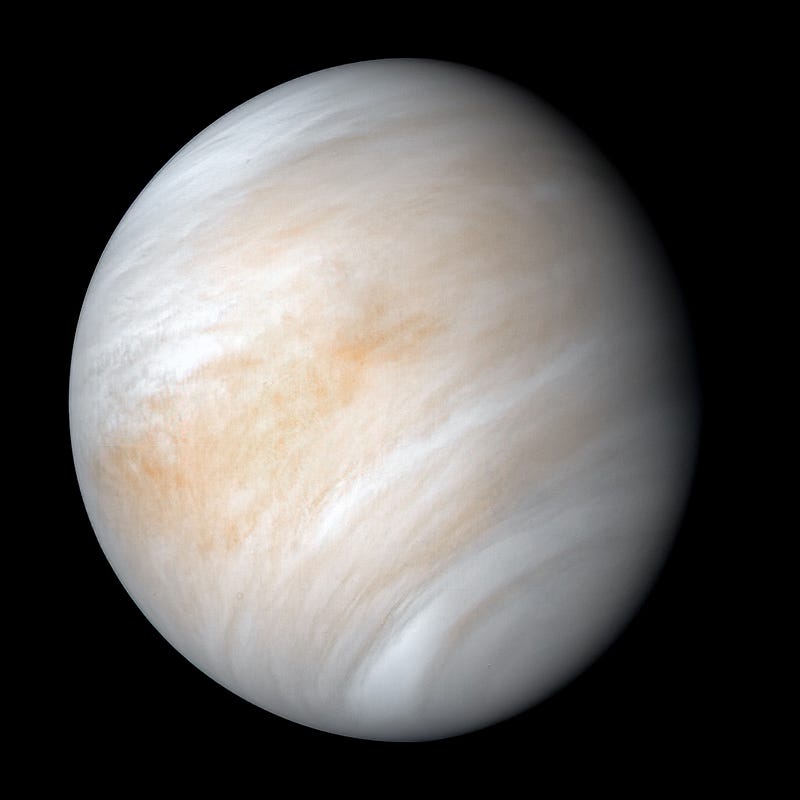
It was an easy mistake to make. Venus is similar to Earth in size, and though it is closer to the Sun, astronomers realised that its thick atmosphere should reflect much of the heat back into space. If Venus was like Earth — which seemed reasonable — then it could be filled with oceans, with deep clouds of water surrounding the planet. Venus, scientists and writers thought, was torrid but inhabitable.
The first hints that this view was wrong come in the early 1960s. Radio measurements of the planet revealed soaring temperatures — reaching hundreds of degrees Celsius. Even so, the old ideas were hard to abandon. When the Soviets built two probes to visit Venus in 1964, they designed them to float — just in case they landed in an ocean.
Those spacecraft, like many of the early interplanetary missions, failed to reach Venus. But when the Soviets did, finally, send a probe through the Venusian atmosphere, they found a world more awful that anyone had expected. None of the first five probes to Venus survived more than an hour. Even so, the data they sent back revealed crucial details of the planet.
They found an incredibly dense atmosphere, more than ninety times heavier than the Earth’s. Thick clouds of sulphuric acid swirl perpetually over the planet, blocking sunlight from the surface. Thanks to an extreme greenhouse effect — the atmosphere is almost entirely composed of carbon dioxide — the surface is baked in constant oven-like conditions.
These details crushed the expectations of a planet full of alien life. But not everyone was ready to give up on the idea. While most planetary scientists turned their attention elsewhere — to Mars, or to the Moons of Jupiter and Saturn — some persisted with Venus.
Carl Sagan, the famed author of Cosmos, was one of those who did. In a 1967 letter to Nature he noted that parts of atmosphere of Venus might be habitable. There — around 50km above the surface — temperatures and pressures fall to more survivable levels. Life, he speculated, could thrive.
Sagan was known for proposing that life could exist in all sorts of fantastic places. He once, for example, suggested that Jupiter might be home to giant floating creatures. But the idea that Venus could support life is not quite as ridiculous as it may seem.
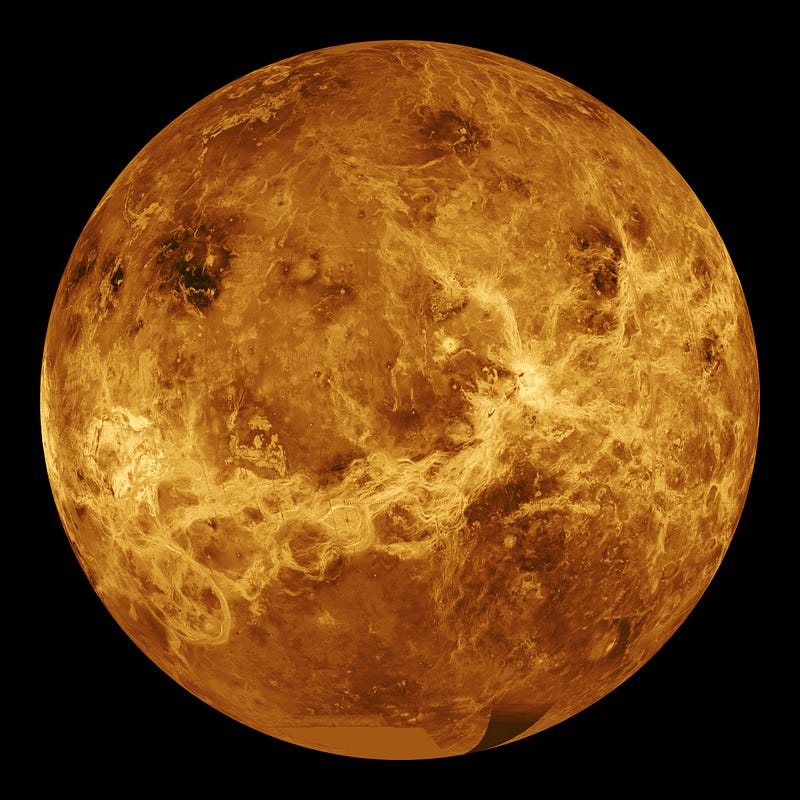
Billions of years ago, when the Solar System was young, Venus may have been much more Earth-like. Some models suggest that Venus once had large oceans — speculations borne out by recent space missions observing water escaping from the planet’s atmosphere. Life may well have blossomed there at some point. Could a few survivors from those happier days still lurk high in the atmosphere?
Mysterious signs from Venus might signal that they do. For more than a century astronomers have observed unexplained dark patches on Venus. What they are, and where they come from, is unknown. But scientists have seen that they absorb a great deal of energy — so much, in fact, that they may influence the entire climate of Venus.
Some have suggested that these “unknown absorbers” are actually clouds of micro-organisms blooming in the atmosphere. They could, in principle, feast upon nutrients thrown up by Venus’ volcanoes, or upon the Sun’s ultraviolet light. And, if they do, they would not be so dissimilar to life on Earth. Microscopic organisms have colonised every part of our planet, including the atmosphere.
With all this in mind, then, the recent discovery of unexplained phosphine on Venus looks extremely interesting. By rights, phosphine should not be present on Venus at all. It is a highly reactive chemical, bursting into flame upon contact with oxygen. Any phosphine that did happen to form on Venus should rapidly disappear.
But observations with the James Clerk Maxwell Telescope in Hawaii revealed that phosphine is indeed present on Venus. To be absolutely certain of these surprising results, the researchers turned to another, more powerful, telescope. It too confirmed the presence of phosphine — at levels of twenty parts per billion.
How did this phosphine appear on Venus? For it to be present at all, some process must be constantly creating it. The researchers ran through a number of chemical and geological options, but ultimately found that none of them could explain the levels seen. Something unexpected must be happening.
Could that something be biology? Scientists are understandably cautious, but it is possible. We know that bacteria on Earth sometimes produce phosphine. Intriguingly, they do so when starved of oxygen — something extremely likely in the harsh Venusian atmosphere.
As Sagan said, extraordinary claims require extraordinary evidence. Though tantalising, none of this is yet proof of alien life. Further study will be needed. Fortunately, Venus is nearby, and relatively easy to send probes to. Though much neglected in recent years in favour of Mars, we may just be about to see a renaissance of interest in our twin planet.
So much reporting around health, science and space exploration is unrealistic, hyperbolic and misleading. These are complicated topics, and there are often no easy or straight forward answers. Instead what is needed is analysis, discussion and an exploration of the possible ways forward.
Follow me, and subscribe to our free Substack newsletter to get the latest. Articles are published regularly, and by signing up you will never miss an update.