Is There a “Right Time” to have a Baby?

There is a journey in life that we are all expected to follow — go to college, get a job, find a partner, buy a house , get married , have babies. What you are not told when growing up is the pressure you would be put under by society to do all of these things and in a certain time limit, it is as though when you reach 30 all of these things will suddenly not be available to you. It is a scientific fact that most women reach peak fertility between the ages of 23 and 31 (Avawomen.com). By the age of 31 the chances of getting pregnant begins to drop by around 3% per year. But conceiving a child after this age is not impossible:
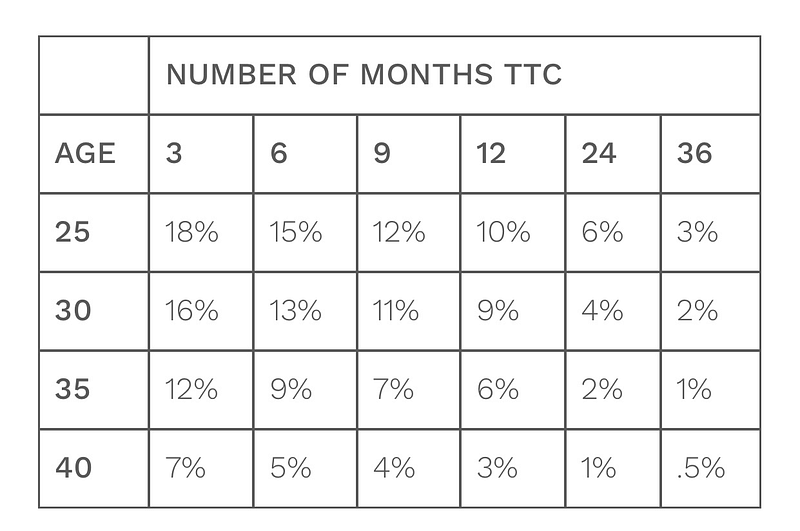
The percentages in this chart show the probability of a woman becoming pregnant in her next cycle.
As a co-habiting unmarried woman who has recently turned 30 the stress and anxiety, I have personally felt towards this subject I feel is relatable to many women. All of a sudden your personal life can become everybody’s business, even people who you do not necessarily know that well will have an input into how they believe you should be living your life, without knowing any sort of background information. It is never at the forefront of their mind to consider any health issues you or your partner may have faced, any financial difficulties you may be under or simply the desire to want to travel and see the world. They see your age “30”, the golden age by which you should have “figured it all out”.
The average UK student finishes university at the age of 21 / 22 with £36,000 ($44,500) of debt. This debt is taken on with absolutely no guarantee of a job at the end of it. If you do find a job in your degree field that is great and you are all set for your new journey into the world of adulting, but for many they are back where they started but now with the burden of owing thousands of pounds.
So, let’s say you have landed on your feet and are in your dream job. Now to find a life partner! Endless Tinder dates with no chemistry, nothing in common and some people who definitely are a dab hand at photo shop when it comes to their profile pics. You find someone who is perfect for you and you can see yourself being with them forever. How long does this take? A year, maybe two? By this point you are 25 and have managed to save a bit of money from your dream job that you and your newfound love want to see the world.

Travel is so important, to experience different cultures and to see what the planet has to offer. Being young and free is only ever going to happen once in your lifetime and if you want to live your dreams you should be able to without other people passing judgement.
After exploring the world, you may think it is time to settle down and buy a house. However, with rising living costs, debt and the high deposits that are needed a study in 2019 found the average first time buyer in the UK was aged 33 (bbc.co.uk/news). With this in mind you have 2 choices, you can either rent a property which some people are completely happy with or you can move back home with your parents to try and save for a deposit.
During this time you decide that you want to get married! The white dress, beautiful venue, amazing food. Hopefully this is only going to be done once so you want to make everything extra special, but this does come at a price with the average cost of a UK wedding in 2019 being £31,974 (hitched.co.uk) this equates to $39,600.
From leaving university the time can quickly pass and the debt can quickly add up. Is it fair for women to feel a social stigma if they want to live their lives free of responsibility and debt for a little while before settling down?
In the modern world I think it is unrealistic to expect that we are all going to follow the life stages set out for us by our previous generations who quite often were married with children before the age of 20. When life was perhaps a bit simpler? You married your high school sweetheart, lived in the same town, had children who went to your old school, had family who lived close by and you never moved away.

Times have changed and we have changed. We want to see more, do more, live more and this should be free from judgement. Whether you chose to have children in your teens, 20’s, 30’s or 40’s this is your choice. The human body is amazing, and conceiving is a miracle which is not taken for granted by any means but who is to say this needs to happen at a certain time? Parking the science aside our timescales are our own , there may never be a ‘right time’ to have a baby but this should be down to us to decide and not society.


