
Is there a connection between legal marijuana and the opioid crisis?
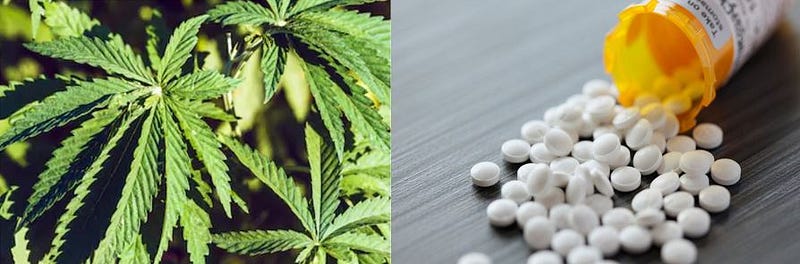
The Trump administration has at times suggested that we should use federal law to overturn state law, to ban recreational marijuana use. One of the arguments is that banning marijuana would be good because we have an epidemic of opiate overdoses in America. I suppose that’s some kind of gateway drug theory.
The logic is all wrong, but it’s an interesting topic to think about — I think legal marijuana and heroin overdoses are actually connected, but in an entirely different way.
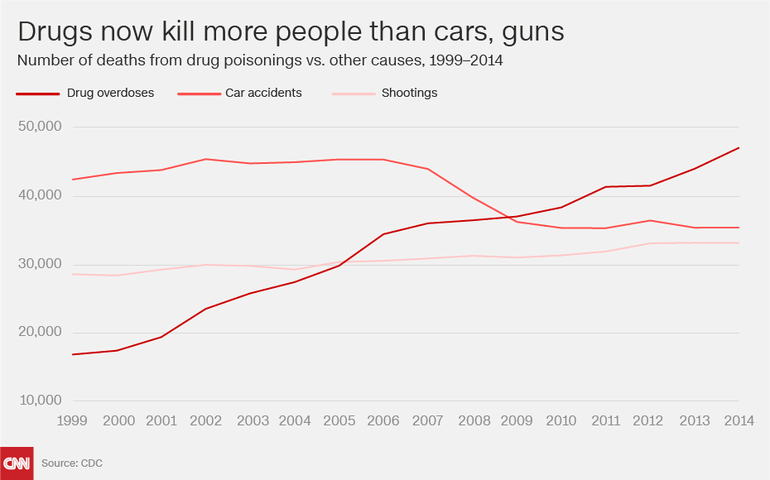
First off, a few numbers and graphs. There’s a big opiate problem in America, and it’s largely a new thing. Pill overdoses have been climbing steadily since about 2000, and heroin overdoses have shot up since 2010. Overdoses are now the biggest cause of accidental/early death in the country, more common than car crashes or gun deaths:
I think this doesn’t get reported on as much as, say, mass shootings or terrorism, because it’s a big, distributed problem. Every overdose is a tragedy, but each one is generally not a newsworthy incident. Some of the best reporting I’ve read aggregates the problems in clever ways. One good article described opiate problems across one state, for one day, to give a picture of the problem.
The gateway drug to heroin isn’t pot, it’s pills like oxycodone. 3 out of 4 heroin users abuse pills before trying heroin.
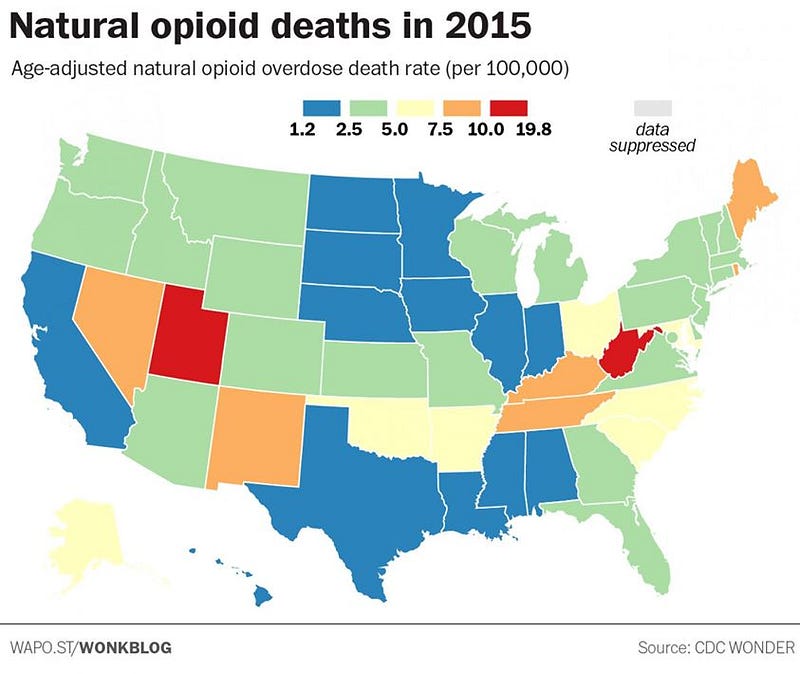
If legal pot was a gateway drug to heroin you’d expect that the states with legal pot would be the states with opiate overdoses, but the problems happen in totally different places. This is a map of deaths from opiate pills (like vicodin or oxycodone) by state:
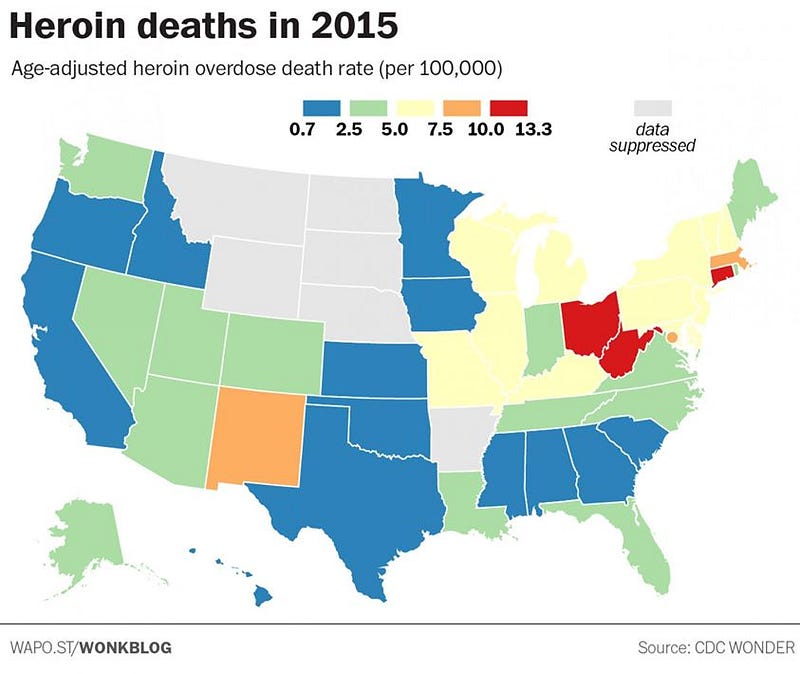
This is heroin deaths:
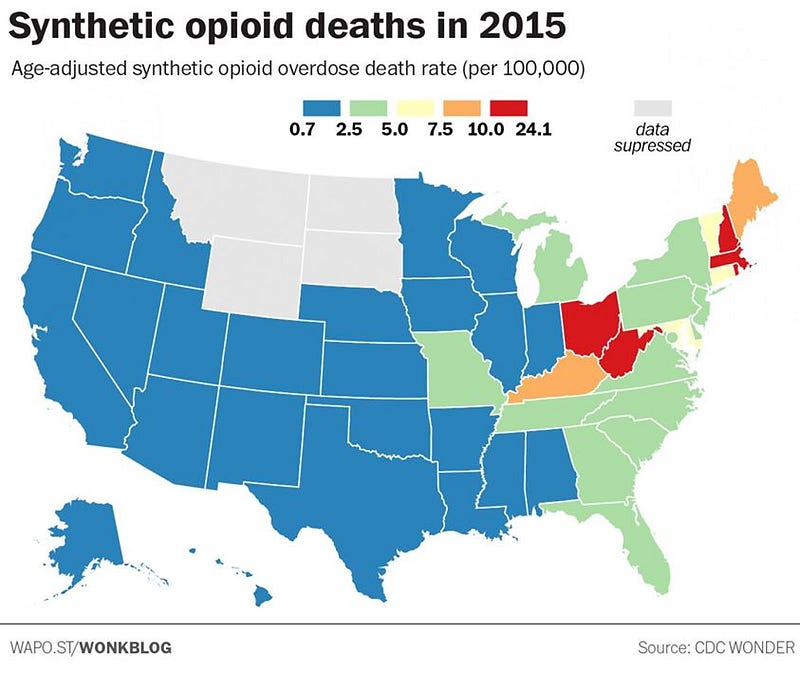
This is fentanyl deaths:
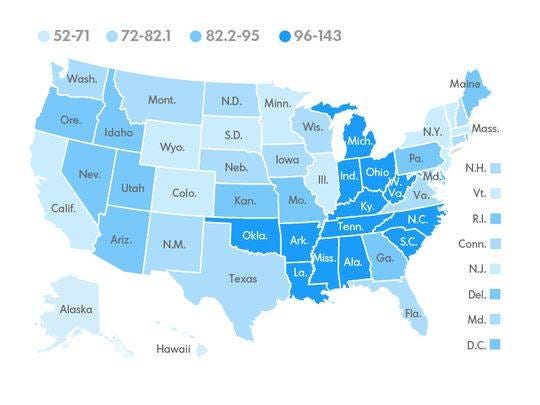
This is opiate prescriptions (per 100 people, per year) by state:
Here’s an estimate of marijuana use rates across the country:
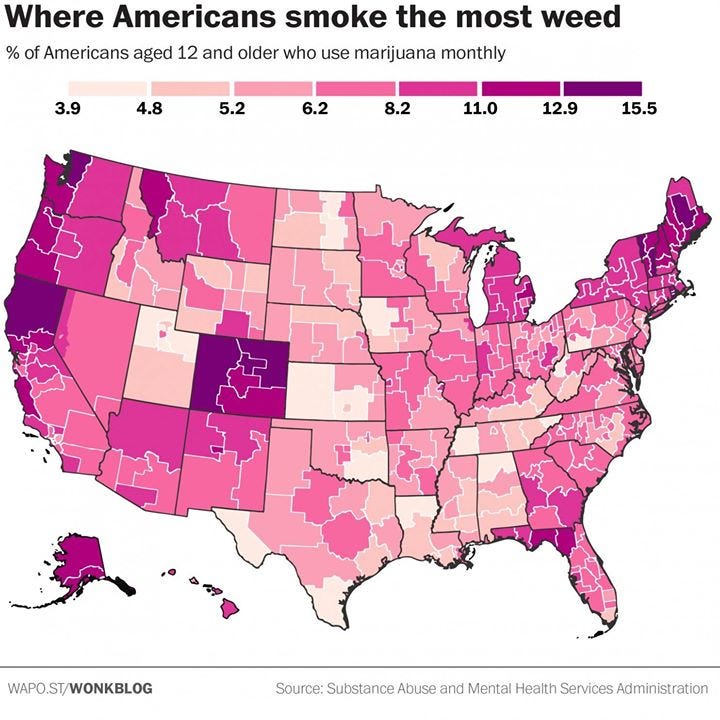
So, there’s lots of different trends going on, but pot and opiates are clearly not related at all. People smoke a lot of pot in Colorado, northern California, and Washington state, but these places are not hotspots for opiate overdose.
Opiate prescription rates predict overdoses better than pot smoking does, but there are still regional variations in overdoses that remain unexplained. Heroin ends up in the mid-west. Fentanyl ends up on the East coast. West Virginia is in really bad shape, all around. People in Utah can’t handle their pills.
I think the actual connection to marijuana is that Mexican cartels used to supply a lot of the marijuana used in the US. At some point, it became uneconomical for them to smuggle pot into the country, maybe because they were competing with cheaper pot grown in the US. The cartels responded by importing heroin instead, because it’s easier to smuggle and much more lucrative. So, law of unintended effects, legal pot might have brought more heroin into the country.
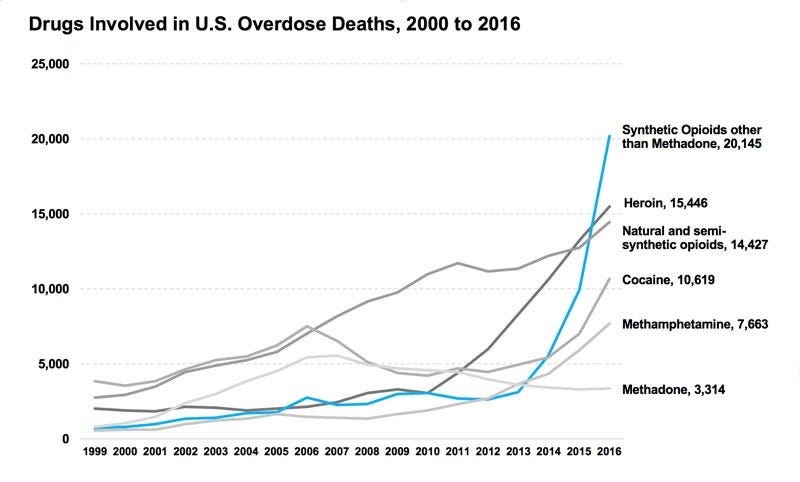
At some point after that, maybe around 2014, possibly because of border security aggressively confiscating heroin, drug smugglers started importing fentanyl, a synthetic opiate that’s more potent by weight than heroin. Because it’s more potent, the same number of doses fit in a smaller package, so fentanyl is easier to smuggle into the country. Because it’s more potent, it’s also easier to overdose on. Fentanyl (represented by the blue line in this graph) has rapidly exceeded both heroin and pills in overdose deaths:
That’s the funny thing about black markets — fighting them can just make them more profitable and dangerous. Taking out El Chapo (a bad but somewhat predictable drug lord) lead to the rise of much more violent, much less predictable drug cartels.
The way to defeat the black market drug trade is to work in entirely the opposite direction — make less addicts or legally provide what addicts demand.
Instead of trying harder to block the heroin coming into the country, we could start more programs for junkies to legally treat their addictions. Basically, a heroin junkie could legally register as such, then get cheap methadone or buprenorphine from a doctor. These are opiates with much longer half-lives, that will stop heroin cravings for a sustained period of time. Instead of having that addict stealing things to afford expensive, imported Mexican heroin, they could maybe lead a normal life, maintaining the addiction on a cheap and legal product, the same way that millions of cigarette smokers maintain their addiction and lead normal lives. Heroin addicts wouldn’t overdose and die, and Mexican cartels would stop making money from it.
We’d, of course, also need to create less addicts, which means prescribing a lot less narcotics. One simple thing that might help would be to legalize medical marijuana, nationwide, so some people could treat their pain that way, with less harm — pot is much less addictive and pretty much impossible to overdose on.


