Is The United States An Empire?
A look at US holdings around the world
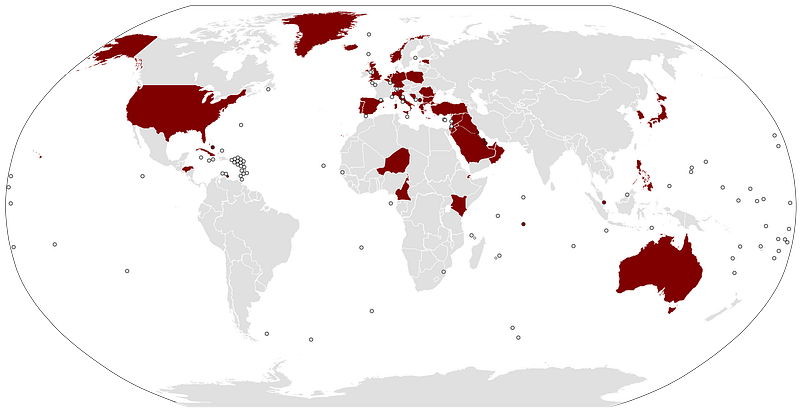
There are some people who call the United States an empire in a derogatory way. These people rant about American Imperialism and claim that the United States is dominating the world in an unhealthy way. These phrases often come up in radical political jargon or in opinion pieces that take aim at America’s place on the world stage. But is it accurate? Is the United States an empire? Let's look at the definitions, some historical context, and the extent of American power in the world and come up with a verdict.
The Definition of Empire
According to Britannica, the definition of empire is as follows:
Empire, major political unit in which the metropolis, or single sovereign authority, exercises control over territory of great extent or a number of territories or peoples through formal annexations or various forms of informal domination.
Merriam-Webster defines empire as:
a major political unit having a territory of great extent or a number of territories or peoples under a single sovereign authority
especially : one having an emperor as chief of state
From these two comprehensive definitions, we see that an empire requires two things and benefits from a third.
- An empire must be under the control of a single sovereign authority.
- An empire must include a large territory that includes multiple different groups of people.
- It benefits from being under the control of an emperor or similar hereditary monarchy.
For example, the Roman Empire ruled large swaths of territory stretching from Britain to Syria under the control of Rome, which was ruled by a Roman aristocracy.
Does the United States meet this definition?
US Territories
The United States has various territories around the world that they administer directly. The United States directly controls:
- Puerto Rico
- Guam
- Northern Mariana Islands
- US Virgin Islands
- American Samoa
Other territorial expansions in the past included swaths of Mexican territory, Alaska, and Hawai’i, which were all integrated into the United States.
The United States also controls a handful of unincorporated islands in the Pacific, including Wake Island, and a number of nearby atolls, including places like Midway and Johnson Atoll.
Together, these territories do not include a large number of people. Puerto Rico is by far the US’s largest territory, encompassing over 3 million people who have their own culture and identity. Guam only has 170,000 people, and many of them are ex-pats or American servicemembers. However, the United States does not pull together large groups of diverse people like the Romans or Ottomans did.
US Military Bases Around The World
While the United States does not own large swaths of territory that it directly administers, it does have an outsized military presence around the world. The exact number varies depending on what definition you use, but the number ranges between 700 and 1,100 military bases in foreign countries.
According to the Department of Defense, the definition of a foreign military installation is:
A military base, camp, post, station, yard, center, homeport facility for any ship, or other activity under the jurisdiction of the Department of Defense, including leased space, that is controlled by, or primarily supports DoD’s activities. An installation may consist of one or more sites (geographically-separated real estate parcels)
According to The Guardian, the United States operates 800 such bases. According to Al Jazeera, that number is 750 and is spread across 80 countries. Politico puts the number at 800 across 70 countries.
This increases the reach of the United States exponentially, but these military installations have nothing to do with directly ruling or controlling the local population.
If these military bases controlled the local populations, akin to how British trading posts dominated nearby people groups in the 18th and 19th centuries then you would have a better argument for an American empire. But that is not the case.
Self Determination and the Death Of Empires
World War I heralded the death of the classical empire. World War I crippled the British Empire and shredded the Austro-Hungarian Empire, the Russian Empire, and the Ottoman Empire. Afterwards, there were no real empires left. In the wake of World War I, there was a push to grant individual people groups self determination. That meant that the international community pivoted from supporting imperial domination of small groups of people to pushing for them to become their own nation-state. This is still the zeitgeist that dominates political thought to this day. Each unique group of people is entitled to their own form of self governance and their own nation. This idea was a new one and is one that still garners pushback today.
People balk at the idea of Russia swallowing Ukraine because the Ukrainians are seen as their own distinct people group that deserves their own state. Similarly, there are people who advocate for the creation of a Palestinian and Kurdish state for the same reasons. The idea that a central authority like Washington or Moscow can control distant foreign peoples causes consternation and prevents the creation of new empires.
Verdict
By the definition, the United States is not an empire. But it is close. In fact, one could argue that it is the closest thing to a modern empire that the international system will allow. The United States is the fourth largest country by area, but land mass doesn’t constitute an empire. (No one is accusing Canada of being an empire even though it is the second largest country in the world.) The US does control a handful of overseas territories stretching from the Caribbean to the Central Pacific, but none of these territories are very large or contain huge numbers of people. The closest thing the US has to an imperial system are the hundreds of US military bases around the world, but since these bases do not directly control the local populations, they don’t count toward empire.
The US is close to being an empire but it does not quite reach the necessary threshold to be classified as such. It also is not ruled by an emperor (though some argue that our current political class is no better than the Roman or Russian aristocracy of eras past.)