avatarCindy Heath

Free AI web copilot to create summaries, insights and extended knowledge, download it at here

4645

Abstract

chy of Needs</a></figcaption></figure><p id="7345">Self-examination should result in a heightened sense of appreciation and thankfulness for life. I realize that if I am blessed with the maximum likelihood of 30 more years of life, I have only 10,950 more precious days to enjoy.</p><p id="d71d">Some days are filled with joy, others with sorrow, but all are valuable. I refuse to waste one, counting it trivial.</p><p id="0e78">Would I think of mundane tasks such as washing dishes differently if I knew this was the last time the smell of Mrs. Meyer’s Lemon-Verbena dish soap would tickle my nose, and I would enjoy warm water washing over my well-worn hands?</p><p id="350e">The sun on my face is welcome, and I no longer mind if a sudden shower spots my recently washed car. What does it matter at the end of time?</p><h2 id="e236">How would I spend today if it was my last day?</h2><p id="2634">Can I combine that mindfulness with the requirements of daily life?</p><p id="096f">Yes, I still need to work for money to pay the electric bill, my rent, auto insurance, and more. But more and more, I agree with Saunders and will <i>avoid the things that make me <b>trivial.</b></i></p><p id="7e92">Hmm…<b><i>trivial</i></b>, one of those words we often use without thinking about too much.</p><figure id="1ce2"><img src="https://cdn-images-1.readmedium.com/v2/resize:fit:800/1*0MuFtyZY2CvIKPa3tINv0g.png"><figcaption>The author’s screenshot from the definition on <a href="https://masterwriter.com/?gclid=CjwKCAjwpKyYBhB7EiwAU2Hn2RgA0aIXYYRNX4ncY2EPEZwjX_t6M8zQb7nAVg3hFNsK8UKnjbTrURoCrK8QAvD_BwE">masterwriter.com</a></figcaption></figure><p id="ffa5">Of course, what is insignificant, negligible, or even rinky-dink to one may be momentous to somebody else.</p><p id="0a15">However, the older I become, the more I realize how often I confused trivial and monumental events and feelings. My sister shared this poem recently, and I love the first line; <i>if we only knew then what we know now.</i></p><figure id="df39"><img src="https://cdn-images-1.readmedium.com/v2/resize:fit:800/1*C4wUw-8utNKtCJEdocn0ow.jpeg"><figcaption><a href="https://www.facebook.com/UllieKaye">Ullie Kaye Poetry on Facebook</a></figcaption></figure><p id="e087">Each day, I aim to live with mindfulness, asking myself the question that Jane Friedman shared, “Will this choice enlarge me or diminish me?”</p><h1 id="4f2a">Self-transcendence may be key to happy elderhood.</h1><p id="03ed">The report of a 2015 study, <a href="https://ir.library.louisville.edu/cgi/viewcontent.cgi?article=1017&amp;context=faculty#:~:text=Self%2Dtranscendence%20changes%20how%20older,multiple%20indicators%20of%20well%2Dbeing."><i>Self-transcendence and well-being in community-dwelling older adults</i></a><i>, </i>is among multiple research papers attesting to the value of self-transcendence as we age.</p><p id="33d7"><i>Self-transcendence changes how older adults perceive themselves, their relationships with others, the material world, and the metaphysical or spiritual dimension. It is associated with multiple indicators of well-being.—<a href="https://ir.library.louisville.edu/cgi/viewcontent.cgi?article=1017&amp;context=faculty#:~:text=Self%2Dtranscendence%20changes%20how%20older,multiple%20indicators%20of%20well%2Dbeing."></a></i><a href="https://ir.library.louisville.edu/cgi/viewcontent.cgi?article=1017&amp;context=faculty#:~:text=Self%2Dtranscendence%20changes%20how%20older,multiple%20indicators%20of%20well%2Dbeing.">University of Louisville study.</a></p><p id="c71f">Higher levels of self-transcendence (ST) resulted in:</p><ul><li>greater levels of well-being;</li><li>meaning in life;</li><li>hope which helped transcend losses of later life.</li><li>greater resilience;</li><li>sense of coherence;</li><li>physical and mental health;</li><li>increased competence in daily life;</li><li>and purpose in life among the oldest old, aged 85 and older.</li></ul><figure id="d9bc"><img src="https://cdn-images-1.readmedium.com/v2/resize:fit:800/1*8K-fRratU-SMaIC7fpqsZA.jpeg"><figcaption>Image from canva.com</figcaption></figure><h1 id="4ac0">What causes older people to become self-transcendent?</h1><p id="3784">My sister and I discussed what happened to us about five years ago—what created a seismic shift in our consciousness. We both agree that we are now in the happiest, calm, and self-assured states of our long lives.</p><p id="37cd">Sis nearly died before receiving an organ transplant, and I barely survived a severe auto accident. Then, in another blow, my sister’s spouse died. And I began writing my memoir, which required more self-reflection than

Options

I’d ever attempted.</p><h2 id="fef7">Tragedy often creates change.</h2><p id="de3f">According to the same study mentioned above, serious illness often precipitates a desire for greater self-awareness.</p><p id="e32c"><i>A significant body of research demonstrated a relationship between ST and factors which have important effects on older adults’ well-being, including adults facing terminal or life-changing illnesses such as women with breast cancer, liver transplant recipients, and women dealing with rheumatoid arthritis and multiple sclerosis.—<a href="https://ir.library.louisville.edu/cgi/viewcontent.cgi?article=1017&amp;context=faculty#:~:text=Self%2Dtranscendence%20changes%20how%20older,multiple%20indicators%20of%20well%2Dbeing."></a></i><a href="https://ir.library.louisville.edu/cgi/viewcontent.cgi?article=1017&amp;context=faculty#:~:text=Self%2Dtranscendence%20changes%20how%20older,multiple%20indicators%20of%20well%2Dbeing.">University of Louisville study</a>.</p><p id="b207">Pamela Reed, an influential researcher, and educator, proposed an updated <a href="https://pmhealthnp.com/pamela-reeds-theory-of-self-transcendence/">theory of ST</a> as part of a balanced sense of consciousness that includes:</p><blockquote id="a650"><p><b>Self-transcendence</b> is a natural and beneficial developmental state.</p></blockquote><blockquote id="14d9"><p><b>Vulnerability</b>: the awareness of one’s own mortality that develops with age, health issues, and crises.</p></blockquote><blockquote id="3d68"><p><b>Well-being</b>: the sense of being healthy, whole, and generally fulfilled and satisfied with one’s state.</p></blockquote><p id="4809">When these three things come together, we can often look beyond ourselves and find new perspectives. I think this may be the quest for elderhood and the essence of wisdom.</p><figure id="02c7"><img src="https://cdn-images-1.readmedium.com/v2/resize:fit:800/1*TatbfMrmVvgGuqTJ9H91Sg.jpeg"><figcaption>Image from canva.com</figcaption></figure><h2 id="fb1e">My goal is to become sagacious—a sage.</h2><p id="6609">Pamela Reeds say that ST expands us inward, looking at our values and dreams. It also changes how we relate to others and our world as we merge the past and the future to find meaning in the now. We may relate differently to dimensions outside of the discernible world.</p><p id="9854">Others propose we’ll see changes in relationships, creativity, contemplation, and spirituality.</p><p id="c398">A sage shows keen discernment, sound judgment, and farsightedness. If the perils of elderhood are the price of becoming self-transcendent, I’m ready.</p><p id="1668">I want to pass what I’ve learned on to others. I want to urge younger folks to “Do those things that incline you toward the big questions, and avoid the things that would reduce you and make you trivial,” as George Saunders said.</p><p id="d104">What about you? Have you seen changes in consciousness as you reached the middle of life and beyond? Where do you find meaning in life? Please share your thoughts.</p><div id="c103" class="link-block"> <a href="https://readmedium.com/are-you-living-in-liminality-1c37187f8c56"> <div> <div> <h2>Are You Living in Liminality?</h2> <div><h3>I am learning to be at peace in an unknown space.</h3></div> <div><p>medium.com</p></div> </div> <div> <div style="background-image: url(https://miro.readmedium.com/v2/resize:fit:320/1*qDGa8uBAdHJ31EovMJHRpg.jpeg)"></div> </div> </div> </a> </div><p id="e482"><a href="https://readmedium.com/about-me-cindy-heath-16f5d60dd135">Cindy </a>is writing a memoir of her adventures growing up on a homestead in Alaska, farming in the southwest, owning bookstores, parenting, and more. Access exclusive <a href="https://www.subscribepage.com/memoirmagnet1">family photos here</a>.</p><div id="f123" class="link-block"> <a href="https://cindyheathwrites.medium.com/membership"> <div> <div> <h2>Join Medium with my referral link - Cindy Heath</h2> <div><h3>Read every story from Cindy Heath (and thousands of other writers on Medium). Your membership fee directly supports…</h3></div> <div><p>cindyheathwrites.medium.com</p></div> </div> <div> <div style="background-image: url(https://miro.readmedium.com/v2/resize:fit:320/0*m4ewEwDqruDdSyK_)"></div> </div> </div> </a> </div></article></body>

Is the True Meaning of Life Nothing But An Astounding Trivial Pursuit?

This may be the secret to a happier, more peaceful rest of your life.
Image from canva.com

Don’t you love the mystery of serendipity? That unexpected collision of thought and sudden discovery resulting in just what you need?

And no! I’m not talking about unbidden advertisements suddenly arriving on your computer the day after you discuss your need for new hiking boots with your sister!

Last week I was reading Jane Friedman’s free newsletter, Electric Speed. It arrives every other Saturday full of resources, reviews of helpful digital tools, and inspiration.

If you don’t know her, Jane is renowned in the publishing world for her insight into creativity and for sharing her experience and wisdom about all things writing-related. And after all, writing is simply about life.

A simple answer to making complicated choices

Jane found clarity in this quote from author and professor George Saunders.

Do those things that incline you toward the big questions, and avoid the things that would reduce you and make you trivial. —George Saunders in a commencement speech, 2013.

She considered her response by asking, “Will this choice enlarge me or diminish me?”

“I like this as a rule of thumb because it avoids unanswerable questions (will this lead to a desirable outcome? will this lead to happiness? will this have a payoff?) and looks at how I best grow,” Jane concluded.

Of course, this question requires introspection.

That was an interesting question, so I found the text of Saunders’ speech on the website of The Indiana Express.

Do all the other things, the ambitious things — travel, get rich, get famous, innovate, lead, fall in love, make and lose fortunes, swim naked in wild jungle rivers (after first having it tested for monkey poop) — but as you do, to the extent that you can, err in the direction of kindness. Do those things that incline you toward the big questions, and avoid the things that would reduce you and make you trivial. That luminous part of you that exists beyond personality — your soul, if you will — is as bright and shining as any that has ever been.—George Saunders

The older I become, the more I value each day and the more peaceful I become. Something has changed deep within, and I’m wondering why it took so long to become what feels like my real self.

Perhaps we are so busy filling the pressing physiological requirements—those demands for safety, love, and belonging we can’t possibly spare the time for serious self-reflection.

Self-actualization may be the task of middle age and self-transcendence for our elderhood. Maybe it takes that long to begin to recognize the trivial pursuits we spend so long chasing.

What is self-transcendence?

Transcendence refers to the very highest and most inclusive or holistic levels of human consciousness, behaving and relating, as ends rather than means, to oneself, to significant others, to human beings in general, to other species, to nature, and to the cosmos.—William Maslow
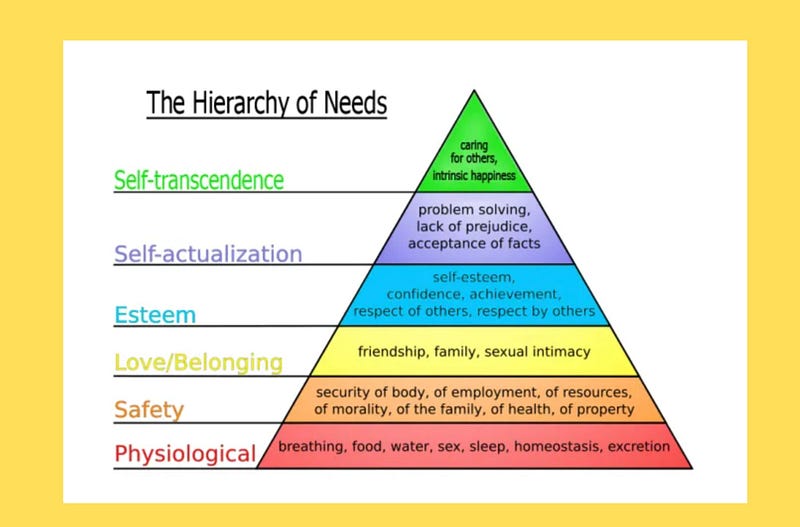
William Maslow’s Hierarchy of Needs

Self-examination should result in a heightened sense of appreciation and thankfulness for life. I realize that if I am blessed with the maximum likelihood of 30 more years of life, I have only 10,950 more precious days to enjoy.

Some days are filled with joy, others with sorrow, but all are valuable. I refuse to waste one, counting it trivial.

Would I think of mundane tasks such as washing dishes differently if I knew this was the last time the smell of Mrs. Meyer’s Lemon-Verbena dish soap would tickle my nose, and I would enjoy warm water washing over my well-worn hands?

The sun on my face is welcome, and I no longer mind if a sudden shower spots my recently washed car. What does it matter at the end of time?

How would I spend today if it was my last day?

Can I combine that mindfulness with the requirements of daily life?

Yes, I still need to work for money to pay the electric bill, my rent, auto insurance, and more. But more and more, I agree with Saunders and will avoid the things that make me trivial.

Hmm…trivial, one of those words we often use without thinking about too much.

The author’s screenshot from the definition on masterwriter.com

Of course, what is insignificant, negligible, or even rinky-dink to one may be momentous to somebody else.

However, the older I become, the more I realize how often I confused trivial and monumental events and feelings. My sister shared this poem recently, and I love the first line; if we only knew then what we know now.
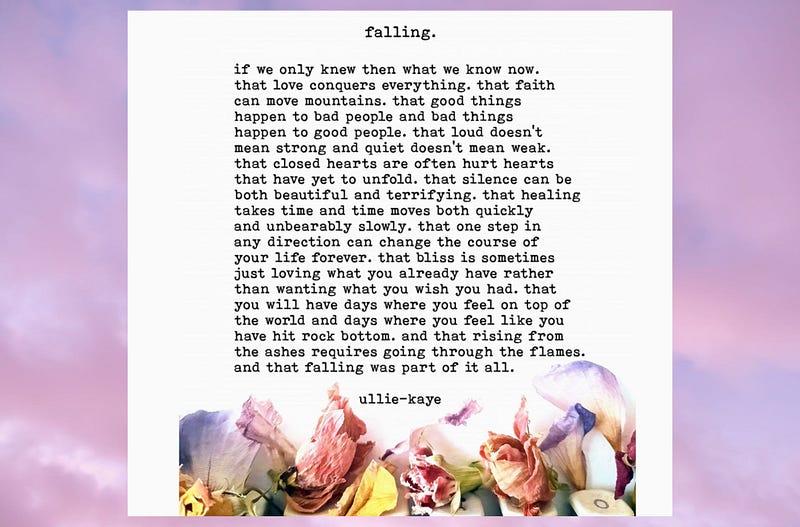
Ullie Kaye Poetry on Facebook

Each day, I aim to live with mindfulness, asking myself the question that Jane Friedman shared, “Will this choice enlarge me or diminish me?”

Self-transcendence may be key to happy elderhood.

The report of a 2015 study, Self-transcendence and well-being in community-dwelling older adults, is among multiple research papers attesting to the value of self-transcendence as we age.

Self-transcendence changes how older adults perceive themselves, their relationships with others, the material world, and the metaphysical or spiritual dimension. It is associated with multiple indicators of well-being.—University of Louisville study.

Higher levels of self-transcendence (ST) resulted in:

  • greater levels of well-being;
  • meaning in life;
  • hope which helped transcend losses of later life.
  • greater resilience;
  • sense of coherence;
  • physical and mental health;
  • increased competence in daily life;
  • and purpose in life among the oldest old, aged 85 and older.

Image from canva.com

What causes older people to become self-transcendent?

My sister and I discussed what happened to us about five years ago—what created a seismic shift in our consciousness. We both agree that we are now in the happiest, calm, and self-assured states of our long lives.

Sis nearly died before receiving an organ transplant, and I barely survived a severe auto accident. Then, in another blow, my sister’s spouse died. And I began writing my memoir, which required more self-reflection than I’d ever attempted.

Tragedy often creates change.

According to the same study mentioned above, serious illness often precipitates a desire for greater self-awareness.

A significant body of research demonstrated a relationship between ST and factors which have important effects on older adults’ well-being, including adults facing terminal or life-changing illnesses such as women with breast cancer, liver transplant recipients, and women dealing with rheumatoid arthritis and multiple sclerosis.—University of Louisville study.

Pamela Reed, an influential researcher, and educator, proposed an updated theory of ST as part of a balanced sense of consciousness that includes:

Self-transcendence is a natural and beneficial developmental state.

Vulnerability: the awareness of one’s own mortality that develops with age, health issues, and crises.

Well-being: the sense of being healthy, whole, and generally fulfilled and satisfied with one’s state.

When these three things come together, we can often look beyond ourselves and find new perspectives. I think this may be the quest for elderhood and the essence of wisdom.
Image from canva.com

My goal is to become sagacious—a sage.

Pamela Reeds say that ST expands us inward, looking at our values and dreams. It also changes how we relate to others and our world as we merge the past and the future to find meaning in the now. We may relate differently to dimensions outside of the discernible world.

Others propose we’ll see changes in relationships, creativity, contemplation, and spirituality.

A sage shows keen discernment, sound judgment, and farsightedness. If the perils of elderhood are the price of becoming self-transcendent, I’m ready.

I want to pass what I’ve learned on to others. I want to urge younger folks to “Do those things that incline you toward the big questions, and avoid the things that would reduce you and make you trivial,” as George Saunders said.

What about you? Have you seen changes in consciousness as you reached the middle of life and beyond? Where do you find meaning in life? Please share your thoughts.

Cindy is writing a memoir of her adventures growing up on a homestead in Alaska, farming in the southwest, owning bookstores, parenting, and more. Access exclusive family photos here.

Life Lessons
Psychology
Mental Health
Self-awareness
Aging
Recommended from ReadMedium