
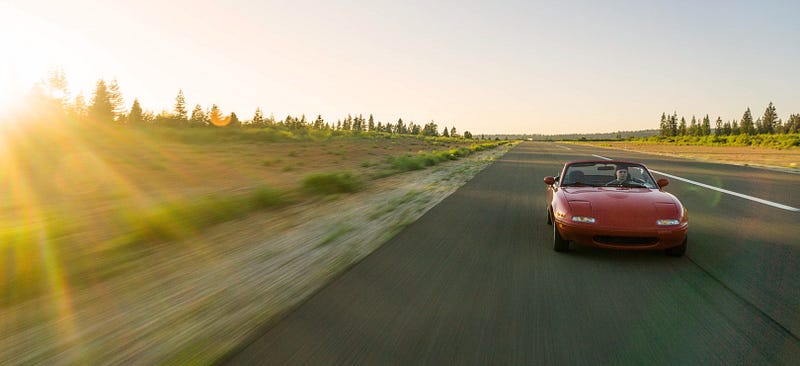
Is the sports car really dying?
The classic two-seater roadster currently looks like a dying breed, saleswise. But I think this vehicle format may get an unlikely savior…
Sales of open two-seaters in Europe and the USA, their traditional markets, have never recovered from the Great Recession’s devastating blow: even sales of perennial favorites like Mazda’s MX5 are still well below 2007 levels. BMW Z4 sales between 2016 and 2018 looked like a rounding error on the company’s charts. Munich execs are on the record saying the newly-launched “G29” model will be the last.
Their argument is a subjective one: they fear the “commoditization” of the automobile
Slow sales of existing models discourage new sports cars’ development, as these are expensive vehicles to design and manufacture: enthusiastic buyers are a notoriously demanding bunch, and “parts-bin engineering” only gets you so far. On top of that, those demanding enthusiasts’ definition of “affordable” is always much lower than a manufacturer’s one.
Meanwhile, as the automotive industry strives to bring electric vehicles into the mainstream, many hard-core automobile enthusiasts struggle to embrace them, regardless of performance and design merit. Their argument is a subjective one: they fear the “commoditization” of the automobile into a white good, a mere tool rather than a mean of self-expression and a source of enjoyment.
If performance and what’s under the bonnet no longer matter, it doesn’t mean the human need for self-expression and indulgence will go away.
The most vigorous EV advocates may dismiss this as a trivial issue, but it definitely isn’t. Many companies built their reputation and success on their engines’ specific characteristics, creating entire legacies and legions of loyal followers.
That’s not going to happen with electric motors and batteries: nobody cares who makes them and where they come from, as long as they work flawlessly. Production of electric motors and batteries can be heavily automated and concentrated in one place rather than multiple sites. If that doesn’t look like commoditization, I don’t know what does.
It doesn’t stop there either: the way the driver experiences acceleration and speed won’t differ much, if at all, between comparable vehicles. Certainly not in the same way one can currently tell between a Ferrari and a Porsche by listening to their engines and appreciate how their transmission works. This transition will weed the weakest competitors out of the market for good… But will the sports car die with them?
Not necessarily.
Driving enjoyment won’t fade away together with internal combustion engines. In fact, I believe quite the opposite will happen: the electric revolution may prove to be the unlikely savior of the sports car genre. If performance and what’s under the bonnet no longer matter, it doesn’t mean the human need for self-expression and indulgence will go away.
Automotive fashions come and go, and after the current “sports utility mania,” it’s not so far-fetched to imagine a kind of “return to playfulness.”
The remarkable flexibility of electric vehicle architectures, with their flat battery packs and compact motors, is ideal to satisfy those desires with a diversified range based on the same base modules. Not only the cost of batteries is bound to go down, but the cost of making the entire vehicle is bound to go down, as EVs are inherently simpler to build.
According to recent research by Goldman Sachs, an electric car needs about 11.000 parts against the 30.000 of an internal combustion one. Such a reduced number of commoditized components, made in fewer factories by fewer people, could dig the industry out of the razor-thin margins hole where it’s currently stuck. That simplicity and those fatter margins are the sports car’s potential saviors by making easier the business case for the affordable niche models enthusiasts want.
Automotive fashions come and go, and after the current “sports utility mania,” it’s not so far-fetched to imagine a kind of “return to playfulness.” Back in the late 1970s, Alfa Romeo advertised its Spider with a headline that captured the charm of drop-top motoring like few managed before or since: “Spider é muoversi nella natura.” Roughly translated, it means “Spider is to travel in nature,” and that’s what a roadster is all about.
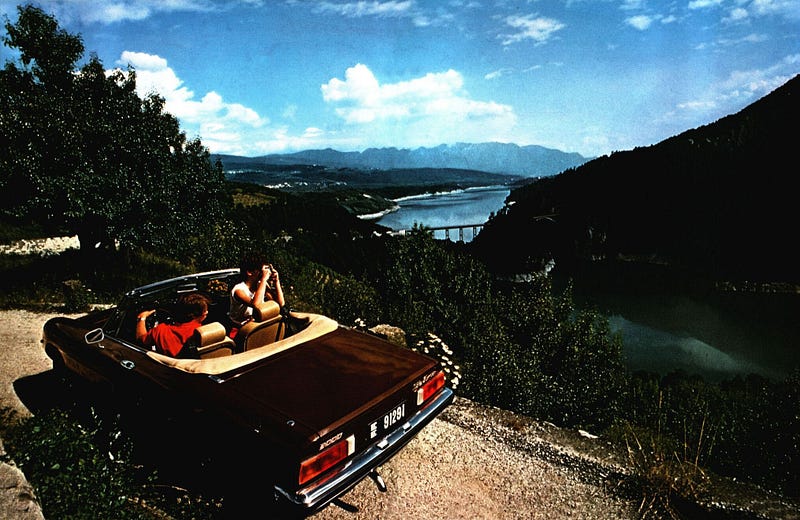
Approached this way, “electric sports car” ceases to appear a dichotomy to become desirable. Drop-top motoring immerses the driver and passenger in their surroundings. They will move through nature without disturbing it, almost like a cyclist, but with the quick, seamless acceleration of the electric motor available at a blip on the throttle.
The idea of moving fast immersed in nature with only the wind to listen to may lead the future sports car designer to adapt the design language from outdoor sports equipment, just to give an example. Things like the need to explore, experience, and seek thrills are part of human nature, and the EV revolution may be the ticket for a new generation to enjoy driving once again.