
Is The Self An Illusion?
From neuroscience to philosophy, evidence suggests that the self is not constant.

The field of neuroscience is full of intriguing case-studies from which we draw our understanding of the brain. Phineas Gage had a part of his prefrontal cortex damaged by a railroad spike; afterwards, he experienced significant personality changes. Becoming more impulsive and less considerate for others, he eventually lost his job as a railroad foreman.
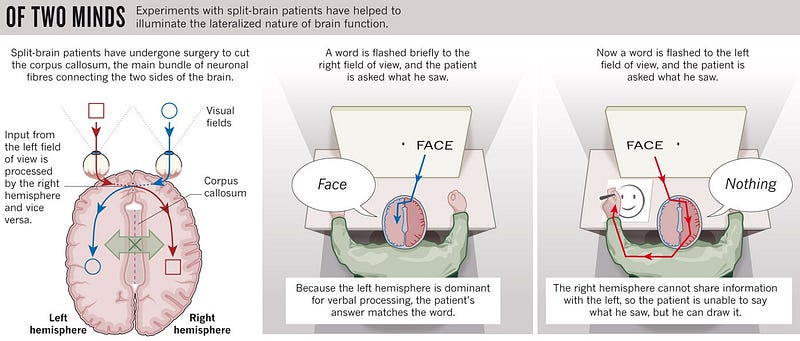
Some individuals experiencing epilepsy opt for a surgery that cuts off some of the connections between the brain’s two hemispheres. By cutting off this region, the corpus callosum, seizures can no longer spread from one hemisphere to the next. As a consequence, the right and left sides of the brain lose many of their communication pathways. These surgeries lead to the characterization of many intriguing behaviours forming the split-brain syndrome.
One experiment involved asking an individual to press a button whenever an image flashed on a screen. These images flashed either on the left or the right visual field. The right hemisphere processes information on the left side of the visual field. The left hemisphere processes information from the right side of the visual field. The left hemisphere is involved in processing language. By asking the patient to describe what they see, clinicians assessed what happened when the two sides of the brain could not communicate.
While the patient could identify images delivered to the left hemisphere, something strange happened when images presented to the right hemisphere. Though the patient claimed he didn’t see any image, his left hand kept pressing the button, indicating that an image did indeed flash onto the screen. These are the strange consequences of two hemispheres that would not communicate.
An additional question emerges from these observations. Since these two parts of the brain function independently, are they two separate selves? When asked to describe actions a patient takes requiring the right side of the brain, the patient would use the left hemisphere to try and answer.
Speech and language lateralized to this side of the brain, no longer connected to the right hemisphere. Incredibly, the left-hemisphere confabulated an explanation! These individuals still experienced a unified self, only because the left hemisphere functioned to explain away anything the right side of the brain performed, even if it had to guess.
An even more basic example involves our experiences of the world. If we zoom in one sense, vision, we know that many of us detect wavelengths of light. There is a complex neurobiological pathway by which this information travels to the brain. These physical aspects of the outside world get converted into neural impulses.
Once it reaches the brain, it’s unclear how much our perceptions differ. Our personal experience of a stimulus by our conscious mind is called qualia. There is no way to prove the way I perceive and imagine red, my qualia, is equivalent to yours. Senses develop as our brain grows, so it follows that my experiences or qualia may also change.
Is the unified or constant self a confabulation too? Perhaps.
Many Buddhist beliefs feature a philosophical point-of-view where the self is an illusion. Over the last 2500 years, several schools of Buddhism developed teachings to help us cope with the pain, difficulties and emotions associated with our existence. The convergence across many of these schools centers around distancing from the idea of the self. Here, the idea of the nonself arises.
Many of our wants and desires link to impermanent objects or feelings. A personal narrative defines our wants and desires. But with nonself, these wants and desires are rejected, replaced with a pursuit of self-improvement and wisdom. Achieving introspection and liberation requires the practice of different methods of meditation.
Neuroscientists, psychologists and cognitive scientists who aim to understand the neural correlates of meditation and awareness contribute fascinating work on this topic. These studies show that some practices alter core aspects of the brain, including how often the mind tends to wander as well as how different regions talk with each other.
Do change core aspects of our cognitive processes, our awareness, our motivations and our discipline change who we are at the core? After all, a plethora of personality research suggests that we become less open to new experiences, more agreeable and more disciplined with age.
There is evidence that core personality traits and networks within the brain may change throughout specific practices and across time. Tying these together is the left-hemisphere interpreter effect, that builds a tidy narrative about who you are. Ultimately, this question validated by psychology and neuroscience is debated across fields of philosophy.
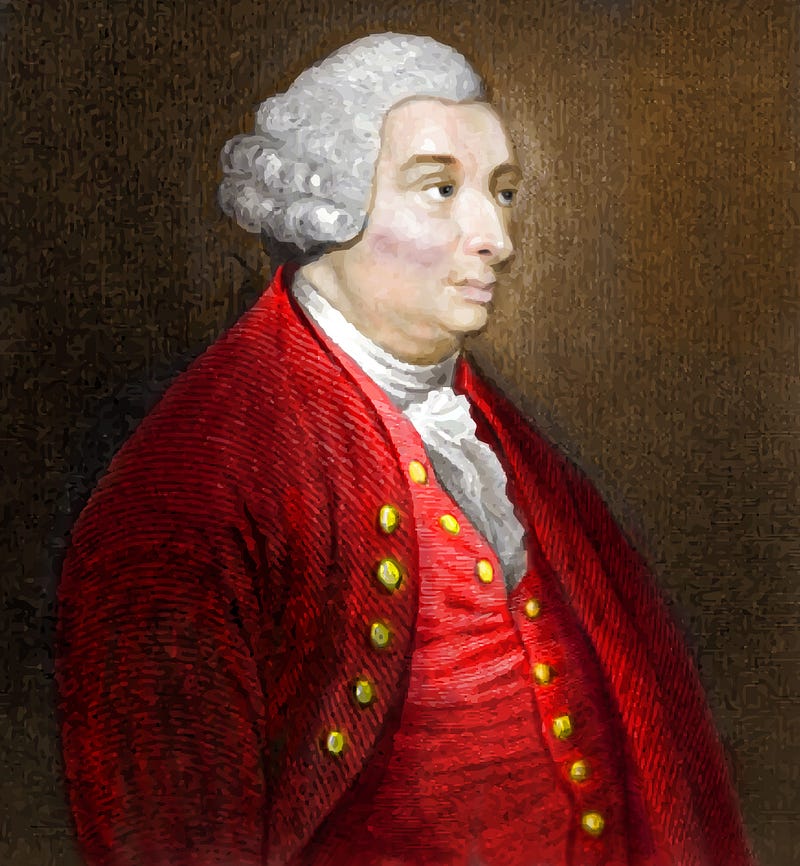
The Scottish philosopher, David Hume, developed similar ideas about the self. In A Treatise of Human Nature (1739), Hume concludes:
Identity depends on the relations of ideas; and these relations produce identity, by means of that easy transition they occasion. But as the relations, and the easiness of the transition may diminish by insensible degrees, we have no just standard, by which we can decide any dispute concerning the time, when they acquire or lose a title to the name of identity. All the disputes concerning the identity of connected objects are merely verbal, except so far as the relation of parts gives rise to some fiction or imaginary principle of union, as we have already observed.
After all, our interests and motivations change very little day-to-day. We might not notice a significant transition that occurs for a year that fundamentally changes our identity. Imagine removing one small grain of sand from a large dune every day. Imperceptibly, this dune will shrink though we cannot tell the difference between two subsequent days. After all, we only remember these minuscule changes day-to-day.
If one would start a habit of writing, by adding five more words each day, they would gradually write longer and longer pieces. On the first day five words, the second day ten words, the end of the month 150 words and at the end of the year, 1825 words. Gradually over a year, you become more interested in writing but there is no one time in which you pinpoint this change in skills and habits. However, your writing improves significantly between the first month and the last. This is the paradox of the relational, ever-changing self.
According to Hume’s philosophy, as well as scientific research, the self may be a convenient way to bundle our perceptions, to link cause and effect. So is there really a true self? And why does it matter?
This is just an introductory primer to this curious question underlying the very essence of who we are. No matter who you are, I recommend learning philosophy to enrich your perspectives, critical thinking and world-view.


