
Is the Raunchy Hit Single ‘WAP’ Sexually Empowering to Women?
The answer may surprise you.
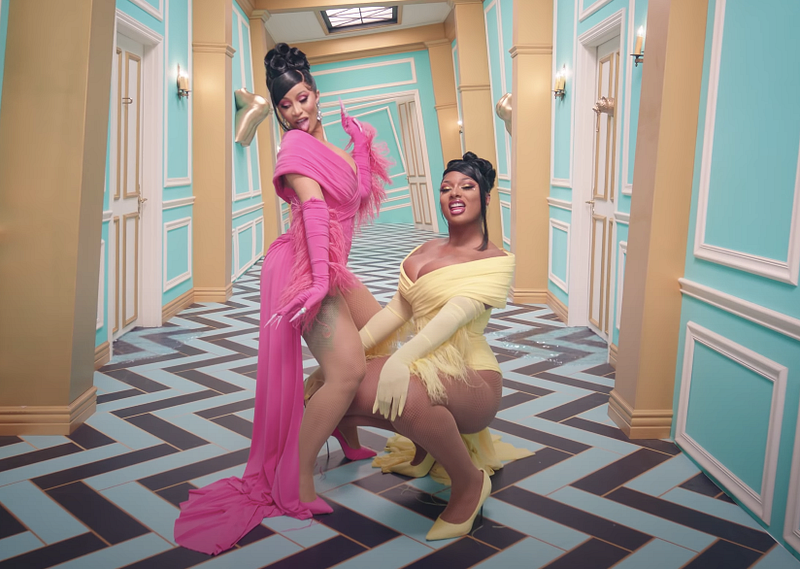
The famed female rap artists, Cardi B and Megan Thee Stallion, recently debuted their now-viral hit single “WAP.” The song’s steamy music video has already racked up over 100 million views since being recently released on YouTube. The song has already broken records and has reached the #1 spot on global Spotify.
WAP’s explicit lyrics and raunchy acronym (“Wet-Ass Pussy”), describing female sexual desire and arousal, have sparked rapid controversy and discussion throughout social media.
Predictably, right-wing political commentators clashed with magazine writers and editors about whether or not WAP was sexually empowering to women.
The viral controversy around WAP begs the question — is WAP sexually empowering to women?
In response to this question, I argue three main points in this article —
1) WAP’s message of female-centered sexual liberation and agency can be inspirational for femmes of all genders and sexual orientations, not just cisgender heterosexual women.
2) The perceived need for ‘female/femme sexual empowerment’ implies that femmes inherently lack sexual agency and need to be given this power by others, such as Cardi and Megan.
3) Musically, WAP may help to incite a surge of confidence and sexually liberating feelings within the listener, however the process of being empowered ultimately lies within ourselves.
The Online Culture Clash
Right-Wing Response to WAP
Quickly after WAP dropped, white conservative politicians and commentators immediately condemned the song as anti-feminist and generally unholy.
Deanna Lorraine, Republican politician, and former congressional candidate described WAP as “setting the entire female gender back by 100 years.”
James Bradley, a Republican congressional candidate, claimed that he “accidentally” heard the song, and declared that this is “what happens when children are raised without God and without a strong father figure.” This an especially offensive statement considering Megan’s father passed away when she was a teenager.
Ben Shapiro, a conservative political commentator, made the internet collectively cringe when he stated that a woman’s well-lubricated and aroused vagina is a sign of a medical condition. Ben Shapiro’s commentary, as well as a remixed version of him reading the lyrics to WAP, has now been dispersed across the internet in mockery of his naked misogynoir.
Ultimately, it is not surprising that white conservative politicians used a sexist and racist combination of faux-outrage mixed with insincere religious piety to attempt to shame women expressing themselves sexually.
However, these viral conservative tweets immediately were met with proclamations that WAP is the epitome of female sexual empowerment.
The Cultural Pushback: WAP as Empowerment
More liberal-minded writers responded to the conservative narratives around WAP by insisting that the song is about women’s sexual empowerment.
Brittney McNamara, a senior editor at Teen Vogue, pushed back against WAP-hating conservative politicians by concluding that it was a sign of right-wing men being threatened by female sexual agency and empowerment.
Brianna Holt, a writer, and editor at Complex went so far as to conclude that WAP is the epitome of female empowerment.
Cardi B herself has stated in an interview with Elle magazine that her upcoming album, including her single WAP, was specifically created with female empowerment and sexual liberation themes in mind.
“My music is always going to make a woman feel like a bad bitch. When you make a woman feel like she’s the baddest bitch in the room, to me, that’s female empowerment” — Cardi B
Although WAP was highly connected with cisgender and heterosexual women’s sexual identities within mainstream media magazines, on social media it appeared that WAP resonated with other queer femme identities as well.
Bob the Drag Queen, a queer pop culture figure and winner of Rupaul’s Drag Race Season 8, remarked on Twitter that WAP could imply either vaginal or anal sex making it “Truly a versatile song.”
On social media, young queer people made the song into their own by using WAP within their TikTok videos. Ve’ondre Mitchell (@veondre), a trans woman of color, and Ricardo Mariano Armijo (@riri.realness), a self-proclaimed “#femboy,” made viral TikTok videos of themselves lip-syncing and dancing to WAP.
Clearly, Cardi and Megan’s message of ‘women’s sexual empowerment’ within WAP spoke to a much larger audience that included queer and femme expressing people.
If WAP isn’t just about women’s sexual empowerment, is it instead about femme sexual empowerment?
Let’s Talk about Femmes
Femme As a Form of Gender Expression
People of all genders and sexual orientations can identify as being feminine. To be a femme does not require a vagina, a set of XX chromosomes, or sexual attraction to men. Femininity is a form of gender expression, that is constructed by complex social and cultural norms (for more information, go to ‘The Gender Elephant’).
Due to patriarchal and heterosexist norms in society, femme-presenting people are frequently subjugated to discrimination and negative stereotyping. Cisgender women, transgender women, and queer cisgender men are just a few examples of identities that have been historically marginalized in part due to their perceived proximity to femininity.
It is also notable that people of color, particularly Black cisgender women, Black transgender women, and Black queer cisgender men, experience disproportionate rates of violence and negative health outcomes due to intersections of systemic racism and sexism within our society.
These complex and varying identities can provide context to specific issues, such as the intersection of femininity and sexuality.
Stereotypes about Femme Sexuality & Empowerment
Femininity is frequently associated with negative stereotypes and assumptions, particularly around sexuality.
In general, people who are perceived as feminine are stereotypically assumed to be the sexually passive counterpart to a partner who is masculine and sexually assertive. Femmes are assumed to be sexually receptive partners, while a more masculine expressing person is presumed to be the penetrative sexual partner.
Femmes, due to stereotypes around passivity, are sometimes treated as receptacles for masculine sexual pleasure. These sexist norms contribute to the idea that sexual pleasure is more naturally centered around the wants and desires of those who exude masculinity.
However, it is important to keep in mind that Cardi and Megan are Black women rapping about their sexuality. When specifically discussing Black femininity and sexuality, these broader stereotypes intersect with systemic racism.
Due to racism and the history of slavery in the U.S., Black women are frequently hypersexualized and stereotyped as sexually aggressive, in contrast to white women who are presumed to be sexually pure and modest.
In reality, white supremacy and chattel slavery have justified a legacy of objectification, sexual exploitation, and violence against Black women and femmes that still exists today. Black women and femmes can consequently experience racist and sexist stereotypes around being both sexually aggressive and passive as a sexual object.
Overall, due to femininity being stereotyped as weak and receptive, there is an erroneous presumption that femme-expressing people inherently lack sexual agency. Our white patriarchal society concludes that femmes need to be taught how to claim their own sexual empowerment, as opposed to changing culturally sexist and racist norms that uphold the current power structures.
WAP and Femme Sexual Empowerment
The real reason why WAP is “controversial,” has nothing to do with the sexually explicit language or the raunchy music video; it’s because Cardi and Megan saturated every bar with inherent confidence, bravado, and an unwavering decisiveness about what they sexually desire.
In a world where femmes are expected to be deferential, insecure, and unsure of what they sexually desire, WAP is a flagrant rejection of these social norms. Cardi and Megan’s lyrics never second-guess what they want. They tell you, in explicit detail, everything they want to do with their partner.
“I want you to touch that lil’ dangly thing that swing in the back of my throat” — Cardi B
The lyrics in WAP not only outline what Cardi and Megan sexually desire from their partners, but they also describe how they are going to get what they want.
“I tell him where to put it, never tell him where I’m ‘bout to be” — Megan Thee Stallion
Cardi and Megan use catchy and quotable lyrics that depict how feminine sexual expression can encapsulate assertive, enthusiastic, and consensual sex. The lyrics are perfectly designed to be shouted out loud at the club with your friends on a night out.
“I said certified freak, seven days a week / Wet ass pussy make that pull out game weak” — Cardi B
WAP may feel liberating to some because the lyrics and vocals can give a voice to what many femmes may still struggle with today. When the expected social norm is for femmes to be passive and ambivalent, it may at times feel exceptionally brave to clearly voice exactly what you want — especially when it comes to sex.
However, it is a mistake to think that Cardi and Megan are somehow exceptional and hold some type of special power around sexual empowerment. Cardi and Megan are not gatekeepers of femme sexuality, no one is, but they can model their own radical expressions of femininity. No one gave Cardi and Megan “female sexual empowerment,” they fostered it within themselves and have proudly showcased their liberation in their work.
Listening to WAP does not automatically compel you to shout from the rooftops and reveal all of your deepest sexual desires to your significant other. WAP can provide a sexually liberating emotional headspace, but it is an overreach to state that it has the capacity to distribute power to its listeners. At the end of the day, if you took the time to be vulnerable and to tell your partner exactly what you want, it is you who had the guts to do it.
To all the femmes out there, no one, not even Cardi or Megan, can give you sexual empowerment. You’ve already had the power to a bad bitch the entire time.