avatarSadie Seroxcat

Free AI web copilot to create summaries, insights and extended knowledge, download it at here

3566

Abstract

t had been responsible for this? <b>To put it bluntly, AIDS</b>. Or, to be more specific, misunderstanding and misrepresentation of the HIV/AIDS pandemic. The pandemic which so many people still don’t want to acknowledge.</p><p id="c999"><a href="https://www.independent.co.uk/news/uk/home-news/aids-crisis-timeline-its-a-sin-b1791286.html">A timeline of the AIDS crisis in the UK | The Independent</a></p> <figure id="accb"> <div> <div> <img class="ratio" src="http://placehold.it/16x9"> <iframe class="" src="https://cdn.embedly.com/widgets/media.html?src=https%3A%2F%2Fwww.youtube.com%2Fembed%2FhnR5DxP2e2g%3Ffeature%3Doembed&amp;display_name=YouTube&amp;url=https%3A%2F%2Fwww.youtube.com%2Fwatch%3Fv%3DhnR5DxP2e2g&amp;image=https%3A%2F%2Fi.ytimg.com%2Fvi%2FhnR5DxP2e2g%2Fhqdefault.jpg&amp;key=a19fcc184b9711e1b4764040d3dc5c07&amp;type=text%2Fhtml&amp;schema=youtube" allowfullscreen="" frameborder="0" height="480" width="854"> </div> </div> </figure></iframe></div></div></figure><p id="9ced">Bizarrely, in 1987, the year before Clause 28 was passed, the UK Government launched “<a href="https://en.wikipedia.org/wiki/AIDS:_Don%27t_Die_of_Ignorance">AIDS: Don’t Die of Ignorance</a>”, a major public information campaign. A leaflet about AIDS was delivered to every household in the UK, which warned that it is impossible to tell who is infected with the virus. It seemed as though open sharing of information was being recognised as the best way forward…and then, all of a sudden, it wasn’t.</p><p id="f1db">Or perhaps it was ok to be ignorant if you were still school age? How many ways is that statement appalling?! Then again, consider that the age of consent (for male homosexual relationships) was set at 21 from 1967 to 1994 — until 2000, when it was dropped again to be inline with the legal heterosexual age of 16. Now, I suppose it could be argued that you don’t need to know about sex or sexually transmitted diseases until you’re old enough to legally be having sex — but we’ve all seen how well that attitude has worked out for heterosexual relationships haven’t we. It doesn’t matter how much people push a ‘purity/abstinence’ agenda, the number of teenage pregnancies which still occur on a yearly basis attest to the fact that teens have sex. It simply seems unbelievably irresponsible to me, with a killer virus running through the gay community, to not only avoid mentioning this in schools, but to go so far as to <b><i>forbid homosexual sex to be mentioned at all.</i></b></p><p id="4392" type="7">“Section 28 passed into UK law, forbidding local authorities from the teaching “of the acceptability of homosexuality as a pretended family relationship.” It would send shockwaves through British society: silencing gay pupils and teachers, while galvanizing mass protests and the formation of the LGBTQ+ rights groups OutRage! and Stonewall” — Outrageous!: The Story of Section 28 and Britain’s Battle for LGBT Education by Paul Baker (goodreads.com)</p><figure id="c375"><img src="https://cdn-images-1.readmedium.com/v2/resize:fit:800/0*6FIw0STC0BfQTzaq"><figcaption>Photo by <a href="https://unsplash.com/@carrier_lost?utm_source=medium&amp;utm_medium=referral">Ian Taylor</a> on <a href="https://unsplash.com?utm_source=medium&amp;utm_medium=referral">Unsplash</a></figcaption></figure><p id="7a16">Which brings us to the present and my feeling of deja vu.</p><p id="f953">Earlier this year, Florida lawmakers proposed what is commonly kn

Options

own as their ‘Don’t Say Gay’ bill. This bill will essentially bar educators from even acknowledging the existence of anyone whose sexuality is anything other than straight. Which means that, any mention of gender or sexuality:</p><p id="8d40"><b><i>“in kindergarten through grade 3 or in a manner that is not age appropriate or developmentally appropriate for students in accordance with state standards.”</i></b></p><p id="bacb">could end in prosecution — and who knows what age and developmentally appropriate even means…</p><p id="61ae"><a href="undefined">James Finn</a> has written recently:</p><p id="1599" type="7">“As Equality Florida puts it, “This legislation is meant to stigmatize LGBTQ people, isolate LGBTQ kids, and make teachers fearful of providing a safe, inclusive classroom. The existence of LGBTQ students and parents is not a taboo topic that has to be regulated by the Florida Legislature.”</p><p id="c5b9" type="7">(in his article) Disney Just Endorsed Don’t Say Gay | by James Finn | Prism & Pen | Mar, 2022 | Medium</p><p id="8e30">This bill, along with the removal of books from schools and communities up and down the states — the list of which includes a large number of texts which deal with LGBTQ+ subjects in one way or another (see here: <a href="https://readmedium.com/removing-titles-from-a-whole-stateful-of-libraries-and-schools-7383ebec2d81">https://readmedium.com/removing-titles-from-a-whole-stateful-of-libraries-and-schools-7383ebec2d81</a> ) — really reminds me of our ‘Prop 28 Era’ in the UK of the 1980s/90s. Which is frankly tragic in my opinion.</p><p id="57ce">Meanwhile, back in the UK anti-transgender fervour has been gaining momentum — and anti-LGBTQ+ violence has been on the increase again for a good few years now, which is concerning, but as the parent of a teen who identifies along that spectrum I have to admit to being extra saddened to see we seem to be sliding back towards the ‘bad old days’.</p><p id="23a7"><b>Resources for the UK</b></p><p id="8132"><a href="https://www.stonewall.org.uk/">Stonewall</a></p><p id="609e"><a href="https://www.tht.org.uk/">Home | Terrence Higgins Trust (tht.org.uk)</a></p><p id="ee54"><a href="https://www.pinknews.co.uk/2019/04/03/lgbt-charities-supporting-donating/">10 LGBT+ charities worth supporting and donating to (pinknews.co.uk)</a></p><p id="472e"><a href="https://www.mind.org.uk/information-support/tips-for-everyday-living/lgbtiqplus-mental-health/about-lgbtiqplus-mental-health/">About LGBTIQ+ mental health — Mind</a></p><p id="6c72"><a href="https://survivorsnetwork.org.uk/resource/lgbtq-resources/">LGBTQ+ Resources — Survivors Network</a></p><p id="90ce"><a href="https://www.studentminds.org.uk/lgbtq.html">LGBTQ+ — Student Minds</a></p><p id="b005"><a href="https://www.samaritans.org/">Samaritans | Every life lost to suicide is a tragedy | Here to listen</a></p><div id="6f61" class="link-block"> <a href="https://sadieseroxcat.medium.com/membership"> <div> <div> <h2>Join Medium with my referral link - Sadie Seroxcat</h2> <div><h3>As a Medium member, a portion of your membership fee goes to writers you read, and you get full access to every story…</h3></div> <div><p>sadieseroxcat.medium.com</p></div> </div> <div> <div style="background-image: url(https://miro.readmedium.com/v2/resize:fit:320/0*GqRMPEtm_itdf07n)"></div> </div> </div> </a> </div></article></body>

Is the history of the 1990s UK Prop/Section 28 repeating itself?

It feels like Deja-vu

Photo by Steve Johnson on Unsplash

At university in an English city in the late 1980s, I protested against ‘Proposition 28', which became Section or Clause 28 in UK law.

If you went to school in the UK in the 1990s, you grew up under the control of Section 28. It was a law that censored schoolbooks, the national curriculum, and could see teachers lose their jobs if they dared speak of its forbidden subject. The subject was gay people, and in effect, any part of the LGBTQ+ community.

Section 28 (also known as Clause 28) was part of the Local Government Act 1988, and decreed that any local authority ‘shall not intentionally promote homosexuality or publish material with the intention of promoting homosexuality’. It also prohibited ‘the teaching in any maintained school of the acceptability of homosexuality as a pretended family relationship’.

In practice, this meant any mention of being gay or what that meant now or in history was expunged from every school library and classroom in the land. You could no longer learn about it in any context, and any questions you might have asked would go unanswered. - Growing Up in Silence — A Short History of Section 28 (twentysixdigital.com)

I’d spent my teenage years listening to Bronski Beat/The Communards, The Pet Shop Boys, Frankie Goes To Hollywood and the like. I had gay friends — but even if I didn’t, I know what’s right and this was not right.

So I and others from my college, gay/straight/otherwise, joined the protestors in the city centre. We marched, chanted, waved placards. As did others all over the country.

Yet still the bill was passed.

The passing of Section 28 came at the very peak of anti-gay sentiment in the UK, when in the British Social Attitudes Survey of 1987 three quarters of the population believed being gay was ‘always wrong’ or ‘mostly wrong’. Just 11% said it was ‘never wrong’. - Growing Up in Silence — A Short History of Section 28 (twentysixdigital.com)

“The very peak of anti-gay sentiment in the UK”. What had been responsible for this? To put it bluntly, AIDS. Or, to be more specific, misunderstanding and misrepresentation of the HIV/AIDS pandemic. The pandemic which so many people still don’t want to acknowledge.

A timeline of the AIDS crisis in the UK | The Independent

Bizarrely, in 1987, the year before Clause 28 was passed, the UK Government launched “AIDS: Don’t Die of Ignorance”, a major public information campaign. A leaflet about AIDS was delivered to every household in the UK, which warned that it is impossible to tell who is infected with the virus. It seemed as though open sharing of information was being recognised as the best way forward…and then, all of a sudden, it wasn’t.

Or perhaps it was ok to be ignorant if you were still school age? How many ways is that statement appalling?! Then again, consider that the age of consent (for male homosexual relationships) was set at 21 from 1967 to 1994 — until 2000, when it was dropped again to be inline with the legal heterosexual age of 16. Now, I suppose it could be argued that you don’t need to know about sex or sexually transmitted diseases until you’re old enough to legally be having sex — but we’ve all seen how well that attitude has worked out for heterosexual relationships haven’t we. It doesn’t matter how much people push a ‘purity/abstinence’ agenda, the number of teenage pregnancies which still occur on a yearly basis attest to the fact that teens have sex. It simply seems unbelievably irresponsible to me, with a killer virus running through the gay community, to not only avoid mentioning this in schools, but to go so far as to forbid homosexual sex to be mentioned at all.

“Section 28 passed into UK law, forbidding local authorities from the teaching “of the acceptability of homosexuality as a pretended family relationship.” It would send shockwaves through British society: silencing gay pupils and teachers, while galvanizing mass protests and the formation of the LGBTQ+ rights groups OutRage! and Stonewall” — Outrageous!: The Story of Section 28 and Britain’s Battle for LGBT Education by Paul Baker (goodreads.com)
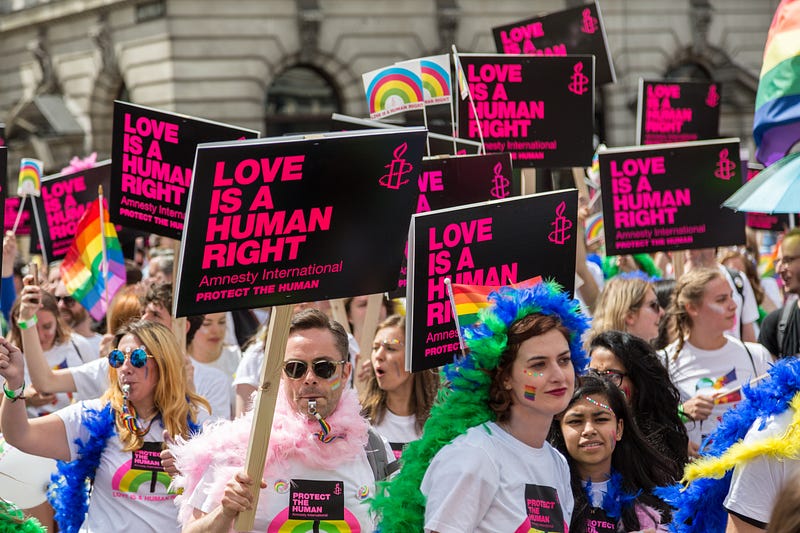
Photo by Ian Taylor on Unsplash

Which brings us to the present and my feeling of deja vu.

Earlier this year, Florida lawmakers proposed what is commonly known as their ‘Don’t Say Gay’ bill. This bill will essentially bar educators from even acknowledging the existence of anyone whose sexuality is anything other than straight. Which means that, any mention of gender or sexuality:

“in kindergarten through grade 3 or in a manner that is not age appropriate or developmentally appropriate for students in accordance with state standards.”

could end in prosecution — and who knows what age and developmentally appropriate even means…

James Finn has written recently:

“As Equality Florida puts it, “This legislation is meant to stigmatize LGBTQ people, isolate LGBTQ kids, and make teachers fearful of providing a safe, inclusive classroom. The existence of LGBTQ students and parents is not a taboo topic that has to be regulated by the Florida Legislature.”

(in his article) Disney Just Endorsed Don’t Say Gay | by James Finn | Prism & Pen | Mar, 2022 | Medium

This bill, along with the removal of books from schools and communities up and down the states — the list of which includes a large number of texts which deal with LGBTQ+ subjects in one way or another (see here: https://readmedium.com/removing-titles-from-a-whole-stateful-of-libraries-and-schools-7383ebec2d81 ) — really reminds me of our ‘Prop 28 Era’ in the UK of the 1980s/90s. Which is frankly tragic in my opinion.

Meanwhile, back in the UK anti-transgender fervour has been gaining momentum — and anti-LGBTQ+ violence has been on the increase again for a good few years now, which is concerning, but as the parent of a teen who identifies along that spectrum I have to admit to being extra saddened to see we seem to be sliding back towards the ‘bad old days’.

Resources for the UK

Stonewall

Home | Terrence Higgins Trust (tht.org.uk)

10 LGBT+ charities worth supporting and donating to (pinknews.co.uk)

About LGBTIQ+ mental health — Mind

LGBTQ+ Resources — Survivors Network

LGBTQ+ — Student Minds

Samaritans | Every life lost to suicide is a tragedy | Here to listen

Equality
Lgbtqia
Section 28
Society
Culture
Recommended from ReadMedium