
Is Silver a Good Investment?
Millennials are going crazy after silver and want to buy it all — almost like the two brothers, Nelson Bunker and Herbert Hunt, in the seventies. But how does the silver market work and why is silver such an interesting asset at the moment?
Purchasing Silver
Purchasing ALL the silver can be done, but not via futures exchanges such as the New York Comex. There, professional financial investors place bets on the future development of the silver price, while producers, traders, and processors of the metal protect themselves against undesirable price fluctuations. Generally, only virtual delivery rights to silver are traded; only in very few cases, actual deliveries are made. Also, the exchange providers can change trading rules at any time.
Just recently, the operator of NYMEX increased the initial margin, causing the silver price rally to pause promptly.
The silver price can only move sustainably if global physical demand increases significantly over a longer period. Only then will this also affect the virtual silver market. This is possible through purchases of bars, coins, or exchange-traded commodities (ETCs) that are physically backed by ingots.
The vaults of all ETCs covered by the Bloomberg stock market index now hold more than 1,000 million ounces or 130 percent of annual mine production. At the end of 2006, there were only 124 million ounces. By buying ETCs, the physical silver market could be tightened and the price boosted substantially. After all, the supplier must buy physical silver for each new share and store it safely and adequately secured in vaults.
Once Upon a Time…
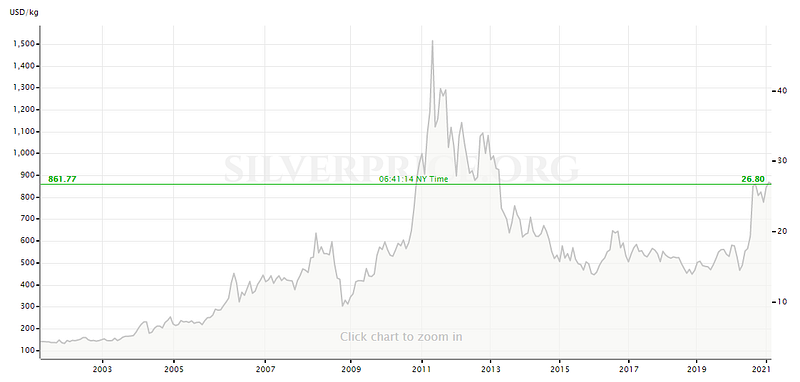
It would not be the first time that investors want to take over the silver market. A famous example from the past: Nelson Bunker and Herbert Hunt, sons of the Texas oil tycoon Haroldson Lafayette Hunt, began buying silver in the early 1970s to preserve their billion-dollar fortune and protect it from inflation. The Hunt brothers initially bought 200,000 ounces but continued to build their silver fortune to 55 million ounces by 1974. At the time, that represented about one-tenth of the world’s silver supply. Together with futures that guaranteed a claim to physical delivery, the Hunt brothers had access to half of the world’s deliverable silver. By January 1980, the price of silver had risen, almost exponentially in the final months, to nearly $50 per ounce.
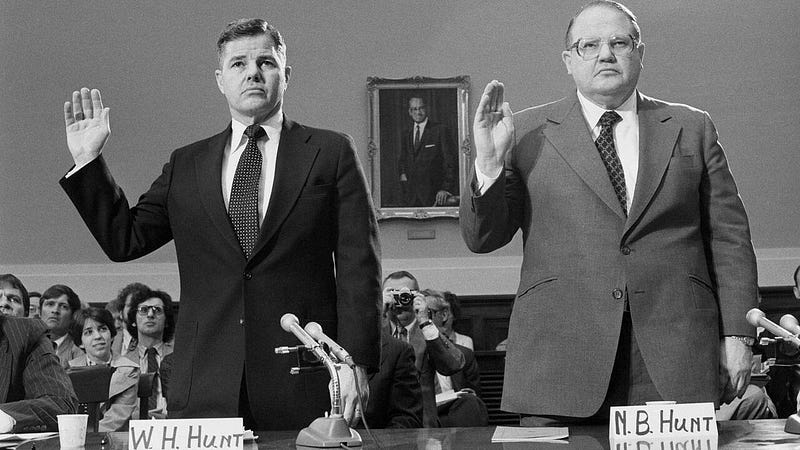
The problem of the Hunts: They bought the delivery claims on the futures exchanges mainly on credit. When the CBoT and Comex exchanges modified their trading rules and even temporarily suspended trading, the silver price was under severe pressure. The Hunt brothers, however, were unable to raise any more funds — game over. Their speculation ended in private bankruptcy with losses running into billions. In 1988, the Hunts were convicted of a “conspiracy to manipulate the market”.
Today’s Demand
The big question today is: How do you want to regulate millions of young investors who only exchange information loosely on social media? Or the other way around: Why should young investors who want to buy silver on their account not be allowed to do so on a free market?
Even before the recent run of young silver fans, the importance of investors in the silver market has increased sharply. In 2020, investors bought a net 350 million ounces via silver ETCs and another 237 million ounces via direct purchases of coins and bars, more than twice as much in total as in 2019. Silver, which was the most common means of payment for many centuries, is making a comeback as a means of preserving value with a monetary character. Taking into account the total investment demand, the silver market reached an unprecedented supply deficit of around 320 million ounces in 2020.
„There is no silver short squeeze happening. NONE. NEVER.“ — reddit.com/r/wallstreetbets
The deficit would have been even larger if demand from industry had not fallen by a tenth to its lowest level in five years due to lockdowns and temporary disruptions to supply chains. However, industrial demand should stabilize again. Among all metals, silver has the highest conductivity for heat and energy and the highest reflectivity. The metal is needed, among other things, for the expansion of the solar industry and electromobility, i.e. in growing areas that are also promoted by the government.
Silver is mostly extracted as a by-product in mines that extract lead, zinc, or copper. Supply from the mines has recently declined — mainly due to temporary closures following corona outbreaks among miners. Mines in Mexico and Peru were particularly affected. The two Latin American countries account for almost 40 percent of global silver production. So there is also a local risk on the supply side. Overall, global silver production fell by six percent to 780 million ounces. This was the lowest production volume since 2011.
Industry
A study by the “Silver Institute” raises awareness for the increasing importance of silver, especially in the automotive industry. According to the estimates, vehicles with internal combustion engines consume around 15 to 28 grams. For hybrid cars, the figure already climbs to 18 to 34 grams per light vehicle. The demand for electric vehicles is even higher at 25 to 50 grams per car. But that’s not all. Due to its physical characteristics, silver is also a sought-after raw material in the photovoltaic industry. The new U.S. government under President Joe Biden is not the only one to want to massively support the renewable energy sector. If the ambitious plans for the expansion of solar and wind power capacities are implemented, a noticeable boost in demand for silver is likely to come from this side as well.
Silver is thus supported from several sides and should therefore also benefit from stronger investment demand.
Silver’s use in photovoltaics (PV) grew by 7 percent to its second highest annual level in 2019. Demand for silver from the PV sector is forecast to improve as governments from various countries continue their commitment to generating electricity from renewable energy sources, including solar. Australia, Europe and India are anticipated to see increased installations of solar energy systems in the coming years. How is silver used in solar cells? Silver powder is turned into a paste which is then loaded onto a silicon wafer. When light strikes the silicon, electrons are set free and the silver — the world’s best conductor — carries the electricity for immediate use or stores it in batteries for later consumption. — silverinstitute.org
Still, in 2019 the Fraunhofer ISE (Institute for solar energy systems) in Munich was able to reduce the manufacturing costs of silicon solar cells. With the help of a newly developed screen printing process, the use of silver was reduced by about 30%.
Is Silver a Good Investment?
Silver acts as an inflation hedge. As a physical asset, it has intrinsic worth, unlike the dollar or other currencies. Silver holds its value long-term and fares well when interest rates are low — and fixed-income investments aren’t earning much.
Similar to gold, silver is being used as an investment. However, silver is an industrial asset as well. Especially needed in future-oriented areas like e-mobility and solar-panel production.
Silver is finite and demand increases... so what do we expect to happen?
The risks include the sensitivity to recessions, as it is driven by industrial growth, the exposure of being replaced by another material, and the volatile character.
What do others think?
Despite its affordability and industrial uses, silver has maintained a fairly low profile, especially in comparison to gold. As Giancarlo Camerana, a strategic advisor at QORE Switzerland, notes, investor demand currently represents just 15% of the market, as opposed to industrial uses, a statistic that suggests the commodity is both under-owned and undervalued. It also remains relatively cheap — especially in comparison with gold — presenting investors with more buying opportunities.
But silver is more volatile and less liquid than gold. These factors, along with its dependence on different industries, can make it difficult to predict what the silver market will look like in 10 minutes, let alone 10 years. — businessinsider.com
If Silver doesn't do the job for you, you should definitely have a look at an NFT newcomer:
VeVe: The Altcoin Meant for the Moon? (NFT, OMI Token)
or an everyday cryptocurrency:
CRO Token: The Everyday-Cryptocurrency?
The article includes the personal opinion of the author