
Is SAFe too much for your organization?
When I was first introduced to SAFe, I received a laminated A4 sheet about the SAFe Framework and its certification roadmap. My immediate thought was that this thing is huge and it will take time to digest. But if it takes me time to digest as a person, then what kind of effort is required to digest it as an organization with hundreds or thousands of employees? I asked the “apostles” of SAFe about it and they clearly stated that the framework must be implemented at once. Quickly recapping the IT companies I worked for I told myself that this is nearly impossible.
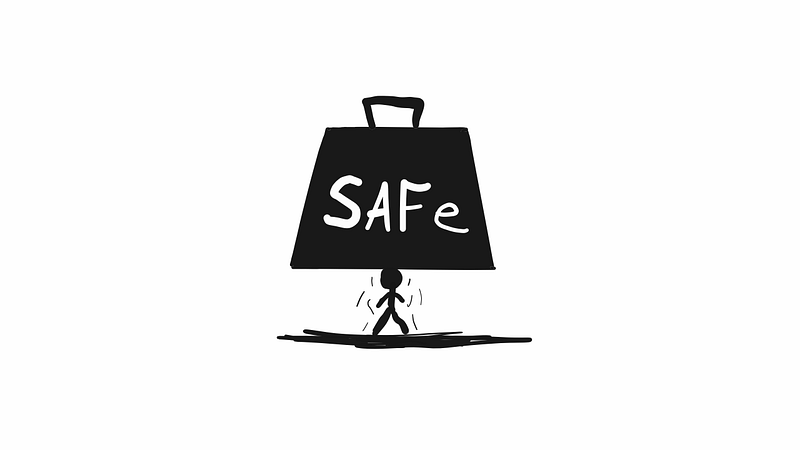
The sad truth is that those companies who would desperately need the SAFe Framework, are also the companies lacking strategic leadership and finisher culture.
They jump into topics and initiatives without setting up clear strategic goals and without real commitment on higher and middle management level. As the members of the higher management have no real interest and inartistic motivation to carry out strategic initiatives, every attempt of change will die and fade away on the slightest resistance of the middle managers’ level. So I basically see two internal issues which can kill such ambitious transition projects like implementing SAFe:
- Unit leaders buy in to the initiative, but only formally. They say yes because they have no other option, but they are rather skeptic, don’t see the benefits or their personal profit in carrying out the change.
- Team leaders, project managers and line managers don’t buy in at all. First of all because in most cases they were not even involved in the planning and decision making, and changes have to be carried out as orders without the option of giving any feedback or room for adaptation. People on this level have already enough problems and implementing new initiatives is just another set of problems, another set of responsibilities without authority. Of course if unit leaders shift the responsibility to lower management levels, those people will either shift the responsibility back or just start to pretend and ignore.
As a consequence of the lack of buy-in and strategic thinking, people will just shift responsibilities, do blame-game instead of implementing any change. The focus will be on having as many meetings as possible and to include as many managers into emails as possible, because nobody wants to step up and do something.
Nobody wants to be that idiot who will take the initiative to do something then be the black sheep to be blamed. No sane manager would risk her or his career to carry out a stupid initiative.
But what can be done in a dysfunctional organization like this?
I’m pretty sure that most SAFe trainers would say the opposite, but let’s just put aside the SAFe Framework apart as a whole and let’s check its components. As I said before, SAFe is a framework which uses a re-branded collection of known best practices, tools and techniques and it just connects these dots together to create something more valuable.
Most things SAFe offers are typical part of bottom-up initiatives. Look at DevOps. Most developers, testers and architects are begging for continuous integration, continuous delivery and automated testing. This is typical something people on the lowest level of IT companies need and want but mostly never implemented because of the lack of time and budget. We can also mention Scrum here, there are projects or customers which were more than happy to use Scrum, but the organization-wide support, the political support is missing to be able to adopt Scrum. Once again Scrum is something which is desperately needed and repeatedly asked for on the lowest levels of an IT company, yet barely implemented. Design Thinking could be also mentioned here as this is mostly applied by UX teams and it’s barely recognized by other parts of the organization, however it has a lot to do with requirements engineering, development and testing too.
All in all you can see that the most basic components of SAFe are things what the employees who produce software actually need and want. If you would spend some time and energy on selling SAFe to the lowest levels of the company first, they would totally buy-in and support the initiative, they would even come up with plans and ideas how to implement SAFe, because they probably read and know more about these topics than you do. Of course you need to sell SAFe to the managers as well, but you will have an easier work, when there is a huge pressure coming from the bottom. If a team leader sees that his employees are fully into SAFe, one must adapt too, if a unit leader sees that all his teams are fully into SAFe, one cannot fight against it.
All in all I believe that in most cases SAFe can be only implemented from the bottom up. SAFe trainers will only say to you that it’s your responsibility to make your organization committed to the implementation of SAFe and they are right. Be smart, make a plan and don’t take the commitment of the employees and managers granted. Having a good idea which actually makes sense too is not enough.
If you enjoyed reading this article, please support me with a few claps. Thank you!