<div><h3>It seems an unlikely place to find a discussion on free will, but neuroscientists often grapple with the question of…</h3></div>
<div><p>brainworldmagazine.com</p></div>
</div>
<div>
<div style="background-image: url(https://miro.readmedium.com/v2/resize:fit:320/0*ur80dhCOrjZ_S74i)"></div>
</div>
</div>
</a>
</div><p id="4f63">In his discussion Brain Vs Mind, <a href="https://eagleman.com/">neuroscientist David Eagleman</a> recounts a study that was conducted where a group of men was asked to rate the attractiveness of women’s faces in photographs. What the men did not know was that in half the photographs the women’s eyes had been dilated with eye drops.</p><p id="22ed">It turned out that the men uniformly chose the pictures of women with dilated eyes as more attractive. The important part was that none of the men had even noticed the pupil dilation consciously and none of them knew that dilated eyes were a biological sign of sexual readiness in women.</p><p id="7cf2" type="7">But their brains knew it and it ran the deep evolutionary program to steer their behavior in the right direction without the men having any conscious access to what was going on.</p>
<figure id="f430">
<div>
<div>
<img class="ratio" src="http://placehold.it/16x9">
<iframe class="" src="https://cdn.embedly.com/widgets/media.html?src=https%3A%2F%2Fwww.youtube.com%2Fembed%2FUWBtT-Gl4vQ%3Ffeature%3Doembed&display_name=YouTube&url=https%3A%2F%2Fwww.youtube.com%2Fwatch%3Fv%3DUWBtT-Gl4vQ&image=https%3A%2F%2Fi.ytimg.com%2Fvi%2FUWBtT-Gl4vQ%2Fhqdefault.jpg&key=a19fcc184b9711e1b4764040d3dc5c07&type=text%2Fhtml&schema=youtube" allowfullscreen="" frameborder="0" height="480" width="854">
</div>
</div>
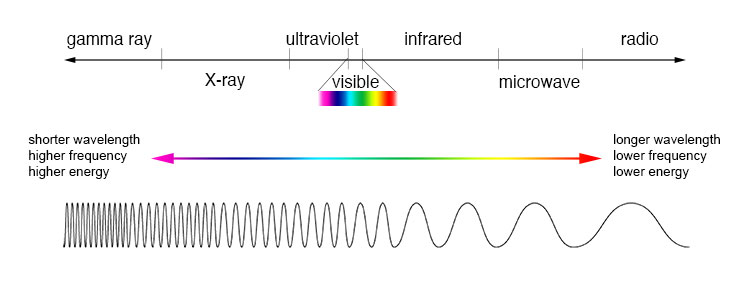
</figure></iframe></div></div></figure><h2 id="9cbe">Brain and evolution</h2><p id="d418">There is a spectrum of electromagnetic radiation available in our reality like radio waves, microwaves, infrared, visible light, ultraviolet light, x-rays, and gamma rays.</p><p id="acd9">But we only have the biological receptors to pick up a small portion of the visible light, which would be the color spectrum of the rainbow. This visible light is what enables us to see everything.</p><figure id="0631"><img src="https://cdn-images-1.readmedium.com/v2/resize:fit:800/1*26qjoPCA96uaFGaeJ15XWA.jpeg"><figcaption>Image Credit-<a href="https://imagine.gsfc.nasa.gov/Images/science/EM_spectrum_compare_level1_lg.jpg">https://imagine.gsfc.nasa.gov/Images/science/EM_spectrum_compare_level1_lg.jpg</a></figcaption></figure><p id="3db2">Somehow billions of years of evolution decided that it would be a terrible waste of brain resources for humans to be able to see ultraviolet like honey bees or infrared like snakes.</p><p id="afff">Evolution figured that we don’t need the olfactory density of a hound dog or be able to echolocate like bats.</p><p id="cb37">Maybe it felt that we don’t need the migratory antenna of monarch butterflies because it probably knew that we would eventually invent GPS.</p><p id="2873">And for all right reasons, evolution knew that humans will be deader than dead if we were trusted to breathe consciously or digest at will, so it assigned all important bodily activities to the brainstem as autonomic functions.</p><p id="6433" type="7">So, if our brain is the driver of a state-of-the-art vehicle called human body and evolution is the shotgun-riding map reader that tells the brain which way to go, then are we, the sentient thinking part, the third-wheel hitchhiker that they unintentionally picked up along the way? More importantly, who is even this “we” in the evolutionary equation?</p><h1 id="1d92">Consciousness — The Magnificent, The Mysterious</h1><h2 id="d0ba">Everyone has it, but no one can explain it</h2><p id="7a91">Almost every brilliant mind in the scientific field has tried to explain consciousness from a scientific point of view. But how well they’ve succeeded at that is pretty clear from the statement made by the astrophysicist Neil deGrasse Tyson —</p><blockquote id="08b3"><p>“The fact that people keep publishing books on consciousness is evidence that we don’t know anything about it.”</p></blockquote><p id="e41a">Experts describe consciousness as the quality of awareness, a subjective experience of oneself and the world. But they are unable to pinpoint the nature and purpose of consciousness, making it the hard problem of science right alongside the Big Bang itself.</p><p id="8817">If we skip over the arcane philosophical ‘isms and approach consciousness purely from the scientific perspective, one thing becomes clear — most neuroscientists believe that <b>consciousness originates in the brain</b>.</p><p id="50e2">From a layperson’s perspective, this sounds reasonable too because in the words of neuroscientist Giulio Tononi —</p><blockquote id="0303"><p>“Everybody knows what consciousness is: it is what abandons you every night when you fall into a dreamless sleep and returns the next morning when you wake up.”</p></blockquote><figure id="db4d"><img src="https://cdn-images-1.readmedium.com/v2/resize:fit:800/0*ys2jEDaLhtvAd0N-"><figcaption>Photo by <a href="https://unsplash.com/@anniespratt?utm_source=medium&utm_medium=referral">Annie Spratt</a> on <a href="https://unsplash.com?utm_source=medium&utm_medium=referral">Unsplash</a></figcaption></figure><h2 id="c827">Proofs for consciousness originating in the brain</h2><p id="2add">Be it deep sleep, coma, or general anesthesia, <b>the level of consciousness is squarely determined by the level of brain activity</b>.</p><p id="d298">Researchers monitoring people under general anesthesia have been able to identify distinct brainwave patterns that correspond to the <a href="https://news.mit.edu/2013/how-the-brain-loses-and-regains-consciousness-0304">gradual loss and regain of consciousness</a>.</p><p id="91ce">In cases of patients in a vegetative state, <a href="https://www.nature.com/articles/s41598-022-16470-2#:~:text=Deep%20brain%20stimulation%20(DBS)%20of,in%20consciousness%20have%20been%20reported.">deep-brain stimulation</a> using electrodes inserted in the thalamus region has shown marked improvement in the patient’s awareness and motor control, to the extent that some have had spontaneous recovery from a minimally-conscious state to a state of consciousness.</p><p id="d0e9">While treating epileptic seizures in a patient, which involved inserting electrodes in the brain’s claustrum region, a team of doctors accidentally stumbled upon the <a href="https://www.newscientist.com/article/mg22329762-700-consciousness-on-off-switch-discovered-deep-in-brain/">on-off switch for consciousness</a>. When the electrodes were stimulated, the patient stopped reading and stared blankly ahead. She became unresponsive and her breathing started to slow down. When the stimulation was halted, she regained consciousness and had no recollection of what happened.</p><p id="58f2"><a href="https://christofkoch.co
Options
m/">Dr. Christof<b> </b>Koch</a>, president of the Allen Institute for Brain Science in Seattle, Washington, traced three neurons branching from the densely connected claustrum, stretching across both hemispheres, and wrapping around the brain, which he calls the <b><i>seat of consciousness</i></b>.</p><div id="5ea0" class="link-block">
<a href="https://singularityhub.com/2017/03/09/are-these-giant-neurons-the-seat-of-consciousness-in-the-brain/">
<div>
<div>
<h2>Are These Giant Neurons the Seat Of Consciousness in the Brain?</h2>
<div><h3>The towering trees with their sprawling branches in the redwood forests have always reminded me of neurons in the…</h3></div>
<div><p>singularityhub.com</p></div>
</div>
<div>
<div style="background-image: url(https://miro.readmedium.com/v2/resize:fit:320/0*-xOKQXcKV7G-TXVk)"></div>
</div>
</div>
</a>
</div><p id="cf39" type="7">We may not know what consciousness itself is, but it is at least reasonable for all of us to agree that consciousness originates in the brain. Yes?</p><p id="5b79" type="7">Probably, no!</p><h1 id="1c25">Perceptions of Plants</h1><h2 id="7485">Another kind of consciousness</h2><p id="462e">In the 1960s,<b> <a href="https://archive.nytimes.com/www.nytimes.com/news/the-lives-they-lived/2013/12/21/cleve-backster/"></a></b><a href="https://archive.nytimes.com/www.nytimes.com/news/the-lives-they-lived/2013/12/21/cleve-backster/">Cleve<b> </b>Backster</a>, an investigator with law enforcement and a highly respected authority in the polygraph field, decided to hook up a houseplant in his lab to the lie detector.</p><p id="3650">Polygraph machines work by measuring the electrical changes on the skin caused by physiological factors like perspiration. Backster wanted to see if he would get a reading on the chart when he watered the plant and if it would make a better conductor when the moisture spread to the leaves.</p><p id="c41d">To his surprise, nothing remarkable registered on the chart. So he wondered if the machine can pick up changes in the conductivity of the plant if it were threatened in some way, i.e. made to perspire like humans during interrogation.</p><p id="e741">He immediately thought of fire and with the intention of burning the leaf, he thought he should go next door to borrow a match from his secretary.</p><p id="9ae5">But right at the moment the image of fire entered his mind, the small, squiggly graph that the machine was recording to reflect the changes in the plant spiked up and shot right off the top of the page.</p><p id="9476">There was no fire.</p><p id="dbfc">No match was lit.</p><p id="05aa">There was only an image of fire in the man’s mind.</p><p id="5b43"><b><i>Yet a plant that doesn’t have a brain was able to read a human’s thoughts.</i></b></p>
<figure id="b5a3">
<div>
<div>
<img class="ratio" src="http://placehold.it/16x9">
<iframe class="" src="https://cdn.embedly.com/widgets/media.html?src=https%3A%2F%2Fwww.youtube.com%2Fembed%2FM2ezqEAG_vA%3Ffeature%3Doembed&display_name=YouTube&url=https%3A%2F%2Fwww.youtube.com%2Fwatch%3Fv%3DM2ezqEAG_vA&image=https%3A%2F%2Fi.ytimg.com%2Fvi%2FM2ezqEAG_vA%2Fhqdefault.jpg&key=a19fcc184b9711e1b4764040d3dc5c07&type=text%2Fhtml&schema=youtube" allowfullscreen="" frameborder="0" height="480" width="854">
</div>
</div>
</figure></iframe></div></div></figure><h2 id="bd91">Intelligence of chlorophyll</h2><p id="6bbe">Plants have some impressive abilities like —</p><ul><li>Releasing odorous chemicals in the air to warn their neighbors about the presence of a predator</li><li>Having extensive communication systems through their root networks and fungal filaments to exchange water and nutrients</li><li>Being spatially aware to identify nearby supports for tendrils to cling onto</li><li>Recognizing kin versus other plant species growing alongside, so they could reduce their root development to share nutrients with their brethren or sprout more nutrients-grabbing roots to compete with strangers.</li></ul><figure id="d34e"><img src="https://cdn-images-1.readmedium.com/v2/resize:fit:800/1*W4ngB1H_ikA087w_CBQuEw.jpeg"><figcaption>Image by <a href="https://pixabay.com/users/cocoparisienne-127419/?utm_source=link-attribution&utm_medium=referral&utm_campaign=image&utm_content=276636">Anja</a> from <a href="https://pixabay.com//?utm_source=link-attribution&utm_medium=referral&utm_campaign=image&utm_content=276636">Pixabay</a></figcaption></figure><p id="a74b">Biologists recognize these qualities as chemical reactions in plants through rudimentary neural nets that enable them to sustain life.</p><p id="55ce">But they also claim that to consider this intelligence as a higher consciousness will be a gross misinterpretation.</p><h2 id="f0af">Is our idea of consciousness skewed?</h2><p id="6515">Maybe to think that plants could have an altruistic consciousness is a little far-fetched, but to also discard it as simple neurobiology feels like an insult to its intelligence.</p><p id="10e1">Maybe the conflict arises because we place hard lines around what we think constitutes as consciousness.</p><p id="9abc" type="7">We see the world through a lens that is calibrated by the known laws of physics and we expect blurry concepts like consciousness to conform within those laws.</p><p id="63f7">But what if there is <i>something</i> beyond our laws, something that is both similar to but also different from our consciousness that plants employ, which we are yet to discover, define, and fit into our existing models of understanding?</p><p id="2a1e">We are quick to assume that any information processing and communication requires a brain and nervous system. But without brains and neurons, plants still have mechanisms to collect sensory data and integrate them into their behavior.</p><p id="53a3">By our human standards, the ability of roots to sense an obstruction in their path, even before they come in contact with that obstruction, and switch direction beforehand could be akin to having extra sensory perception.</p><p id="c5b1" type="7">But what if this ability, just like being able to read a human’s thoughts when it means a threat to the plant, is just a separate level of consciousness that evolution bestowed on plants to ensure survival but deemed unnecessary in the case of humans?</p><p id="959d">So if plants are conscious, just not self-conscious, and if a plant is able to sense the thoughts of a human, then the question is not whether plants have consciousness similar to ours.</p><p id="8339">It is rather <b>what is the nature of thought </b>itself, in that the act of thinking emits signature identifiers, which are picked up by plant receptors but not by humans.</p><p id="4c1a"><i>“If you are plotted anywhere near me on the spiritual graph or if you find my journey relatable, please follow me for more rants, raves, and reflections.”</i></p></article></body>
Is Our Puppeteer Brain Limiting Our Consciousness?
Evolution, consciousness, and the weird world of plants

Up until one post ago, I thought I had been viewing life with one foot on science and the other on the mystical. But it turns out that I have been having both feet on science with my toes pointing toward the mystical.
I suffer from confirmation bias that favors the metaphysical nature of life, but I also look to science to validate my beliefs so I could feel comfortable about being biased.
When I started my grand spiritual journeysome time back, I had hoped to find clarity, deepen my faith, and secure a spiritually fit mind all in a simple linear progression. But looking back, I realize that where this joyride has landed me now, after all the trudging and traipsing around, is a questionable landscape that looks like the night forest of Pandora in Avatar movie — dark but luminescent, scary yet hopeful.
On the one hand, I wonder if I should’ve saved myself the trouble of posing labyrinthine questions to seek the nonexistent truth and instead chosen the beaten path of blind faith; but then, I also know that I would have eventually ended back in Pandora no matter what, slightly delayed, but all the same.
However interesting the ride may be, my search keeps expanding the spiritual maze I find myself in instead of narrowing down to a single light source, and considering the prospects at the end of it all, I don’t know if I should feel elated or depressed.
So why am I going on and on conflicted and confused with my own line of thinking? Why do I sound like I have no grip on my mind and like someone else is running my show?
Because, according to cognitive psychologists, that probably is very much the case.
Evolution’s Master Tool — The Brain
The brain and reality
The three-pound tofu sitting between our ears exchanges ions to generate electrical impulses using a measly 20 watts. It’s sophisticated enough to make us experience a kaleidoscopic reality rich in colors and sounds while complex enough to enable us to contemplate existence.
The brain is not just a biological instrument that operates on stimuli and electrical impulses, but an exceptional mechanism that exerts serious control in deciding what we perceive, and thus, in shaping our reality.
Scientists claim that what we observe as reality, the picture that our brain cross-stitches together at a mind-boggling speed through our senses and perception, is not the whole picture of what is actually out there, but only a selective simulation reconstructed by our brain based on what it thinks is required for our efficient functioning.
According to neuroscientist Susana Martinez-Conde, we don’t have the neural machinery to experience reality the way it is, because in order to process the entire reality pixel by pixel, our brain will have to be bigger than the size of a building.
Even with a skull-sized brain, every time we get a sensory input, the brain runs permutations and combinations based on past associations and experiences, which adds up to six times more information than what is coming in.
So the brain has evolved mechanisms to pick and choose by actively suppressing many things surrounding our perception.
More importantly, the brain deprives us of a wholesome experience, because evolution has trained the early brain to not be distracted by the entire forest, but only pick out the lion hiding behind the tree in order to ensure survival.
The brain and memory
This restriction put in place by our brain is not just limited to the perception of reality but also to our memory.
Our ability to recall an event is only as good as the last time we remembered it. This is because every time we recollect something, the brain doesn’t retrieve that memory like a stored file. It instead rebuilds the event each time using only a few key points and fills-in the missing details using associations and past experiences.
So the more we recollect a memory, the less reliable its details become.
The brain and decision-making
Even decisions that we think we make consciously are actually being prepared behind the scene by the unconscious part of the brain seven to ten seconds before we think we made the decision.
In his discussion Brain Vs Mind, neuroscientist David Eagleman recounts a study that was conducted where a group of men was asked to rate the attractiveness of women’s faces in photographs. What the men did not know was that in half the photographs the women’s eyes had been dilated with eye drops.
It turned out that the men uniformly chose the pictures of women with dilated eyes as more attractive. The important part was that none of the men had even noticed the pupil dilation consciously and none of them knew that dilated eyes were a biological sign of sexual readiness in women.
But their brains knew it and it ran the deep evolutionary program to steer their behavior in the right direction without the men having any conscious access to what was going on.
Brain and evolution
There is a spectrum of electromagnetic radiation available in our reality like radio waves, microwaves, infrared, visible light, ultraviolet light, x-rays, and gamma rays.
But we only have the biological receptors to pick up a small portion of the visible light, which would be the color spectrum of the rainbow. This visible light is what enables us to see everything.
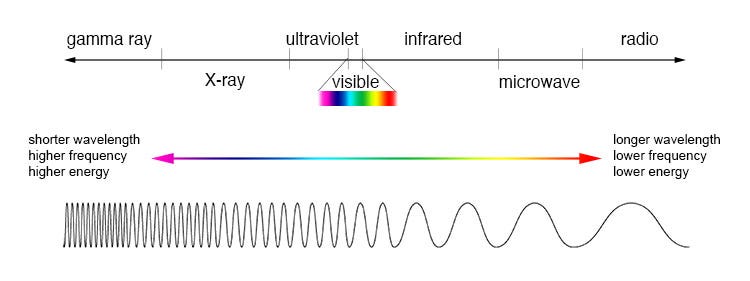
Somehow billions of years of evolution decided that it would be a terrible waste of brain resources for humans to be able to see ultraviolet like honey bees or infrared like snakes.
Evolution figured that we don’t need the olfactory density of a hound dog or be able to echolocate like bats.
Maybe it felt that we don’t need the migratory antenna of monarch butterflies because it probably knew that we would eventually invent GPS.
And for all right reasons, evolution knew that humans will be deader than dead if we were trusted to breathe consciously or digest at will, so it assigned all important bodily activities to the brainstem as autonomic functions.
So, if our brain is the driver of a state-of-the-art vehicle called human body and evolution is the shotgun-riding map reader that tells the brain which way to go, then are we, the sentient thinking part, the third-wheel hitchhiker that they unintentionally picked up along the way? More importantly, who is even this “we” in the evolutionary equation?
Consciousness — The Magnificent, The Mysterious
Everyone has it, but no one can explain it
Almost every brilliant mind in the scientific field has tried to explain consciousness from a scientific point of view. But how well they’ve succeeded at that is pretty clear from the statement made by the astrophysicist Neil deGrasse Tyson —
“The fact that people keep publishing books on consciousness is evidence that we don’t know anything about it.”
Experts describe consciousness as the quality of awareness, a subjective experience of oneself and the world. But they are unable to pinpoint the nature and purpose of consciousness, making it the hard problem of science right alongside the Big Bang itself.
If we skip over the arcane philosophical ‘isms and approach consciousness purely from the scientific perspective, one thing becomes clear — most neuroscientists believe that consciousness originates in the brain.
From a layperson’s perspective, this sounds reasonable too because in the words of neuroscientist Giulio Tononi —
“Everybody knows what consciousness is: it is what abandons you every night when you fall into a dreamless sleep and returns the next morning when you wake up.”

Be it deep sleep, coma, or general anesthesia, the level of consciousness is squarely determined by the level of brain activity.
Researchers monitoring people under general anesthesia have been able to identify distinct brainwave patterns that correspond to the gradual loss and regain of consciousness.
In cases of patients in a vegetative state, deep-brain stimulation using electrodes inserted in the thalamus region has shown marked improvement in the patient’s awareness and motor control, to the extent that some have had spontaneous recovery from a minimally-conscious state to a state of consciousness.
While treating epileptic seizures in a patient, which involved inserting electrodes in the brain’s claustrum region, a team of doctors accidentally stumbled upon the on-off switch for consciousness. When the electrodes were stimulated, the patient stopped reading and stared blankly ahead. She became unresponsive and her breathing started to slow down. When the stimulation was halted, she regained consciousness and had no recollection of what happened.
Dr. ChristofKoch, president of the Allen Institute for Brain Science in Seattle, Washington, traced three neurons branching from the densely connected claustrum, stretching across both hemispheres, and wrapping around the brain, which he calls the seat of consciousness.
We may not know what consciousness itself is, but it is at least reasonable for all of us to agree that consciousness originates in the brain. Yes?
Probably, no!
Perceptions of Plants
Another kind of consciousness
In the 1960s,CleveBackster, an investigator with law enforcement and a highly respected authority in the polygraph field, decided to hook up a houseplant in his lab to the lie detector.
Polygraph machines work by measuring the electrical changes on the skin caused by physiological factors like perspiration. Backster wanted to see if he would get a reading on the chart when he watered the plant and if it would make a better conductor when the moisture spread to the leaves.
To his surprise, nothing remarkable registered on the chart. So he wondered if the machine can pick up changes in the conductivity of the plant if it were threatened in some way, i.e. made to perspire like humans during interrogation.
He immediately thought of fire and with the intention of burning the leaf, he thought he should go next door to borrow a match from his secretary.
But right at the moment the image of fire entered his mind, the small, squiggly graph that the machine was recording to reflect the changes in the plant spiked up and shot right off the top of the page.
There was no fire.
No match was lit.
There was only an image of fire in the man’s mind.
Yet a plant that doesn’t have a brain was able to read a human’s thoughts.
Intelligence of chlorophyll
Plants have some impressive abilities like —
Releasing odorous chemicals in the air to warn their neighbors about the presence of a predator
Having extensive communication systems through their root networks and fungal filaments to exchange water and nutrients
Being spatially aware to identify nearby supports for tendrils to cling onto
Recognizing kin versus other plant species growing alongside, so they could reduce their root development to share nutrients with their brethren or sprout more nutrients-grabbing roots to compete with strangers.

Biologists recognize these qualities as chemical reactions in plants through rudimentary neural nets that enable them to sustain life.
But they also claim that to consider this intelligence as a higher consciousness will be a gross misinterpretation.
Is our idea of consciousness skewed?
Maybe to think that plants could have an altruistic consciousness is a little far-fetched, but to also discard it as simple neurobiology feels like an insult to its intelligence.
Maybe the conflict arises because we place hard lines around what we think constitutes as consciousness.
We see the world through a lens that is calibrated by the known laws of physics and we expect blurry concepts like consciousness to conform within those laws.
But what if there is something beyond our laws, something that is both similar to but also different from our consciousness that plants employ, which we are yet to discover, define, and fit into our existing models of understanding?
We are quick to assume that any information processing and communication requires a brain and nervous system. But without brains and neurons, plants still have mechanisms to collect sensory data and integrate them into their behavior.
By our human standards, the ability of roots to sense an obstruction in their path, even before they come in contact with that obstruction, and switch direction beforehand could be akin to having extra sensory perception.
But what if this ability, just like being able to read a human’s thoughts when it means a threat to the plant, is just a separate level of consciousness that evolution bestowed on plants to ensure survival but deemed unnecessary in the case of humans?
So if plants are conscious, just not self-conscious, and if a plant is able to sense the thoughts of a human, then the question is not whether plants have consciousness similar to ours.
It is rather what is the nature of thought itself, in that the act of thinking emits signature identifiers, which are picked up by plant receptors but not by humans.
“If you are plotted anywhere near me on the spiritual graph or if you find my journey relatable, please follow me for more rants, raves, and reflections.”