
Is Neuro Linguistic Programming (NLP) Pseudoscience ?
My verdict after having gone through the entire learning path
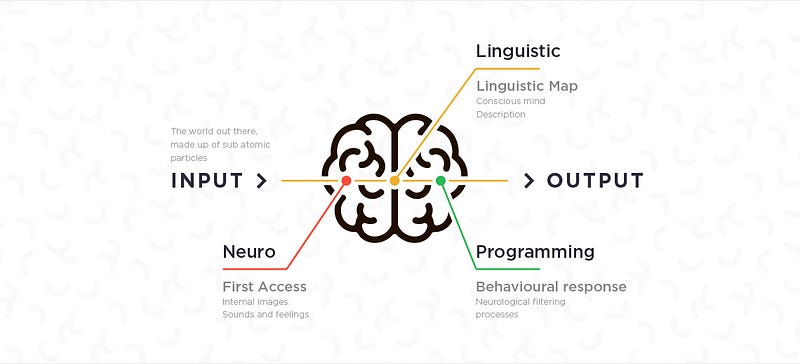
NLP has gone wild in a world cohabited by humans and machines. Long before, however, this acronym has stood for the complex relationships we maintain with each other, and with our wonderful minds alike.
At the Origins of the Appellation
Neuro linguistic programming.. such an unlikely marriage of words which means : Our behavior is conditioned by the way our neurons are connected to each other. Trivial. Whereas, those networks are found to be reshapable at any moment of our lives. Words — aka self talk — are particularly powerful in this regard.
How can this happen ?
Science said that neuroplasticity is real, constantly triggered by our learning and adaptation to different environments, contexts and persons along the way.
Who started NLP ?
Back to the 1970s, Richard Bandler, psychologist, and John Grinder, linguist, put their skills and efforts in common, modeling some of the most successful psychiatrists of their time, namely Virginia Satir, Fritz Perls and hypnotherapist Milton Erickson.
For this purpose, thorough observation had been conducted for years to establish the underlying, unconscious recipes used by each of those brilliant professionals.
As a result, a structured model was born , advocating a set of skills and questions helping coaches and healers to gather relevant information about the underlying thinking patterns of their clients, rather than about their own stories.
“We are victims of the movies we made about our past difficult memories”. — Marie-Paule Rous
Those movies, stories or plays are made of colors, shades, (exaggerated) sizes, loud voices, unpleasing sounds, and some more vivid elements deeply rooted in our subconscious. NLP based coaching aims at highlighting those distorted scenarios, blurring or transforming them.
Beginnings of my learning journey
During the first weeks of my training, I was introduced to concepts such as :
- Relativity of our perceptions, being conditioned by our cultural background but also, our individual experiences. Traumas are some of them.
- Dynamic interconnection between behavior, thoughts and feelings / emotions.
- Distortions and other biases in our daily conversations.
- How to conduct a coaching interview, focusing on those biases instead of the story itself, prior to helping the coachee to question his/her personal, limiting beliefs.
- Values and beliefs cherished by each of us, depicted by the way we express our impressions, goals, limitations, boundaries, etc.
Lesson learnt : At final, notions above were truly mind-changing, inviting me to reconsider the way I interpret mere talks. I was intrigued enough to decide to continue the rediscovery..
The End : Back to the origins!
In the next levels of the learning path, commonly named “NLP Practitioner” and “NLP Master Practitioner”, supplemental bricks come into play :
- Identifying (unconscious) strategies or thought patterns we use for all kind of actions on a daily basis : to wake up early (or not), to get ourselves motivated or creative, to remember this, to start learning that, to manage our stress when deadline hits, etc. Remember the movie above ? There are more like this, playing in a fraction of a second prior to our decisions, no matter how mere they appear. Self talk, visualization, recalling, comparison, etc. are some of the processes happening inside, easing (or not) our action.
- Getting to know the very attributes that differentiate us, far away from the oversimplified “personality types” frameworks. No and no, we, Humans, are far more diverse to be clustered into 4 colors, or any kind of binary typology. Instead, a few targeted questions can teach us about whether : - we focus on our own, or others’ appreciation, - we focus on details, or the big picture, - we tend to reach our goals, or to escape our current situation, - we consider things we can, or things we have to do, - and much, much more of aspects and hence, combinations.
- Learning path comes to an end, a practical one : My peers and I were asked to conduct interviews using the myriad of questions we have to pick the most of our coachees. Even better, we got to model experts’ skills and how-to, deconstructing their genius strategies to be tested and adapted by other people.
Lesson learnt : “We are our habits” some said. Let’s add this part : We can remodel those habits, optimize and replicate them in other areas of our lives. For me, this learning takes self-development and coaching to another level. Furthermore, it promises interesting opportunities for instructors and professionals
My Verdict
To the widespread claim “NLP is pseudoscience”, I would say : NLP never pretended to be an exact nor a human science. Instead, it is an Art of active listening and modeling, live!
Shall we judge Art ? I don’t think so.
Any boundaries ? Yes. Just like any kind of practice, NLP based coaching and solution-focused brief therapy ought to be humble. Practitioners do not substitute to psychologists’ (and obviously psychiatrists’) support.
So if you are about to pursue that learning journey, I would definitely encourage you to do so as long as the training program is :
- One hundred practical. Books and remote learning are seriously limiting.
- Bite-sized and progressive enough to enable much practice and assimilation of your new skills.
- Humble and respectful towards traditional therapy and to your intelligence, dear!


