avatarJonathan Poletti

Free AI web copilot to create summaries, insights and extended knowledge, download it at here

4689

Abstract

scene where Frodo is taken by orcs. Brought up into a tower, his clothes are removed. In the movie, Frodo is just shirtless, but the books go further. When Sam comes to find Frodo:</p><blockquote id="ca34"><p><i>“He was naked, lying as if in a swoon on a heap of filthy rags: his arm was flung up, shielding his head, and across his side there ran an ugly whip-weal. ‘Frodo! Mr. Frodo, my dear!’ cried Sam, tears almost blinding him. ‘It’s Sam, I’ve come!’ He half lifted his master and hugged him to his breast.”</i></p></blockquote><figure id="61ba"><img src="https://cdn-images-1.readmedium.com/v2/resize:fit:800/0*CaEoQpE6XfwkvZXJ"><figcaption>Donato Giancola, “<a href="https://donatoarts.com/middle-earth">Tower of Cirith Ungol</a>” (2012)</figcaption></figure><h1 id="d730">Was Frodo gang-raped by orcs?</h1><p id="96a3">Frodo tries to explain how he came to be naked, but it’s just a series of very suggestive images. “I fell into darkness and foul dreams, and woke and found that waking was worse,” he <a href="https://www.google.com/books/edition/The_Return_of_the_King/WZ0f_yUgc0UC?hl=en&amp;gbpv=1&amp;dq=pouring+some+horrible+drinking+down+my+throat&amp;pg=PT112&amp;printsec=frontcover">says</a>. “There was an orc with a whip,” and they were “pouring some horrible drinking down my throat” and “fingering their knives.”</p><p id="4784">I read that as male rape, presented allusively for a popular novel. The ‘horrible drink’ he’s made to ingest would be semen.</p><p id="2deb">Cradling a battered Frodo, Sam is deeply moved to an emotional discovery.</p><blockquote id="3ac4"><p>“He shook his head, as if finding words useless, and murmured: ‘I love him.’”</p></blockquote><p id="046c">In the movie version, after the ordeal at Mount Doom, Frodo wakes up in bed alone. In Tolkien’s version, Frodo and Sam are in bed together.</p><h1 id="e4e0">All the magical species seem a little ‘queer’.</h1><p id="681c">The dwarves, as the dwarf Gimli notes, have women who look like the men! They’re never seen, alas.</p><p id="57c1">The Ents, those tree-like beings, are all-male. We’re told the ‘Entwives’, one day, just left.</p><p id="fd47">Even the two wizards seem a little—that way? As an aside, Ian McKellen was openly gay when playing Gandalf in the movies. My sense is that his example was, to the American public, the most meaningful example of any public person being openly gay.</p><h1 id="21c3">The plot of LOTR can seem hazy at first.</h1><p id="f653">I’d read the books and watched the movies before even grasping the basic action. A struggle exists between the two major species: humans and elves, which live in opposition. They can read as ‘male’ to ‘female’.</p><p id="6054">The humans are led by patriarch kings. Mothers are little seen and often curiously absent. The typical human father seems almost eager to destroy his sons, who can never be ‘masculine’ enough.</p><p id="c27a">The elves, in contrast, are androgynous—feminine by human standards, almost ‘womanish’. Their language doesn’t distinguish between male and female.</p><p id="09b0">They have male and female rulers, as Galadriel has lately come into prominence nearly as a goddess.</p><h1 id="e200">Elves have no ambitions to rule.</h1><p id="ecf4">That leaves the humans able to take over, on the usual logic of patriarchy—that the most violent beings win. The plot begins when Sauron and Saruman, two magical overlords whose “two towers” seem like connected phallic peaks, hatch a plan to push back against the human threat.</p><p id="7178">By magic, they will create an ultra-violent elf hybrid species called the orc that will be able to crush the humans.</p><p id="8086">The orcs seem to be all-male, and birthed not from biological mothers, but by magic. (That the ‘eye’ of Sauron looks like a <a href="https://www.reddit.com/r/lotrmemes/comments/a2kg5b/does_sauron_looks_like_a_vagina/">vagina from Hell</a> is probably significant.)</p><p id="54e6">The plan is a good one, in that the orcs quickly turn the ‘world of men’ into an endangered species. Galadriel and the wizard Gandalf, in a strategic bid to prevent Sauron from taking over Middle-earth, conceive an idea.</p><h1 id="ac7a">It’s desperate and unlikely.</h1><p id="6277">These magical beings will work with a few humans to inspire them to take a step forward in cultural evolution. Humans must give up their violent ways, and adopt new values of community—<i>feminine</i> values of cooperation and respect for life. This will allow magical energies to empower their world.</p><p id="e992">The “fellowship” which starts <i>The Lord of the Rings</i> is a new political order in seed form. The effort is to get a few human men to learn

Options

a new way of interacting that is democratic and diverse.</p><p id="9378">And, as Hilary Wheaton <a href="https://www.academia.edu/987967/Masculinity_in_Lord_Of_The_Rings">analyzes</a> the shift, we see an “old, dysfunctional patriarchy” in the human world begin to give way to a “new, fraternal patriarchy.”</p><h1 id="bfef">Aragorn arises as a new type of man.</h1><p id="0c64">Quiet, polite, observant, not focused on power, with almost girlish, or elvish good looks, he’s different from other men. As Tolkien clarified later in the <i>Silmarillion</i>, Aragorn is not quite human. He is <i>part elf</i>.</p><p id="f556">But the key to Aragorn’s specialness is that he grew up without a human father. In his exile from the human world and acceptance by elves he learned magical abilities, like decency, wisdom and grace.</p><p id="e290">He seems to have a homoerotic appeal for the more ‘masculine’ Boromir. As LaFontaine notes:</p><blockquote id="0c74"><p><i>“Boromir’s furtive glances at Aragorn communicate his erotic attraction to the man who starts out as his rival and becomes his inspiration.”</i></p></blockquote><h1 id="c24b">Aragorn seems to lack much sexual drive.</h1><p id="c6c6">He gets a little flirty with Éowyn, but only a little. Finding herself rejected, she creates a male persona, ‘Dernhelm’. And <i>he</i> becomes the queer warrior able to kill a magical being, the Witch-king of Angmar.</p><figure id="74e8"><img src="https://cdn-images-1.readmedium.com/v2/resize:fit:800/0*7fSEe91M3YqNBS7N"><figcaption>Miranda Otto as Éowyn/Dernhelm with the Witch-king of Angmar in “The Return of the King” (2003)</figcaption></figure><p id="16d0">The humans must learn this mixing of states, an alchemy of male and female — which is magic! They must learn it quickly, or they won’t survive.</p><p id="c04c">But it’s a power the Hobbits embodied from the start, and the fate of Middle-earth ends up being in their hands.</p><figure id="d3d3"><img src="https://cdn-images-1.readmedium.com/v2/resize:fit:800/0*r30Gwq2jxbhDPGBx.png"><figcaption>Sean Astin & Elijah Wood as Sam & Frodo in “The Return of the King” (2003)</figcaption></figure><h1 id="bea1">In real life, Tolkien had a gay best friend.</h1><p id="84a2">The 2019 film <i>Tolkien</i> surprised with a story about the young John Ronald Reuel Tolkien and his friend Geoffrey Bache Smith. The director, Dome Karukoski, <a href="https://www.themarysue.com/tolkien-queer-subtext/">noted</a> that a gay screenwriter on the project had read all of Smith’s work, and thought it a “100% fact that Geoffrey was gay.”</p><p id="7967">The resulting film became a kind of queer love story. There was talk of “Greek love” and long, lonely glances.</p><p id="cfcd">Smith was mortally injured in World War I, and spent his last moments of life writing Tolkien a <a href="http://tolkiengateway.net/wiki/Geoffrey_Bache_Smith">letter</a>, telling him to be a writer — <i>“and may you say things I have tried to say long after I am not there to say them…”</i></p><p id="7243">I began to read <i>The Lord of the Rings</i> as a story about a gay man leaving something with his straight friend who had been his only love. Tolkien realizes that being a ‘man’—that great, commanding cultural script—isn’t everything. He realizes there’s more.</p><p id="73f3">Without his friend, he’d never have known.</p><figure id="e421"><img src="https://cdn-images-1.readmedium.com/v2/resize:fit:800/1*PLu5TbabpTi3QCnVSuwbHw.png"><figcaption>Nicholas Hoult & Anthony Boyle as J.R.R. Tolkien & Geoffrey Bache in “Tolkien” ( (2019)</figcaption></figure><h1 id="d387">We identify not with human characters, but Hobbits.</h1><p id="24f2">These little, gentle people are closer to who we are, inside. Meanwhile, the humans are mostly violent and mentally ill.</p><p id="6959">The orcs aren’t anyone’s heroes, but they represent typically human aspirations—war and conquest. As Jane Chance <a href="https://www.google.com/books/edition/Tolkien_Self_and_Other/n8mSDQAAQBAJ?hl=en&amp;gbpv=1&amp;dq=%22The+Orc,+as+repressed+sexuality+amid+brute+animality,+in+queer+terms&amp;pg=PA230&amp;printsec=frontcover">writes</a>, they seem driven by a “repressed sexuality amid brute animality…”</p><p id="4a29">And only the Hobbits, in the end, were able to stop them. The enormous effort depletes Frodo completely. Deeply wounded—pierced by a knife, a spider, orcs, and the story itself—he can’t continue in life.</p><p id="1aa4">Frodo leaves for the Undying Lands, as Sam lives out his life as a Hobbit. As per a note in Tolkien’s appendix, when his wife dies, Sam takes the last ship to the Undying Lands, to be with Frodo forever. 🔶</p></article></body>

Is ‘The Lord of the Rings’ a queer love story?

In Tolkien’s fantasy world, gender is “other”

It was strange — an all-male epic whose heroes were the feminine ones? Not everybody was into “The Lord of the Rings.” Reviews were full of tart remarks.

In 1955, one notes that J.R.R. Tolkien’s characters seem not to know “anything about women, except by hearsay.” But, year by year, the world fell in love with the biggest, queerest, most closeted love story ever.
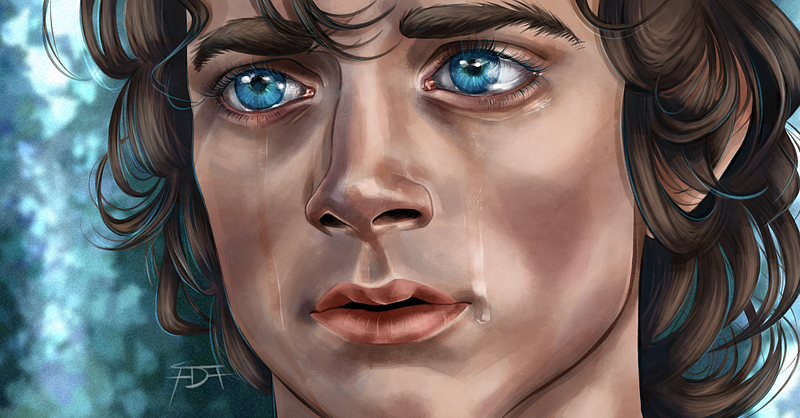
GizTheGunslinger, “Behind blue eyes” (2020)

Tolkien’s species’ are full of gendered cues.

A hobbit, for example, is sort of gay. This seems to me overt and uncontroversial. Hilary Wheaton, in a 2006 essay, “Masculinity in Lord Of The Rings,” notes the Hobbits seem “feminized,” with a lack of “masculine traits.”

But in the generally straight world of Tolkien fans, such observations run into trouble. In a 2015 essay, “Sex and Subtext in Tolkien’s World,” David LaFontaine adds: “The homoeroticism of the hobbits, the race of beings that launched Tolkien’s fame, has often been glossed over, denied, and sometimes attacked.”

He points out that Gollum read as a “lisping Hollywood stereotype of a bitter queen.”

Tolkien had all but said that Baggins was gay.

The hero of the The Hobbit is suspiciously single. In Tolkien’s Unfinished Tales, the wizard Gandalf says “he never married. He was already growing a bit queer, they said, and went off for days by himself.”

Or as another version puts it:

“…he had never married. I thought that odd… I guessed he wanted to remain ‘unattached’ for some reason deep down which he did not understand himself—or would not acknowledge for it alarmed him.”

In a 2001 essay, “‘Queer Lodgings’: Gender and Sexuality in The Lord of the Rings,” David M. Craig notes these passages, and adds that ‘queer’ at the time did suggest a state that was sexually different.

The meeting of Bilbo and Gollum in the darkness could even be allusive of gay experience—so often done in shadow. Tolkien’s epic could be read as a gay story, from The Hobbit on.

Frodo and Sam are nearly a romantic couple.

The plot of The Lord of the Rings features two pairs of male Hobbits, each of which can give the feeling of a romantic couple. Frodo (Bilbo’s nephew) leaves on the quest with Sam as his aide and friend.

The books often suggest a suspiciously close bond between them. Are these ordinary friends?

“In his lap lay Frodo’s head, drowned deep in sleep; upon his white forehead lay one of Sam’s brown hands, and the other lay softly upon his master’s breast…”

A queer suggestion was often on view in the Peter Jackson movies. As LaFontaine observes:

“Elijah Wood, the youngest of the actors, is an androgynously lovely Frodo Baggins, with luminous eyes, featured in many soulful close-ups that convey both his spiritual purity and the beauty that he possesses in Sam’s eyes.”
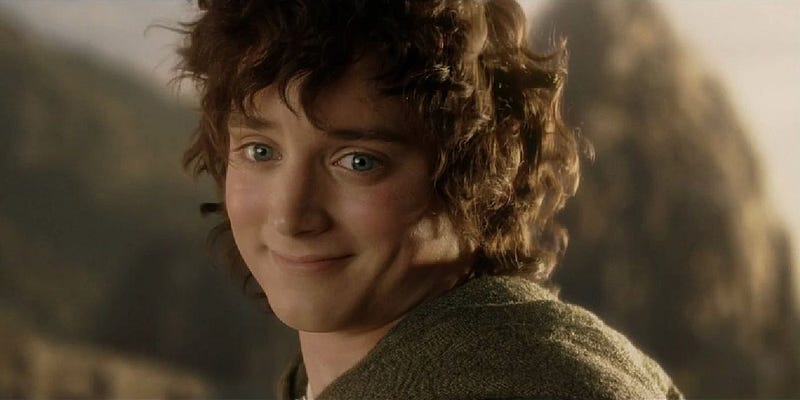
Elijah Wood as Frodo in “The Return of the King” (2003)

Tolkien’s work reads for many as ‘asexual’.

That’s not really tracking with the pregnant imagery of the plot. In the scene where Frodo seems to die of a spider bite, for example, a despairing Sam thinks of suicide. As LaFontaine observes, this seems to allude to a similar scene in Shakespeare’s Romeo and Juliet.

Then comes the weird scene where Frodo is taken by orcs. Brought up into a tower, his clothes are removed. In the movie, Frodo is just shirtless, but the books go further. When Sam comes to find Frodo:

“He was naked, lying as if in a swoon on a heap of filthy rags: his arm was flung up, shielding his head, and across his side there ran an ugly whip-weal. ‘Frodo! Mr. Frodo, my dear!’ cried Sam, tears almost blinding him. ‘It’s Sam, I’ve come!’ He half lifted his master and hugged him to his breast.”
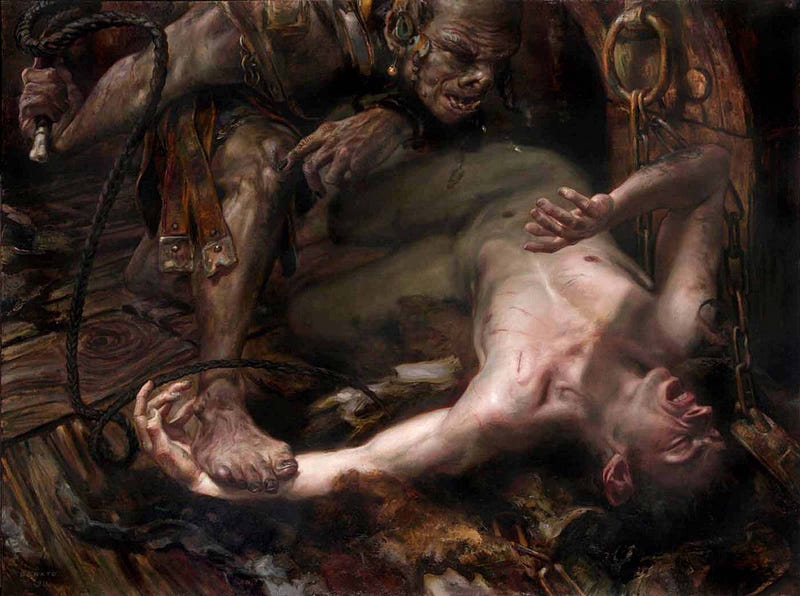
Donato Giancola, “Tower of Cirith Ungol” (2012)

Was Frodo gang-raped by orcs?

Frodo tries to explain how he came to be naked, but it’s just a series of very suggestive images. “I fell into darkness and foul dreams, and woke and found that waking was worse,” he says. “There was an orc with a whip,” and they were “pouring some horrible drinking down my throat” and “fingering their knives.”

I read that as male rape, presented allusively for a popular novel. The ‘horrible drink’ he’s made to ingest would be semen.

Cradling a battered Frodo, Sam is deeply moved to an emotional discovery.

“He shook his head, as if finding words useless, and murmured: ‘I love him.’”

In the movie version, after the ordeal at Mount Doom, Frodo wakes up in bed alone. In Tolkien’s version, Frodo and Sam are in bed together.

All the magical species seem a little ‘queer’.

The dwarves, as the dwarf Gimli notes, have women who look like the men! They’re never seen, alas.

The Ents, those tree-like beings, are all-male. We’re told the ‘Entwives’, one day, just left.

Even the two wizards seem a little—that way? As an aside, Ian McKellen was openly gay when playing Gandalf in the movies. My sense is that his example was, to the American public, the most meaningful example of any public person being openly gay.

The plot of LOTR can seem hazy at first.

I’d read the books and watched the movies before even grasping the basic action. A struggle exists between the two major species: humans and elves, which live in opposition. They can read as ‘male’ to ‘female’.

The humans are led by patriarch kings. Mothers are little seen and often curiously absent. The typical human father seems almost eager to destroy his sons, who can never be ‘masculine’ enough.

The elves, in contrast, are androgynous—feminine by human standards, almost ‘womanish’. Their language doesn’t distinguish between male and female.

They have male and female rulers, as Galadriel has lately come into prominence nearly as a goddess.

Elves have no ambitions to rule.

That leaves the humans able to take over, on the usual logic of patriarchy—that the most violent beings win. The plot begins when Sauron and Saruman, two magical overlords whose “two towers” seem like connected phallic peaks, hatch a plan to push back against the human threat.

By magic, they will create an ultra-violent elf hybrid species called the orc that will be able to crush the humans.

The orcs seem to be all-male, and birthed not from biological mothers, but by magic. (That the ‘eye’ of Sauron looks like a vagina from Hell is probably significant.)

The plan is a good one, in that the orcs quickly turn the ‘world of men’ into an endangered species. Galadriel and the wizard Gandalf, in a strategic bid to prevent Sauron from taking over Middle-earth, conceive an idea.

It’s desperate and unlikely.

These magical beings will work with a few humans to inspire them to take a step forward in cultural evolution. Humans must give up their violent ways, and adopt new values of community—feminine values of cooperation and respect for life. This will allow magical energies to empower their world.

The “fellowship” which starts The Lord of the Rings is a new political order in seed form. The effort is to get a few human men to learn a new way of interacting that is democratic and diverse.

And, as Hilary Wheaton analyzes the shift, we see an “old, dysfunctional patriarchy” in the human world begin to give way to a “new, fraternal patriarchy.”

Aragorn arises as a new type of man.

Quiet, polite, observant, not focused on power, with almost girlish, or elvish good looks, he’s different from other men. As Tolkien clarified later in the Silmarillion, Aragorn is not quite human. He is part elf.

But the key to Aragorn’s specialness is that he grew up without a human father. In his exile from the human world and acceptance by elves he learned magical abilities, like decency, wisdom and grace.

He seems to have a homoerotic appeal for the more ‘masculine’ Boromir. As LaFontaine notes:

“Boromir’s furtive glances at Aragorn communicate his erotic attraction to the man who starts out as his rival and becomes his inspiration.”

Aragorn seems to lack much sexual drive.

He gets a little flirty with Éowyn, but only a little. Finding herself rejected, she creates a male persona, ‘Dernhelm’. And he becomes the queer warrior able to kill a magical being, the Witch-king of Angmar.
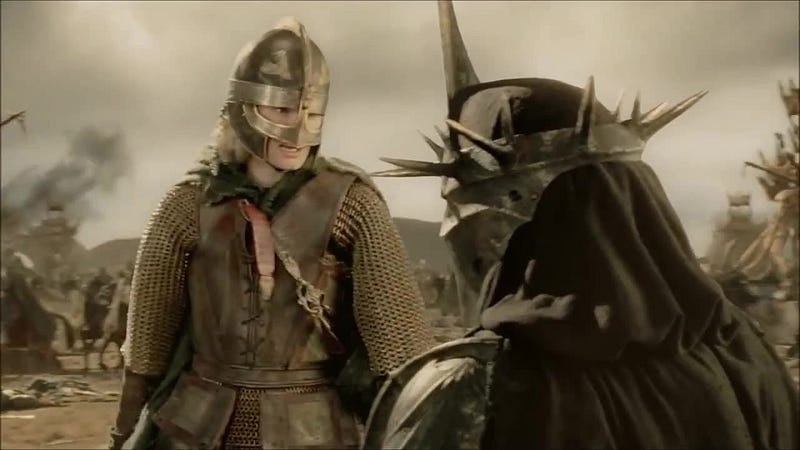
Miranda Otto as Éowyn/Dernhelm with the Witch-king of Angmar in “The Return of the King” (2003)

The humans must learn this mixing of states, an alchemy of male and female — which is magic! They must learn it quickly, or they won’t survive.

But it’s a power the Hobbits embodied from the start, and the fate of Middle-earth ends up being in their hands.
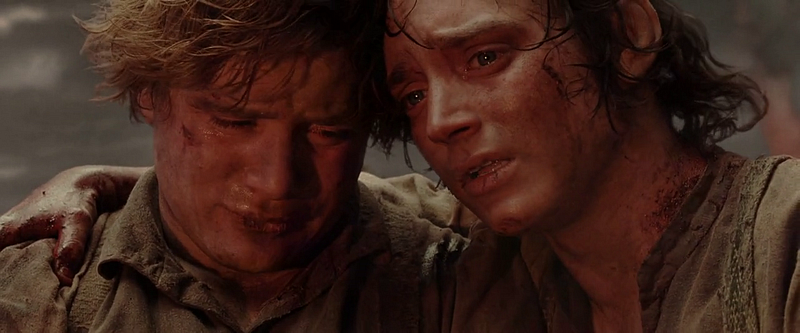
Sean Astin & Elijah Wood as Sam & Frodo in “The Return of the King” (2003)

In real life, Tolkien had a gay best friend.

The 2019 film Tolkien surprised with a story about the young John Ronald Reuel Tolkien and his friend Geoffrey Bache Smith. The director, Dome Karukoski, noted that a gay screenwriter on the project had read all of Smith’s work, and thought it a “100% fact that Geoffrey was gay.”

The resulting film became a kind of queer love story. There was talk of “Greek love” and long, lonely glances.

Smith was mortally injured in World War I, and spent his last moments of life writing Tolkien a letter, telling him to be a writer — “and may you say things I have tried to say long after I am not there to say them…”

I began to read The Lord of the Rings as a story about a gay man leaving something with his straight friend who had been his only love. Tolkien realizes that being a ‘man’—that great, commanding cultural script—isn’t everything. He realizes there’s more.

Without his friend, he’d never have known.
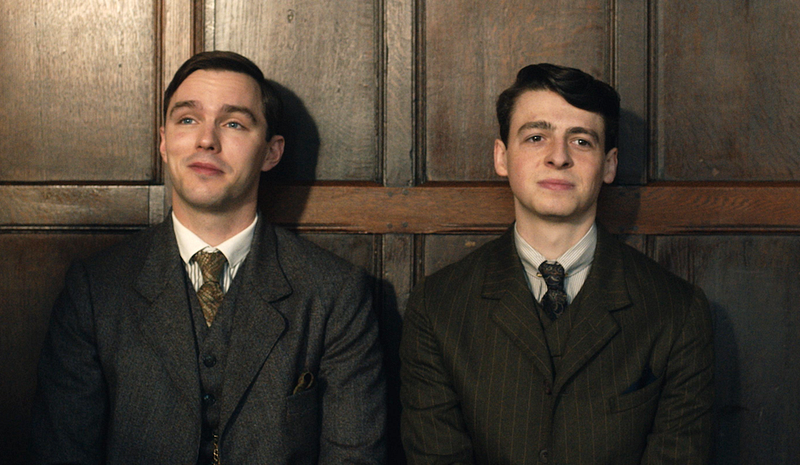
Nicholas Hoult & Anthony Boyle as J.R.R. Tolkien & Geoffrey Bache in “Tolkien” ( (2019)

We identify not with human characters, but Hobbits.

These little, gentle people are closer to who we are, inside. Meanwhile, the humans are mostly violent and mentally ill.

The orcs aren’t anyone’s heroes, but they represent typically human aspirations—war and conquest. As Jane Chance writes, they seem driven by a “repressed sexuality amid brute animality…”

And only the Hobbits, in the end, were able to stop them. The enormous effort depletes Frodo completely. Deeply wounded—pierced by a knife, a spider, orcs, and the story itself—he can’t continue in life.

Frodo leaves for the Undying Lands, as Sam lives out his life as a Hobbit. As per a note in Tolkien’s appendix, when his wife dies, Sam takes the last ship to the Undying Lands, to be with Frodo forever. 🔶

Books
Movies
LGBTQ
Sexuality
Religion
Recommended from ReadMedium