
Is Linux Truly The Best Privacy Alternative For The Average User?
Privacy concerns have soared in the public eye. It’s always been a topic of interest, but more so in recent years, after multiple global scandals. The line between conspiracy theories and soft-core surveillance has blurred more than ever, making privacy a much more global and mainstream topic.
Because of it, there’s been plenty of guides, articles and other resources popping up to inform users on their options when wanting to shift from big techs to privacy-focused options.
Recommended among them is Linux, as the main OS alternative to Windows and Mac OS.
From the perspective of a long-term Microsoft user, who has vaguely dabbled in Apple, Linux seems the most frontier, niche option possible. I think of it less as an alternative, and more as a stand-alone service.
Linux seems to have evolved alongside the two big names in the game, and while even Microsoft uses Linux for some of its services, Linux didn’t evolve as a commercial OS the way the two contenders have.
While the open-source aspect is precisely what drives privacy guides to quote Linux as an option, like we’ll see below, Linux can seem awfully too “tech-y”, too frontier, too isolated, and serve only awfully specific needs, that doesn’t leave a lot of space for the average user to make the switch.
The User Case
When I say average user, I mean the majority of people. I mean the overwhelming 70% of people who purchase machines that all ship with Windows, and get straight-forward and easy solution to their problems.
The average user, in this context, is someone used to things working right out of the box. They’re used to purchasing a computer and maintaining it, eventually updating it for parts, and have everything available when booting.
The average user, is someone with privacy concerns, who refuses for tech giants to harvest their data without their knowing or consent, but is otherwise too committed, whether professionally or personally, and doesn’t care or have time to develop the skills needed for that unnecessary learning curve.
Not everyone cares to become as knowledgeable as the average Linux user seems to be, because not everyone is personally interested and invested in that kind of know-how. Their lives centers around something else, and that’s normal. Which I believe needs to be said, as the most dire-hard Linux fans will have the audacity to blame users for not taking enough steps towards their privacy, rather than blame the actual culprit, when Linux, as we’ll see below, is hardly accessible right out the box.
And most people, though sincerely concerned about their privacy, and willing to pay money to make that happen, also want ease of use and accessibility, a standard that’s been thoroughly developed by our two commercial “options”, and that is so easily obtained nowadays, it no longer should be possible to part from it.
The real solution would be for a genuinely private alternative, as commercial and accessible as Microsoft or Apple are, to emerge.
And in this regard, Linux doesn’t seem as appealing to the average user as privacy guides like to pitch. Let’s take a closer look.
Linux requires a learning curve
Right off the bat, Linux seems confusing. If I were to describe Linux as an outside user, the word that comes to mind is tech-savvy.
I would describe it as something that tech-savvy users may prefer because it suits their needs better, and gives them more wiggle room to do what they need to.
Linux seems like a playground, a group project of nerds having a good time creating something techy. The community seems to be structured in such a way that users seem capable individually, meaning they would be expected to do most things on their own.
And from the perspective of someone who knows what they’re doing, that may be ideal. But from the perspective of a regular user, it’s easy to quickly be in over your head.
That image alone, not particularly polished to be inviting, can already act as a deterrent.
1. Distributions are confusing
When researching Linux as an OS, you’ll hear of several distributions, such as Ubuntu, or PureOS. That idea is so bizarre to me, it’s like multiple OS under one umbrella. The difference can be striking and discouraging to a first time user who has never heard of distros, and is used to a single or global OS per brand and a one-size fits all solutions.
After that bit is done with, the choice can also be overwhelming. Most guides recommend Ubuntu, but the amount of distributions make it feel like any random nerd can create their own version.
Because everything is so scattered, it feels like there isn’t enough effort that’s concerted on making at least one version as competitive and efficient as commercial options. Linux distros feel like somebody’s playground, instead of something as solid as, say, Windows.
2. Set-up doesn’t seem straight forward enough
Many people claim that installing Windows from scratch is as painful as installing a Linux distribution as their number one defence. And seeing as that rarely has to happen, since most people boot Windows after purchasing a new computer, that’s another Linux learning curve that can be intimidating to the average user.
This is the Ubuntu installation guide. I’m scratching my head in puzzled horror looking at it. The steps there, such as needing a USB stick to install it, seem incredibly old-fashioned to me, and something that would be more commonly required back in the days of Windows 7.
For someone who isn’t tech-savvy, it would require a genuine commitment to Linux to want to sit down and figure out this puzzle. Most people, you would find, don’t even have enough time on their hand even if they’d find the dedication.
In comparison, installing Windows takes a couple of minutes (yes, I heard, it’s just as bad if you’re starting from scratch). Installing a Linux distro onto a Windows computer takes proportionately longer: it’s an extra step. Steps can also differ if the OS itself is a bit more obscure.
Stick around to find out why machines that ship with Linux directly don’t automatically solve that issue.
3. Users are expected to be knowledgeable enough on their own
So if or when a problem arises, it seems the average Linux user is expected to take care of it themselves, or will know how to take care of it themselves. It seems more of a “left to your own devices” kind of place. There are always particularities to how such users interact with each other, and I’m fairly certain that an average user completely unused to that kind of atmosphere looking for help might struggle to find it. That makes you feel like if you were to run into an issue or glitch, it might become a much bigger hurdle than it has to be with Windows or Mac OS.
Everyone wants to know they can turn to someone competent to help. Since Linux users are expected to take care of themselves, they can hold their computing experience in their hands. Someone using a commercial option has the “benefit” (an arguable idea) of having dedicated forums with round-the-clock staff there to help with problems.
Linux is too isolated
It’s a cycle that feeds onto itself. Linux not being commercial in nature doesn’t get enough funds. Because of it, distributions are purely relient on community support, who, by definition, are likelier to make their products more viable for their own community than for a broader audience. Bringing me to my next point;
1. Linux is too niche
Often, articles recommending Linux state some of the following reasons:
- Linux is lightweight and can work on really old or slow machines
- It’s an alternative to people who can’t purchase a Windows licence
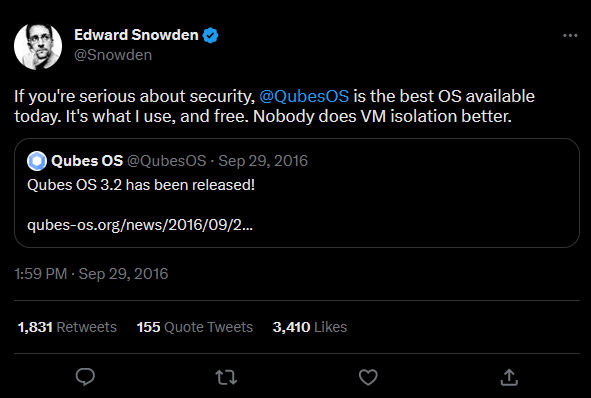
Or, in the context of privacy, it’s often stated to be more private and more secure. Because of the many distributions, there’s a solution to everyone’s most specific needs.
All of these pro-Linux arguments are incredibly specific, they fulfill very precise, rare user cases.
Most people don’t purchase a Windows license, they purchase a computer, that ship with Windows. Not to mention, that someone who can’t afford the cost, will usually just pirate their version.
Weaker hardware is a rare occurrence, because most people will replace a computer every 5 to 10 years, thus benefiting from updates, and I’m sure I’m being generous as I imagine some people likely toss their laptop far earlier than its true expiration date.
In the end, Linux fulfills very specific user cases. It isn’t privacy for the average user, who simply doesn’t want a massive corporation to spy on them, but otherwise wants to keep on living, it’s privacy for someone with a severe threat model. And someone with a severe threat model, isn’t the average user.
2. Linux is too isolated
1. Professional tools are missing
A regular user commonly uses an array of professional tools, from the Adobe creative suite to office packages, that are simply not available on Linux.
Predominant examples are Adobe and Office 365 (recently re-baptised as Microsoft 365).
Some guides like to recommend Libre Office as an alternative to Microsoft 365. There are several issues with this.
- The first one is that using MS may be expected professionally; an employer will typically want to know if you can use Excel, not Libre office’s version of Excel. And globally recognised certifications are for MS, not Libre Office, etc.
- Second, the online version of MS also doesn’t contain all the features the desktop apps do. That’s an argument commonly used in Linux circles.
- MS is updated more often. Libre Office closely resembles what Office used to be like back in 2007. And while Microsoft 365 has made some significant upgrades to their apps, Libre Office hasn’t evolved the same way.
Options for Adobe are more sparse, as the Adobe suite is so complex, complete, and well-funded, it is difficult to replace it the same way office suites are replaceable.
One such option was Gimp as a Photoshop alternative. As a regular Photoshop user, parading Gimp as a Photoshop alternative is a joke. One look at Gimp’s logo convinced me this would be a gigantic downgrade I didn’t need, and that most people would refuse to stoop to. There are online photo editors who already perform better than Gimp does.
Another alternative was Audacity for Audition. Having used Audacity, I can claim it’s useful, for a beginner. And is nowhere near as performant or complex as Audition if you need the software for something specific.
The final option was DaVinci Resolve as an alternative to Premiere Pro. DaVinci is most definitely a fantastic alternative, not only from a Linux point of view but from a professional point of view. However, because it itself has a steep learning curve, it’s a switch best made for professional reasons, and not in a rush to adapt to the harsher environment that is Linux.
2. Linux alternative programs aren’t modernised enough
When browsing the apps available for Linux, the choice is not only small, it’s also out-dated. Most apps in the Linux app library are old, haven’t seen a proper upgrade since 2007, and have better alternatives that can be found out there. LibreOffice and Gimp both have that issue as well, of looking like they have not experienced a massive modernity overhaul since 2007.
It effectively means switching to Linux is a complete downgrade in terms of app performances, variety and availability.
3. There is no guarantee softwares are always available on Linux
There is also no certainty that a software you just discovered and want to download will be available on Linux.
A commercial user doesn’t have that conundrum, because all corners of the industry cater to tech giants: all software are designed for Windows or Apple, just like apps are most always designed for Apple or Android.
That adds another layer of concern for a user looking to switch to more private alternatives.
All in all, software availability when switching from commercial options to Linux also leaves a vacuum behind it. It adds barrier for a user looking to switch to more private alternatives.
3. Linux can be expensive
I mentioned above that we’ll look at why computers that ship with Linux directly aren’t necessarily a solution to problem number 1.
In the case of computers that ship with Linux as opposed to Windows, the few machines that do ship with Linux, such as Purism’s Librem, are quasi non-existent. It’s definitely already interesting that we have real alternatives out there, of computers shipping with a different OS.
But because of their rarity, these options are proportionately more expensive than the average computer. That alone defeats the purpose of switching to Linux, since Linux being free is a major argument. But while it’s possible to purchase a small laptop (running Windows) for a cheaper price and still have a decent machine that’ll run for a few years, starting costs for Linux-running computers can be steeper (it’s definitely not more expensive than buying a Mac, however).
4. The Linux User Base Can Be Particular
The Linux user base also doesn’t take too well to criticism. I’ve seen eye-rolling, mind numbing backlash against these types of arguments, and opinions seem to be mixed; some vehemently disagree, and will find any excuses they can to rebuff arguments instead of answering them. Some agree, despite being Linux lovers.
The wedge between Linux fans/users vs everybody else seems massive to the point Linux users don’t particularly understand when what they’re saying constitutes above-average tech knowledge, and when it doesn’t. The community is used to being closed-off, and they do not particularly understand what can be a barrier to entry to other users.
While not being a major factor, it can be a bit of a turn off when trying to interact with the community.
Conclusion
All in all, when going at it strictly for the sake of privacy, and from an average user’s perspective, Linux is a severe, impossible downgrade. It is not a decent private alternative for the average user. Switching to Linux means having to give up a ton of functionalities and trade them for something worse.
All average areas of services have been covered by our renewed interest and need for privacy. We have tons of cloud storage options, solid email clients, dozens of note taking apps, even analytics tools, that are all private, and solid alternatives to anything Microsoft or Google.
And in the case of VPNs, we understand that they serve two types of users: the ones who just want to bypass region blocks, and the ones with bigger concerns. We understand there’s the average user, and the big threat model user.
But in the case of operating systems, we have nothing. We have, at best, guides telling users to tweak their Windows privacy settings, which is called settling for less, and isn’t a solution.
Linux, is, at best, a massive threat model user option. It is so niche, so specific, it fulfills the needs of a very specific sub-category of users. It is not market-ready in that sense. It is not an alternative for the average user, who just wants privacy out of the box and has very little head space to think and tweak to obtain it, and shouldn’t be paraded as such.
It all boils down to, why should one sacrifice comfort we’ve painstakingly achieved and go back to square one, when all that’s missing is one single feature, and it would be easier to bring over that one feature?
The technology behind big techs is otherwise great. It works. We have made great technological strides in the last decades, and that’s progress for all of our modern world; why should anyone ever give that up? Because some people can’t be bothered to respect basic human rights?
Privacy is one feature, and as such, it’s (arguably) easier to bring privacy over as a feature, rather than to go for a service that has privacy as its core, but is stripped of absolutely everything else.
It is also true that, just like guides will recommend tweaking Windows’ privacy settings as the solution, recommending Linux is done by people who can’t simply admit there are no good options out there to be as performant as Windows or Mac OS, but to be just as private as Linux.
Because to choose Linux for privacy is to give up on nearly everything else, on all the ease of use that is a common standard everywhere else. It’s like going back to the ice age. To give up on progress for the sake privacy is something that most people can’t or won’t do, and shouldn’t really be asked to do (as an answer to the argument: “it’s your fault if you don’t take care of your own data being private”).
Which, in the end, leaves us no closer to finding proper private alternatives, for people looking to make a switch from big techs.
If you enjoyed this article, join the discussion on social systems, on cancel culture and on privacy. & if you’d like to contribute to my work, I would be thankful for your donation~


