
Is Jonah Hill Really The Best Spokesperson For Body-Positivity?
People didn’t begin praising his voice until he made noise about how it affected HIM personally
Let me start out by saying that I am a fervent proponent of body-positivity. My own body is riddled with extra fat cells, stretch marks, cellulite, and acne scars — and many of those blights are considered “abnormal” for a male person. If I had unlimited finances and technological access, I’d expunge these markers of self-consciousness as quickly and painlessly as possible. So the last thing I’d expect from a spouse or a lover is for him to embody some immaculate template of “beauty.”
And, on another level, regarding my platonic friends or close familial peers: I want them to be able to feel open and comfortable about their own bodies, as well. If we’re friends, I don’t expect you to have pristine skin or a gorgeous figure. I’m satisfied with our intellectual and spiritual connection.
The same goes for complete strangers who are just minding their own business. I make it a practice NOT to comment on the appearances of random people by whom I pass on the street or colleagues and acquaintances whom I barely know.
When dealing with prejudice, bigotry, and discrimination based on conventional standards of beauty, many people refer to it as “lookism.” I find this term to be extremely contrived and awkward — what I’d refer to as a “faux-noun.” So I prefer to confront appearance-based discrimination on a case-by-case basis.
Genetics. Height. Weight. Scarring. Elasticity. Hair texture. Inflammation. Glands. Follicle blockage. Peduncle tissue.
It’s different for everyone. But these factors can have a major impact on most of us, across all demographic groups. They occur in a variety of manifestations and combinations.
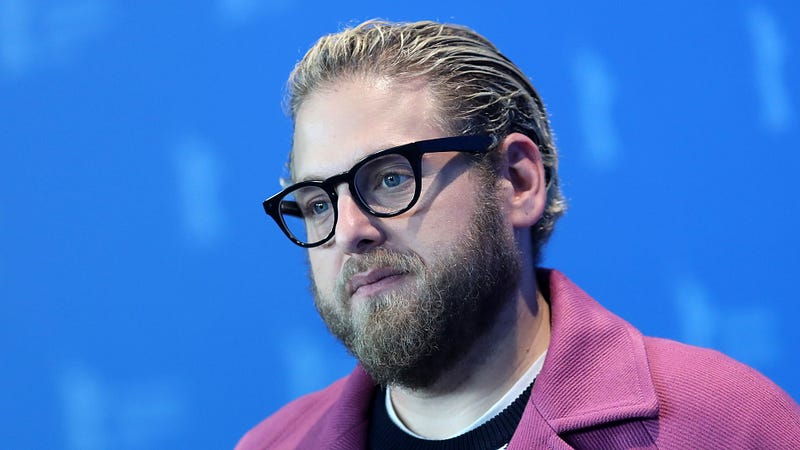
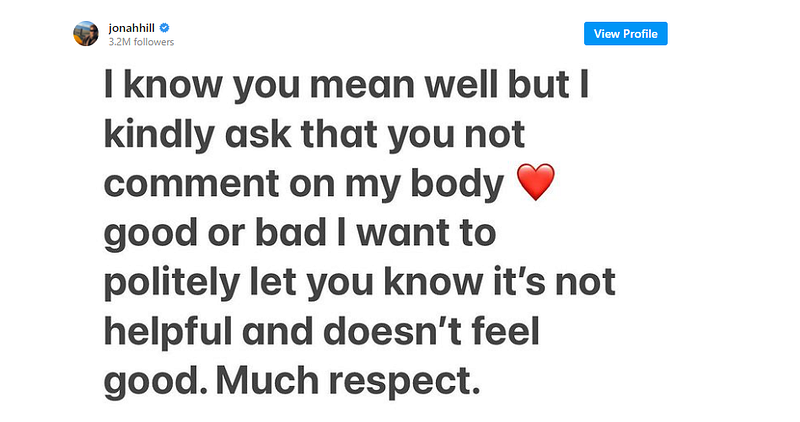
A social media uproar surfaced on October 13, when actor/comedian Jonah Hill made an Instagram post asking people (fans and critics, alike) to stop commenting on his appearance.
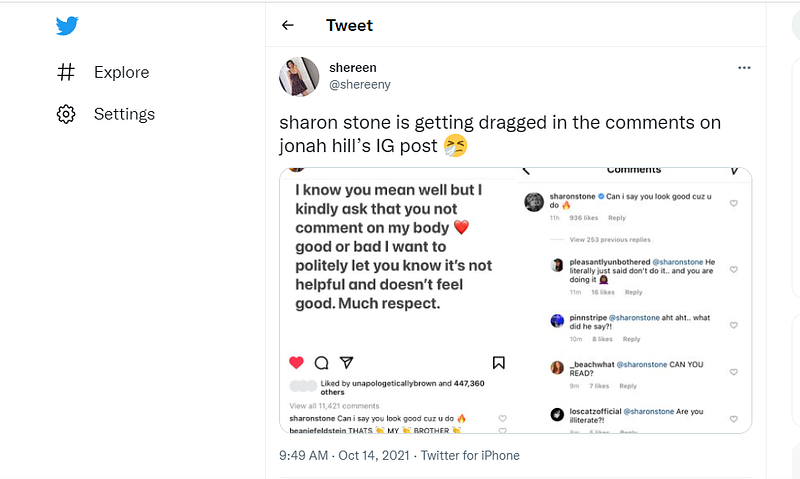
In response, actress Sharon Stone promptly ignored him, and she proceeded to openly compliment Hill on his body. Observers called her out, reminding Stone that she’d missed the point.
So here’s my first question: why is Jonah Hill using Instagram to voluntarily post photos of himself for the masses? If he’s (understandably) self-conscious about making his private life public, then nobody is forcing him to remain on social media.
Secondly, this is the same Jonah Hill who, during an October 2018 appearance on The View, engaged in frail virtue-signaling when cohost Meghan McCain praised him for speaking out about body shame. Hill said:
I mean, I don’t use terminology like that, because it kind of sounds a little like…I don’t want to be ‘victimizing’ myself in any way. And women, first of all, have it way harder than I’ll ever have it in my entire career or life, right?
Um, no, Jonah. Each person’s journey grappling with cosmetic degradation is their own cross to bear. You don’t get to tell other boys/men who are “ugly” or overweight: “Hey, my fellow dudes, count your blessings!”
Before you blowhards in the peanut gallery accuse me of taking a so-called #AllLivesMatter position: of course we shouldn’t ignore systemic misogyny, and there’s still a great need to dismantle systems where women are objectified and subjected to professional inequities. Most feminists would probably agree that demolishing patriarchal standards of “beauty” for women will, in addition, also demolish those same unattainable standards for men and nonbinary people.
At least, one would think it should. In theory.
Long-overdue public awareness campaigns on this front have been underway. Among the most notable is the #SeeHer Initiative, which strives to promote accurate portrayals of girls and women in media and advertising. This includes onscreen, in print, and across digital platforms.
So if Hill meant to specify that there is a systemic element to unattainable beauty that is particularly hostile toward female persons — then, yes, I’d agree with that nuanced point.
However, I’m not so certain Hill considered such nuance when he groveled to the ladies of The View, three years ago.
Cosmetic discrimination is often social and cultural, in addition to systemic. Furthermore, when people of every sex or gender are ogled at school, in the workplace, or during our leisure time, it can be far more complicated than the vagina/penis binary. It intersects with not just sex and gender, but also with race, age, sexuality, religion, and ableness.
MSNBC’s Liz Plank mirrors this paradoxical duality. On the one hand, in her October 18 editorial piece reacting to Hill’s viral Instagram request, Plank exhibited a tone-deaf conventional view that minimizes the negative effects sizeism has on men, when we experience it. She does, nevertheless, make valid points about the systemic misogyny of social media.
Plank’s overarching point, here, seems to be that feminism should provide a gender-inclusive vehicle for ending our propensity to body-shame women and men alike. She emphasizes how it’s patriarchy that has created eating disorders and the corporatization of body image; thus, if we reject those preordained “virtues,” everyone can attain healthier body images all around. Plank caps it off by praising Hill for illustrating how people in general have equal stakes in the body-positivity battle.
The same Jonah Hill who wants to reassure “ugly” men — “Hey, at least you’re not an ‘ugly’ woman.”
The same Jonah Hill who, in a GQ interview from this past August, casually owned the fact that he is addicted to Instagram and its hypocrisy.
And then he goes on THAT VERY PLATFORM to tell people who are visiting his social media profile designed for him to share pictures of himself that they need to stop commenting on those pictures of himself that he is voluntarily posting.
Last February, The Daily Mail infamously posted photos of Hill toweling himself off while shirtless after surfing in Malibu. On that beach, he showed off his tattoos to the camera.
Then, he reposted The Daily Mail’s photographic ambush of him by writing:
I don’t think I ever took my shirt off in a pool until I was in my mid[-]30s even in front of family and friends. Probably would have happened sooner if my childhood insecurities weren’t exacerbated by years of public mockery about my body by press and interviewers. So the idea that the media tries to play me, by stalking me while surfing and printing photos like this, and it can’t phase me anymore[,] is dope. I’m 37 and finally love and accept myself. This isn’t a ‘good for me’ post. And it’s definitely not a ‘feel bad for me’ post. It’s for the kids who don’t take their shirt off in the pool. Have fun. You’re wonderful and awesome and perfect. All my love.
Yes, he’s speaking to those same repressed, ostracized, tormented men and boys whom — two-and-a-half years earlier — he’d just lectured about how grateful we all should be that we’re not women or girls.
I don’t blame Hill for being irked at the paparazzi. I think tabloid photogs are shameless and disgusting in their violations of public figures’ boundaries. But it’s rather telling how Jonah Hill didn’t begin lending a sympathetic voice to exploited male body image until the cameras and megaphones began dogging HIM as an individual.
For someone who “loves and accepts himself” and claims he “isn’t phased” by it, Hill seems fairly hostile toward his groupies on Instagram — again, a platform explicitly intended for SHARING and GAZING AT photographs of people.
And then, BuzzFeed’s Vannessa Jackson refers to Hill as “a national treasure.”
Uh…hardly.
So what I want to see from Jonah Hill is more substance. Is he willing to devote some time to mentoring boys who grapple with a diverse array of bodily insecurities? How about starting an organization that nurtures young boys (and teen boys) to reject shallow portrayals of the human body — whether it’s love interests, buddies, or classmates. Will any of his upcoming projects feature male characters of various ages and backgrounds who discover self-worth amidst a superficial world where only those dudes with muscular, athletic, or skinny physiques are valued?
I’ll wait and see. But, somehow, I’m not holding my breath.


