
Is It Wrong to Wear Day of the Dead Face Painting if You’re Not Mexican?
How To Avoid “Deadface” This Season
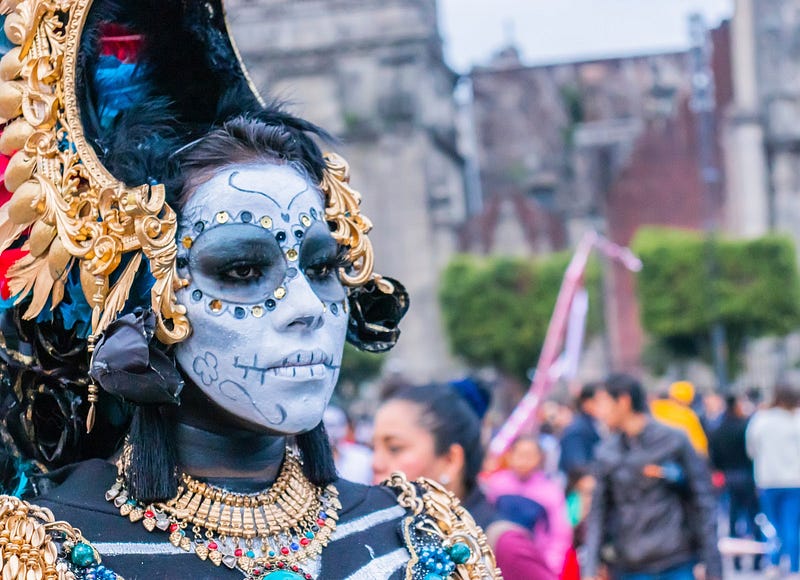
Día de Muertos, or The Day of the Dead, is a celebration, between October 31st and November 2nd, of our human connection to our ancestors. In Mexico, it is also a national holiday. Because the festivities find their roots in Aztec and Mayan beliefs about the afterlife, some have thought that only Mexicans can celebrate it.
Is that right? If people of non-Mexican heritage dress up, paint their faces and so on, are they participating in “dead face?” That is to say, a cultural misappropriation or act of discrimination akin to “blackface?”
The answer is not necessarily, but maybe. As one, of many, Mexican users of Reddit responded:
Instead of being offensive it’s rather flattering to see that people from other countries are interested in our culture. I guess the only important thing is to always be respectful and use the golden rule: treat others the way you’d like to be treated.
This view is shared, as far as I can tell, nearly universally by Mexicans. So if you want to paint your face, dress up, make a little shrine to your ancestors, and give them ofrendas, then go for it. Just do it in a respectful and earnest way.
Of course, everything hinges on what you mean by “respectful and earnest.”
Since I am Mexican-American, my professional area of research is ethics, with an historical area of focus on pre-Columbian Mesoamerica, by chance I find myself in a position to speak in an informed way about this topic.
In this piece, I’ll explain the ethical principle that makes sense of what is a respectful and earnest participation in the Day of the Dead celebrations and I’ll give you some details you can use yourself.
The Ethics Behind Inclusive Practices
You could be forgiven for thinking that there is no principle at work here, that it’s just a matter of whether the majority of a social group happens to be offended by the idea.
You might be thinking: North American original peoples are offended, so headdresses are bad, but Mexicans are not, so Day of the Dead face paint is good.
Despite that impression, there actually is an ethical principle at work here, and it’s not “majority rules.” Its respect for equal persons, which is also called the dignity principle (I’ll use them interchangeably).
There are quite a few ways to spell out what dignity means, so I’ll just take the fastest route here. At base, respect for equal persons just means that you hold that each person, insofar as they are a human, has equal moral worth.
This conception entails that, because people can use reason for themselves, they are able to set their own life goals. Usually, this implication is called “autonomy,” which literally means self-rule.
Autonomy is useful in many contexts. For example, it explains why medical researchers should not be allowed to perform operations on your body without your informed consent. If they did, they would be violating your bodily autonomy.
Respect for equal persons also entails that because people can think of their own goals, then collectively they can articulate a conception of the good life, provided it’s consistent with autonomy. That conception defines what the pursuit of happiness means for a people, what they think of as noble, private, and intimate (among other points).
For example, in the 1950s in the United States, when a woman wore a bikini, it was considered rather scandalous because it exposed what was thought “private.” Today, no one cares — though they certainly do in other parts of the world.
The point is two-fold: that people collectively foster a conception of what is considered good, noble, and intimate … and those conceptions change over time.
To apply these ideas, Native American peoples hold that headdresses are sacred items, to be worn at certain times and at certain places. That’s part of their conception of the good. As long as their practices are respectful of other people, the dignity principle entails that we should respect their views (even if it’s weird to us).
It follows that wearing those headdresses without explicit permission is like walking in on a person showering, or (even more appropriately) desecrating a church.
Mexicans do not think about Day of the Dead in that way — it is not a sacred activity only to be performed by a few. So you aren’t immediately desecrating anything if you dress up for Day of the Dead.
But participating in the activity is still like walking into someone else’s church. Just because they let you in doesn’t mean you get to use it as your private urinal. You are being let in under the assumption that you will be respectful when inside.
How to Respectfully Practice Day of the Dead
The key idea in being respectful is that you recognize that the Day of the Dead is about maintaining and celebrating your relationship with your ancestors.
Too briefly, the Aztecs believed that one part of your “soul” survived you in the afterlife. They called it the yolia, and it was a force that retained (some of) your character traits.
For most of us (apart from those who died gloriously in battle), our yolia had to make a four-year journey in the underworld, called Mictlan. This was a treacherous journey. We were each given a little yellow dog to accompany us and would be sustained by the offerings that our relatives made.
After four years, your yolia finished its journey and would merge with the fundamental energy of the universe, called teotl.
All that remained of us was the power attached to our names (called tonalli), which could be summoned back if another person assumed it for themselves. That’s why so many Mexicans insist on naming their children after ancestors — I have 7 relatives named “Luis” in my fairly immediate family, for example.
Even if you don’t believe all that, and most contemporary Mexicans don’t, then you can at least think of the practice as a way of maintaining your relationship with your ancestors. Here are some ways to do that which will make your face painting more meaningful.
Practice Remembering
If you decide to throw a Day of the Dead party, themed with sugar skulls and all, ask people who come to bring a picture (probably on their phone). If you’re doing it for children, parents will likely need to bring them.
Then at some point have the people tell the story of why that person is important to them.
My wife Elyse, likes to tell this story. Her grandmother (on her father’s side) never got to finish her Ph.D. So as she worked a variety of jobs, mostly as a teacher of French and the violin, she saved up what she could. When she received a small amount of money as her inheritance, instead of spending it on herself, she gave it to Elyse for her university studies.
When she was at that stage in her education, Elyse of course did go to university on scholarship and used those funds to help with living costs. Then, as her grandmother had wanted to do for herself, Elyse continued until she did earn a Ph.D.
Though she’s of Irish and Norwegian heritage, then, Elyse uses the Day of the Dead to remember her grandmother who supported her.
Practice Gratitude
Another way to sustain your relationship with your relatives might be to write them a letter of gratitude.
I have my students do this just so that they can practice something that will bring them joy. About half of them cry — the men too — but they are happy tears.
The assignment is to find someone in your life that you haven’t thanked properly, write a letter to them expressing your gratitude, and then read it to them face to face. My students then have to write up a one-page reflection on the process and turn that in along with the letter.
To practice that for Day of the Dead, you could try a more poignant form of the activity. Pick someone who passed, who you never thanked properly, and write them the letter. Then read the letter to a relative who was close to that person as their proxy.
While strengthening your bonds with those involved, this practice will also help you in grieving.
And if you carry something of the attitude of these practices with you in painting your face, then you’ll be making an ofrenda of the right sort and participating respectfully.
¡Viva México!
I am just old enough to remember my relatives in Guadalajara who, on September 16, used to raise a glass of tequila and say “¡Viva México, hijos de la chingada!” That can’t be translated into English or even Castilian Spanish. And if you’re not of Mexican heritage, it’s not a practice for you to adopt or dispute anyway.
Not all things from Mexico, then, are open to adoption by members of other cultures. The Day of the Dead is.
But knowing that isn’t enough to avoid falling into “deadface.”
This is a practice of remembering your past and your ancestors, not an activity simply to signal your virtue or garner attention through social media.
The traditional practice includes not only face paint and costume, but a vigil set up in memory of those who passed. I’ve tried to suggest two ways to help you deepen your connection with your ancestors — ways that aren’t part of the Aztec original practices, but which develop your attitude in the right direction.
Usually, I close my essays with a statement about the value of the points in the piece. In this case, I think that value is reasonably clear. We all have people who have come before us who mattered and contributed to our lives. If you want to use the Day of the Dead to reconnect with that person and express your gratitude, then do it.
Our complex world changes quickly so that we’re often unsure whether we are being respectful of other peoples’ cultures. But if you take the right attitude towards the Day of the Dead, you’ll not only reconnect with your friends and family, you’ll be engaged in the process of connecting global cultures.
I’ll leave you with a final quote from a father to his son as he concludes his advice on the art of living well. It is taken from the philosophical literature of the Aztecs called the Discourses of the Elders.
May I be an appreciated old man and forefather. And in the same manner as the Lord is satisfied, so too may I be, by my blood and color (H 75, 354).
For more philosophy as a way of life, using all of the world’s traditions, join my newsletter.
Sebastian Purcell’s research specializes in world comparative philosophy, especially as these ancient traditions teach us how to lead happier, richer lives. He lives with his wife, a fellow philosopher, and their three cats in upstate New York.


