
Is It Wrong if No One Is Watching?
The Shopping Cart Theory and ethics
Today, we went to the grocery store. After unloading our groceries, I walked to return the cart and saw this…
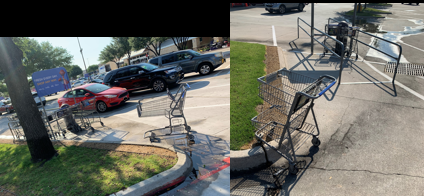
While this is not a monstrous atrocity committed against the store or nature, I thought about if it was ‘wrong’ at all…
Is there an ethical obligation to complete mundane actions that appear to hurt no one? Is breaking a social contract (e.g., I will use your cart and bring it back to a designated location when I have finished) acceptable if it appears to harm no one? Do you get partial credit for sort of completing the contract?
I just finished How to Be Perfect by Michael Schur. He brings a Sitcom writer’s wit to discussing and understanding ethical philosophies (Schur is the creator of The Good Place and co-creator of Parks and Recreation). After taking the reader through the main schools of thought concerning ethics (Utilitarianism, Deontology, and Virtue Ethics), he dedicates an entire chapter to what is most commonly referred to as “The Shopping Cart Theory.”
The Shopping Cart theory is an ethical thought experiment. Similar to the Trolley Problem, but not near as famous (infamous?), the theory proposes to identify a person’s moral character by how they behave when no one is watching.
Do you return your shopping cart?
You just finished unloading your groceries, and it is snowing (or 100+ degrees like it is right now in Texas). You have been running errands all day and just want to get home. The cart drop-off in the parking lot is facing the other aisle 15 spots away. But there is a perfectly nice curb right here. And most importantly — no one is around.
What do you do?
If you ask someone this question in public, they will tell you they always take it back. Maybe they do. Or maybe something called Social Desirability Bias is taking hold of their answer.
When you ask a person if they have ever stolen, cheated, or committed any type of traditionally wrong behavior, their instinct is to lie about it (if they have). They desire to answer the question in such a way as to not be negatively judged. They also desire not to be viewed as a person who does those things. They want to look good in front of others.
So, privately…What do you do with your shopping carts?
Social Contract
As a kid, I still remember being told that I had to return my toys to the toy box when I was done playing with them. It was one of the rules of playtime.
I learned as I played with other kids in their homes that this was a pretty consistent rule.
Super Nintendo and Sega Genesis were the gaming consoles of the time, and we loaned our games constantly. I can’t tell you the number of times I borrowed Donkey Kong or Boogerman (yes…that was a real game). But, it was always understood that I would return them.
This is something called a “Social Contract.” Essentially, there are rules that are either implicit or explicit, and we subscribe to them as part of an organized society. Returning what you are loaned is a pretty common social contract, even for children.
Why, then, do we sometimes break those contracts? Do we feel it is negligible that no one is being harmed? Could it be that we are exhausted? Or maybe just being lazy?
Social contracts exist for the general betterment of those in society. I was able to play twice as many video games because I would return them. If you loan someone money, and they never pay you back, a broken social contract can destroy a relationship.
For our example, my grocery store allows me to borrow their specialized food procurement storage bin to ease my shopping burden. I can now purchase as much as I need for the week. They even paid additional money to design, build, and strategically place more accessible return stations. Yet, many people still put in minimal effort, if any, to honor their end of the social contract.
“But, the store hires people whose job it is to collect those carts...”
Wouldn’t it make that employee’s life and their job just a bit easier to be able to collect the carts from the collection cart? They are out in the snow or blistering heat for hours every day collecting peoples’ broken social contracts; don’t make it harder on them.
The price of your butternut squash and Red Vines bulk pack does not include the price of making someone else’s job more difficult because you ‘don’t feel like it.’
This expands even further. Your tip doesn’t give you the right to treat your server like crap. Your delivery order is hardly ever late because of the driver. That customer service rep on the phone isn’t the one responsible for your internet being out.
How you do anything is how you do everything.
This quote has been attributed to many separate sources, and it fits perfectly. Why do some people take the easy road when they believe that no one will find out? Is it a form of moral exhaustion?
I recently reread Ryan Holiday’s book Ego is the Enemy. He challenges the reader to spend some time introspecting on their own beliefs and personal ethics. It seemed fortuitous that I would come across this quote within a week of taking the opening picture:
It’s not about what you can get away with, it’s about what you should or shouldn’t do.
Do you HAVE to return the cart to the shopping cart drop-off point? Maybe, maybe not.
But, should you?
For those of you who are not fans of 90’s sitcoms, I may lose you in this next section. For the rest of us…you’ll get it.
There is an episode in season 6 of Frasier where Niles is in the middle of his divorce lawsuit, and Maris is claiming alienation of affection; Niles was in love with Daphne, not Maris. It appeared that Daphne and Nile’s lawyer were the only ones not aware of this fact.
Frasier was informed that he would be deposed and that he would be asked specifically about Niles’s feelings toward Daphne. This will be under oath. Niles immediately assumes that he has lost the case, even accepting that it may, in fact, be true — maybe his secret feelings for Daphne negatively affected his marriage.
Martin, a former cop, pulls Frasier into the kitchen to pressure Frasier to lie.
Oh, for God’s sake,[Frasier], nobody’s even gonna know!
Yes, but that’s the point! Ethics are what we do when no one else is looking. For heaven’s sake, I learned that from you.

Do you return the cart, real or metaphorical? How about when ‘nobody’s even gonna know’?
The more you practice something, the easier it becomes. The easier an action becomes, the easier it is to do the next, higher-level action.
Those small, seemingly insignificant breaks in our virtue add up. They train you to think, “Oh, I do X all the time, so X+1 is fine.”
You will have difficult choices in your life to make. How do you know that when the time comes, you will make the right choice?
Practice doing the right thing, even the small things. It prepares you to do the same when big things inevitably arise.
If you haven’t yet, please sign up for Medium.com. You have unlimited access to articles written by a variety of experts and help support writers all over the world for only $5 a month.