
Is it wise to ban ChatGPT?
Some days ago, The New York City Department of Education has announced a ban on the chatbot ChatGPT, citing concerns about its negative impact on student learning.
ChatGPT is a chatbot technology developed by OpenAI that uses natural language processing to generate responses to user queries. It is designed to simulate human conversations and respond to user input in a natural way, and in multiple languages such as English, Spanish, French, German, and Italian.
In its latest versions based on the GPT-3 model, ChatGPT demonstrated mind blowing capabilities and raised concerns on its possible use by students. Indeed, it might make solving some problems quite “easy”. This is an example on solving a differential equation :
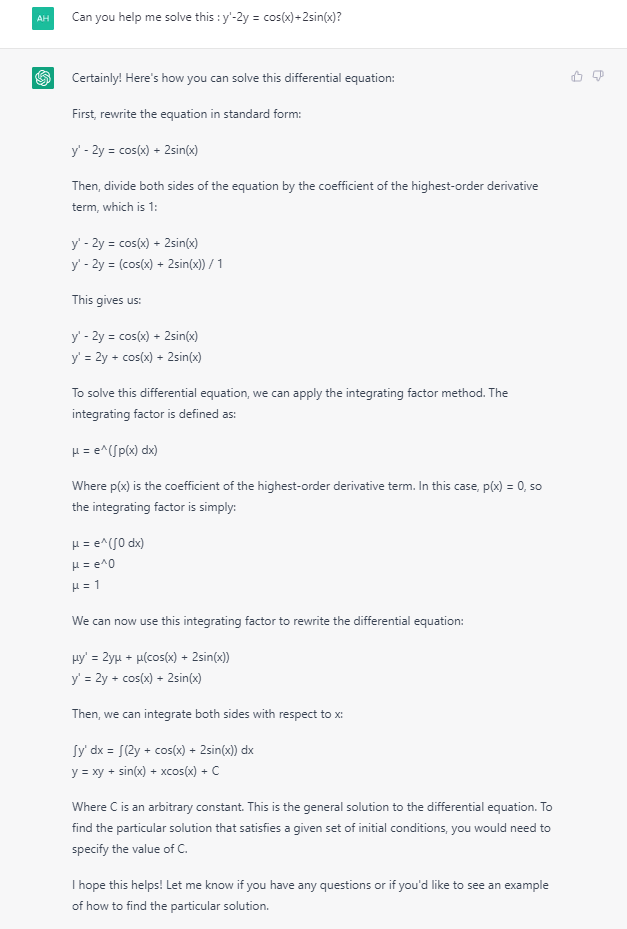
Of course, the capabilities of ChatGPT are larger than simply helping students solving differential equations, it can help globally solve math problems and explaining the different steps, it also help writing code, explaining concepts, proofreading and writing essays.
However, proceeding with a ban of ChatGPT (or tomorrow other AI tools), feels like a primitive reaction.
This reminds us of the invention of the calculator. It was a significant technological development that revolutionized the way people perform mathematical calculations. However, with retrospect, calculators help made learning experiences better. In fact, the calculator was initially seen as a threat to traditional math education, but educators eventually recognized its value as a tool for reinforcing and extending classroom concepts.
We can make the same parallel, with other inventions or tools, like computer-assisted writing tools that are widely used in academia to help students improve their writing skills and efficiency, or more recently, ChatGPT.
I think it is “fine” that some people may have concerns or objections to the use of GPT, other language models, or other AI technology advances, however we should innovate in finding ways to integrate such technology advances in the study curriculum rather than (trying) excluding them.
Education Institutions should not ban the use of ChatGPT, but instead should find ways to incorporate them into their programs. This could involve teaching students how to use these tools to their advantage, for example to research topics, answer questions and potentially even support in the development of tasks and projects. ChatGPT provide students with a unique opportunity to engage with technology in a meaningful way, and it is important that institutions find ways to make the most of this.
If you want to learn more about ChatGPT and how to use it, feel free to follow this Udemy course


