
Is it Trite to Say ‘Count Your Blessings’?
The biblical standard for choosing gratitude
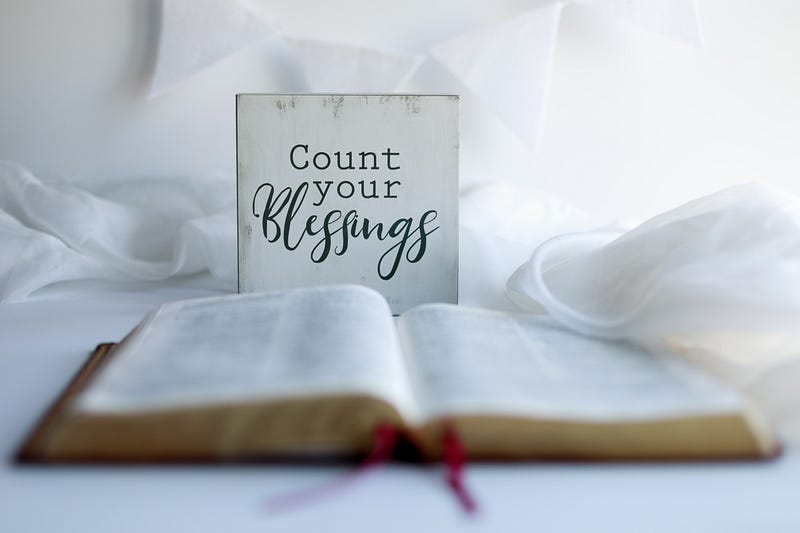
“Count your blessings, name them one by one. Count your blessings, see what God has done.”
It’s a catchy tune to a hymn I’ve heard many times in church. I like it but I didn’t always do it. Instead, I often complained and counted what I didn’t have.
But learning the practice of gratitude has changed me. It’s sometimes toted as a catchy, self-help tactic, but the practice of gratitude is a spiritual practice and one that pre-dates talk show hosts and self-help gurus.
God taught His people to count their blessings when He instructed them to recall all that He had done for them. To talk about such things when they were walking with their children along the riverbanks, or tucking them into bed at night.
Fix these words of mine in your hearts and minds; tie them as symbols on your hands and bind them on your foreheads. Teach them to your children, talking about them when you sit at home and when you walk along the road, when you lie down and when you get up. (Deuteronomy 11:18, NIV)
He told them to talk about the blessings they and their ancestors had experienced by calling them out in the assemblies when they were together.
The people often marked ways that God provided for them like the example in Joshua 4.
After the Israelites had crossed the Jordan River safely, Joshua instructed twelve men from the tribes of Israel to gather up twelve stones from the river and place them on the riverbank as a memorial to God’s provision in that place and time. An early version of a gratitude journal!
In the future, when your children ask you, ‘What do these stones mean?’ tell them that the flow of the Jordan was cut off before the ark of the covenant of the Lord. When it crossed the Jordan, the waters of the Jordan were cut off. These stones are to be a memorial to the people of Israel forever.” (Joshua 4:6–7, NIV)
Most importantly, He ensured that they wrote down these important memories so future generations could know what it meant to count their blessings.
We tell stories to our children and grandchildren so they have a hook to hang their faith on. And embedded in this storytelling ritual is the blessing counting.
When we didn’t have two nickels to rub together, God gave us a miracle. When you were born you were very sick but God healed you. This house? It was a blessing…and on and on the stories go.
Count your blessings could mean that you literally sit down and make a list of one-hundred things you have to be grateful for. If you’re in a dark place, you could start with the basics: I am breathing, I can walk, I can write this list.
Ann Voskamp made the gratitude list popular when she wrote about her journey in One Thousand Gifts, her reflection on finding her way through the mundane to the glorious by keeping a list of 1,000 things she was grateful for.
When I am in a joyful and playful mood, my list sounds something like Maria’s from The Sound of Music: raindrops on roses and whiskers on kittens.
And when I’m struggling it is a way for me to remember that God has come through for me before and He will again: you healed my son, my husband’s back is better, we have money to pay our bills.
But listing things to be grateful for can start to feel trite and we might be tempted to give up our gratitude practice for trendier spiritual strategies. Like God’s promises, which are eternal and readily available to all, gratitude never ends.
Try moving from list-making to representing blessing counting in tangible ways
Reach out and touch someone. When you recall a kindness someone has done for you, reach out and thank them. Send a note or find them on social media and reconnect. Recycling the feelings you had when that person helped you will reboot the gratitude chain in your heart and mind.
Pay it forward. When you remember something that meant so much to you, turn it into action. Recently, I sent off a check in a Christmas card to my niece, a single mom who has persevered through some difficult times to build a stable home for her children. I too have been the recipient of surprise checks in mailboxes during times of struggle.
Honor like kindnesses in return. Did you receive a meal when you were sick? Who needs that kindness now?
Are you touched by someone’s writing or craft? Show them by purchasing their work. Artists and writers put their hearts into their work. If you’ve been blessed, bless them back.
And maybe most importantly, tell everyone what God has done for you! Healing, freedom from addiction, the restoration of your marriage, God finding you when you couldn’t find yourself. Go tell it on the mountains, over the hills, and everywhere.
Don’t be shy about counting your blessings in public — that’s how we glorify God.
Use your gratitude practice as a springboard for action. Move beyond the pages of list-making and blessing counting and pour hope into a world that does not see the value of counting their blessings.
It’s not trite to count your blessings, not at all. It is the key to unlocking the presence of God, like a secret password into a special club.
On your feet now — applaud God! Bring a gift of laughter, sing yourselves into his presence.
Know this: God is God, and God, God. He made us; we didn’t make him. We’re his people, his well-tended sheep.
Enter with the password: “Thank you!” Make yourselves at home, talking praise. Thank him. Worship him.
For God is sheer beauty, all-generous in love, loyal always and ever. (Psalm 100, MSG)


