
Is It the End of the World When a Boy Soprano’s Voice Changes?
A history and a modern perspective on the boy soprano
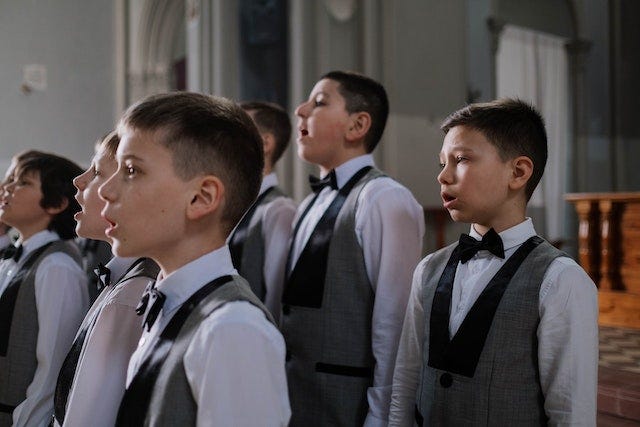
If you’ve heard 13-year-old Malakai Bayoh sing, you’ll agree there’s something beautiful and special about a boy's soprano (treble) voice. Even if you’re not into “church” music.
People are moved to tears when they hear singers like Malakai. Some say these boys’ voices are otherworldly, a gift from heaven. I’m not religious, but I feel a wee bit spiritual when listening to Malakai perform.
But I’ve always wondered what happens to these talented young singers when their voices change. And why is a boy singer’s voice valued above other voices?
The beauty of the boy soprano
The soprano high C (C6) is the defining note in a lot of music. Have a listen; it’s pretty high. Sure, some adult males can get up there, but that’s rare, and most singers of the high C are women.
Back in the day, women were banned from performing in public, especially in churches. But when it came to choral music, composers needed those soaring high notes as the icing on their musical cakes. Enter the boy soprano.
But a boy soprano’s voice isn’t just a substitute for an adult female voice. When a boy is around 11 to 14, he has what is known as a “choirboy voice.” It’s different from a woman’s and a younger child’s voice.
“The voice takes on a resonant masculine quality before its pitch drops, resulting in a liminal stage wherein the boy may sing in a high register with a unique timbre. This brief period of high vocal range and unique colour forms much of the ground for the use of the boy soprano in both liturgical and secular music in the Western world and elsewhere.” ScorSer
If religious or opera music isn’t your bag, listen to performances by Michael Jackson circa 1972, and you’ll hear what I mean.
What happens when a boy’s voice changes?
To put things in context, here’s some science.
At the onset of male puberty, testosterone is released, which, among other things, causes the vocal folds (previously known as cords) to thicken and lengthen. The thicker and longer the vocal folds, the lower the voice pitch.
A boy’s voice can be in a noticeable state of change or a year or two. But a singer might have to wait up to five years to discover his adult vocal range.
What happened to choirboys back in the day?
When I was a kid, I read a book about a teenage boy who sang in a choir in 15th-century London. When his voice changed, he was turfed out of the choir and had to resort to a life of crime to support his impoverished family. I forget the name of the book, but the story remained with me.
That was pretty much what happened. Boys left choirs once their voices changed. Some joined adult singing groups, but most drifted into other professions. But if a young singer was especially promising, there was another, more sinister (to our modern sensibilities), option.
Yes, I’m talking about castration.
And, of course, there was an inequality to it. It was usually only pre-pubescent boys from poorer families who underwent this procedure. Even when the practice was banned, parents continued doing this to their sons. It was concerning how many young boys experienced strange “accidents” such as wild boar attacks.
These boys could continue supporting their families, and castrati were considered the equivalent of today’s pop stars.
If you want to hear how an adult castrati sounded, Alessandro Moreschi (1858–1922) was the last and only recorded one of these singers. To me, he sounds more like a female opera singer than a boy soprano, possibly because his voice, while high, is mature from years of training.
The emotional impacts of a changing voice
These days, obviously, choirboys are not castrated, nor are they expected to support their families. However, they still tend to leave their choir once their voices change.
In addition to dealing with puberty in general, having to quit singing can be distressing for a gifted choirboy. Some of these kids have been members of their choir since they were eight — over half their young lives. They lose their musical camaraderie, and many get upset or depressed.
Transitioning from a singing voice that’s been carefully honed since childhood to a voice that’s unpredictable can affect a young singer’s sense of pride and identity. There’s no guarantee where his voice will settle and if his adult voice will be as impressive as his boy voice. Boys who were once lead sopranos are often relegated to singing harmony or less prestigious choirs.
“I had something beautiful, and then it was gone. It’s just hard to get over that.” Brian, aged 14
Working with the changing voice
In the past, at the very best, boys were told to avoid singing for a few years until their voices settled. Today, in whatever choir he sings, boys who want to continue singing continue to attend classes so they can learn how to sing comfortably at their new, lower pitch.
Boys are assured that while they’ll lose notes, they’ll gain others. Words that can have negative connotations about the voice, like “broken” or “cracked,” are no longer used.
Boys might gradually move from first to second soprano to alto and eventually to a men’s or mixed choir.
The Maryland State Boychoir has a number of choirs boys can join, including the Tour Choir, which consists of boys with both changed and unchanged voices. This choir teaches boys a range of music that extends beyond traditional choir music. Participants are well-equipped to pursue various musical careers if they so desire.
Will precocious puberty put an end to the boy choir?
In the developed world, puberty tends to begin at younger ages. This is most likely due to differences in diet from the past or children in developing countries.
In 1968, the average age a boy’s voice changed was 15. In 2020, it was 13.
Singers need years of training to reach the high standards required to perform pieces by classical composers like Bach, Beethoven, and Mozart. Early onset of puberty could mean that some boys simply never achieve these standards.
“If you think of the music Bach wrote, much of it is virtuosic and it’s pretty hard to get a 12-year-old to sing at that level. Not to mention issues of emotional interpretation.” Robert Geary, Artistic Director, Piedmont East Bay Children’s Choir
Options beyond boys’ choirs
High value is still placed on young male voices beyond the religious music community. Yes, these voices are beautiful, but so are other voices. Perhaps the time has come to stop valuing one voice over another and to increase the appeal of mixed choirs.
These days, there’s no reason why boy choirs can’t become mixed choirs, even if we want to keep them predominantly soprano. Girls sing just as well as boys, and even though their voices drop at puberty, it’s easier for trained girl singers to sing through this pitch change and retain their high notes.
Also, if you include other voice pitches in the choir, like tenors and basses, the choir can perform a greater repertoire of music.
The music plays on
I think some of the beauty and mystique of a talented choirboy’s voice comes from its impermanence.
But I don’t think early puberty or other factors will put an end to the boy choir. When one boy can no longer sing soprano, there are other boys trained and talented enough to take his place. I also think it’s time to celebrate other voices, such as girls’ and older boys’, in the elite choirs of the world.
Finally, I’m sure that, whatever transpires, gifted singers like Malakai Bayoh have promising music careers ahead of them.