

Is it the end of the work as we know it?
A brief analysis of the report Future of Job 2020 by the World Economic Forum
In several ways, 2020 has been a horrible year. Millions have lost their livelihoods, and millions more are at risk from the global recession, economic structural change, and, additionally, automation.
We are at a decisive moment: today’s actions and choices will decide the course of life and entire generations’ way of life.
If you, just like me, work with cutting-edge technology like Artificial Intelligence, the future of the work as we know it can be a constant feature on your agenda.
There are several points of view that we may consider to discuss.
Many people fear that robots will destroy many jobs, while informed optimistic people like me look to a future of smart workplaces where social skills are valuable and workers are freed from mundane tasks.
Studies estimate that up to 65% of children starting school today will have a job that does not yet exist after graduating from high school or college. Most of the attention in this debate is focused on declining jobs — not on creating new jobs.
In this sense, The Future of Jobs Report 2020 offers the timely perspective required to direct labor markets and workers towards opportunities today and future employment. I’ve been doing a deep analysis of the report this year, and here I want to share some of my most relevant findings regarding the future of the work according to the World Economic Forum:
The World Economic Forum The Future of Jobs Report 2020 report forecasts that by 2025, automation and labor division between humans and machines will close 85 million workers worldwide in medium and large companies in 15 industries and 26 economies.
But here’s the good news: at the same time, the introduction of digital technologies, including Artificial Intelligence, would generate 97 million jobs in healthcare, fourth industrial revolution technologies, and content production.
In the coming years, we can see that fields such as data processing, accounting, and administrative support are likely to lose more employment as workplace automation and digitization increases.
According to the survey, more than 80% of executives are accelerating plans to digitize work processes and introduce new technology, and 50% of employers expect to accelerate some feature automation. Unlike in previous years, employment growth decreases as employment closures increase.
Approximately 43 percent of the businesses surveyed by the WEF said they would reduce their workforce due to technology; 41 percent intended to broaden hiring within specialized functions, and 34 percent planned to increase the force due to the technology’s incorporation.
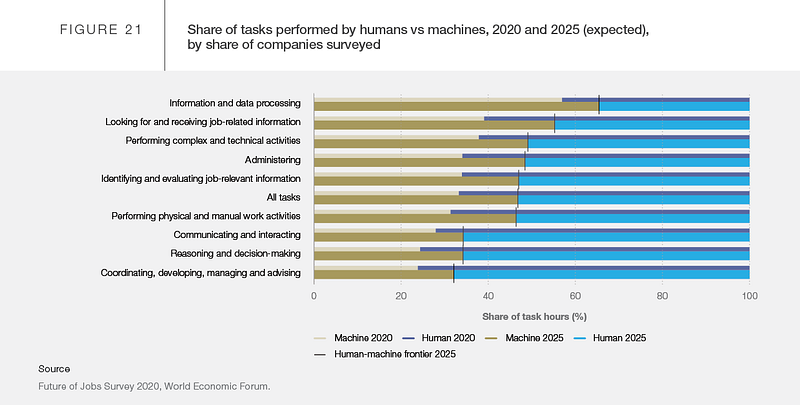
By 2025, businesses will share work with machines equally. Functions that improve social skills would need more. Machine use will concentrate on data processing, administrative activities, and repetitive manual work.
The study is focused on human resource predictions and strategy executives from 300 multinational organizations employing 8 million employees, in addition to data from LinkedIn, Coursera, ADP Research Institute, and FutureFit. AI.
The AI adoption momentum
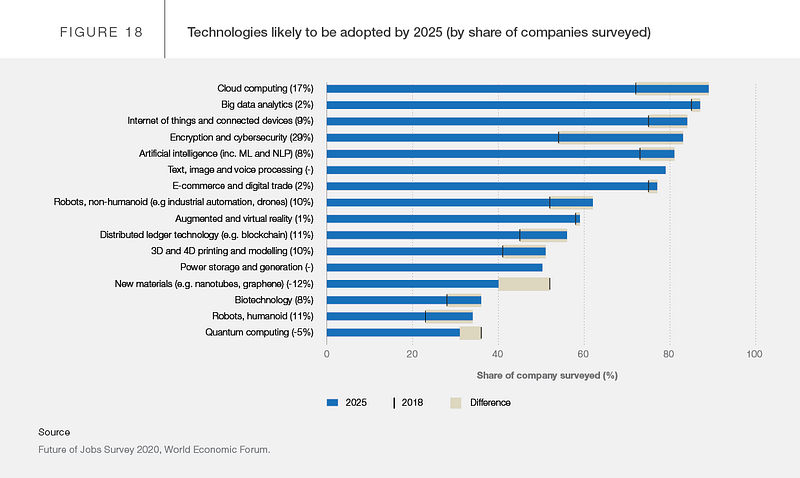
The past two years have seen a strong acceleration in the company’s implementation in emerging technology.
Artificial intelligence finds the most comprehensive adaptation among Digital Information and Communications, Financial Services, Healthcare, and Transportation.
Non-humanoid robots and Artificial Intelligence are increasingly becoming a significant industrial workplace.
These emerging innovations are expected to drive industry-wide future growth and boost demand for new employment and skillsets. But labor disruption will counterbalance such positive effects.
By 2025, humans and computers’ total expected work time would be at equilibrium based on today’s activities. Tasks where people are supposed to maintain their competitive advantage, include management, advice, decision-making, reasoning, communication, and interaction.
Emerging roles in the future
The Future of Jobs Reports 2020 edition shows industry-wide parallels while looking at increasingly strategic and increasingly redundant jobs.
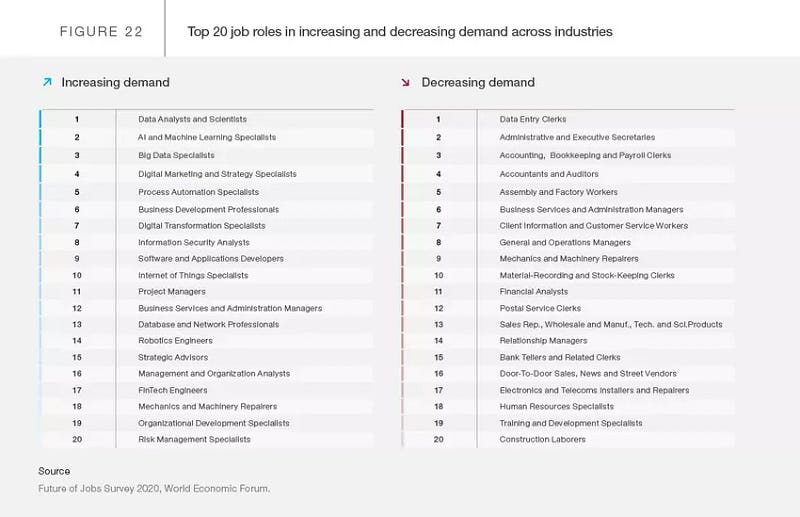
Roles, including Data Analysts and Data Scientists, AI and Machine Learning Specialists, Robotics Engineers, and Digital Transformation Specialists, are the leaders in growing demand.
Process Automation Specialists and Information Security Analysts are emerging among a cohort of positions with rising employers’ market. The advent of these positions represents both increased automation and the revival of cybersecurity threats. At the opposite end of the spectrum, the positions to be gradually obsolete by 2025 will remain broadly consistent with the work roles described in 2018 and across several research articles.
A non-negligible share of newly-created jobs would be wholly new over the next decade. Such work disruption is counterbalanced by work growth in new sectors. The ‘Job of tomorrow’ Data appointed 99 occupations that are steadily increasing in demand across 20 economies.
Those workers were then grouped into distinct technical clusters according to similar skills. This resulting collection of emerging careers represents new technology adoption and rising demand for new products and services. It also means higher demand for green economy work, data and AI leading positions, and emerging positions in engineering, cloud computing, and product development.
Some emerging employment clusters offer significant opportunities for transfers to growing jobs (jobs in increasing demand) through successful career pivots. Among the changes to Data and AI careers, 50% of shifts made are non-emerging roles. These figures say some degree of workforce reallocation is already underway. Some of these so-called ‘Tomorrow’s jobs’ provide more significant opportunities for workers to turn their work-family completely, while other developing careers remain more bounded. Cloud Computing’s emerging work cluster is predominantly populated by IT and Engineering transfer practitioners. By comparison, 72% of data and AI-bound transitions come from a separate work family.
Tomorrow’s many occupations offer more significant opportunities to pivot into careers with a substantial shift in ability profile. Data and AI, product growth, and cloud computing give different ways to break into these frontier areas. Some of Tomorrow’s work clusters remain more ‘locked’ and prefer to hire workers with unique skills.
Emerging Skills for the future
Local labor market expertise shortages and failure to recruit the right talent remain among the leading obstacles to new technology adoption. Employers surveyed via the Future of Jobs Survey estimate that, on average, they have 62% of their employees access to reskilling and upskilling. In new careers, including Data Analysts and Scientists, capacity shortages are more acute. Although the exact skills match is not a requirement for a work transition, workers’ long-term productivity is decided by mastering essential skills.
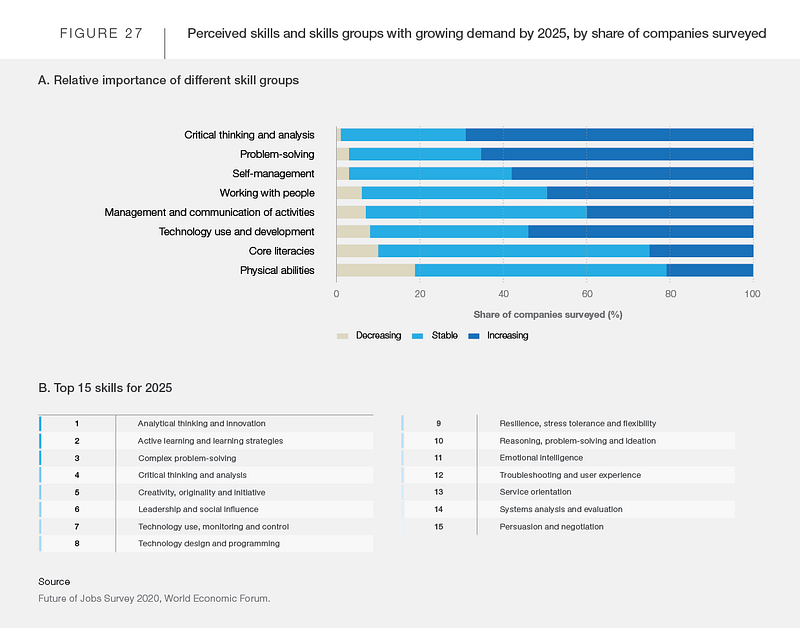
Since its 2016 edition, this report has tracked the cross-functional skills in rising demand. Skills like critical thought and research are top of the agenda for year-to-year continuity. Self-management skills like constructive learning, endurance, stress tolerance, and versatility also appear this year. This report reveals the types of perspectives that can direct work changes through appropriate reskilling and upskilling in more granular detail. It shows that lacking critical data science skills is famous for individuals moving into data and AI.
Demand for new skills has bifurcated. Employees put a greater focus on personal development courses. Employers want more casual than formal learning to lean. In the Future of Jobs Survey, 94% of business leaders report expecting workers to learn new skills on the job, a sharp uptake from 65% in 2018. In-focus courses are mainly those in technical skills alongside a cohort of strategic and leadership management skills. Three thousand seven hundred thirty-seven percent of employers expect to upskill staff.
On average, the Future of Jobs Survey respondents predicts that about 40 percent of employees would need a six-month or less reskill. The movement towards digital online reskilling has intensified during the restrictions on in-person learning since the COVID-19 pandemic started. New data from Coursera’s online learning platform for April, May, and June 2020 (Quarter 2) suggests a significant expansion of online learning.
Areas that will be in demand
On the other hand, 97 million jobs are expected to emerge in the following areas:
health care
technologies of the fourth industrial revolution
data and artificial intelligence
content creation
new engineering roles
cloud computing
product development.
Tasks requiring management, advice, decision making, reasoning, communication, and interaction will be in great demand and point out the report.
Most employers recognize the value of requalifying their workforce — 66% expect a return on investment in employee qualification and requalification within a year. They also plan to relocate 46% of workers to their organization.
Those most affected by the changes brought about by Covid-19 are those who were already at a disadvantage. And inequality will be intensified by the double impact of technology and recession.

Future of work: Remote work is here to stay
About 84% of employers are expected to digitize work processes, including a significant expansion of remote work. Employers say there is the potential to put 44% of their workforce in the home office.
According to the report, 78% of global business leaders expect some negative impact on worker productivity.
This suggests that some industries and companies struggle to adapt quickly to the pandemic’s shift to remote work.
To address productivity and well-being issues, about a third of employers said they would take steps to create a sense of community, connection, and belonging among their employees.
Digitalization is driving a surge in work-from-home arrangements and a new marketplace for remote work. This has also brought significant well-being challenges as workers have struggled to adapt to new work methods over a short period. Hospitality, Retail, Service work, as well as Travel and Tourism are the sectors most negatively affected by the pandemic.
On average, 44% of workers can work remotely during the COVID-19 crisis, but 24% cannot perform their current role. This estimate indicates an aspiration to expand the availability of remote work in the future.
Sectoral differences underpin the estimates shared above. A larger share of roles in the Finance and Insurance and Information and Professional Services sectors can be performed remotely. Despite the limitations listed above, demand from employers for remote-based work is increasing rapidly across economies. Insights from Glassdoor online platform show that access to working from home has nearly doubled since 2011, from 28% to 54% of workers mentioning that they had the opportunity to work from home. The number of workers looking for remote job opportunities has nearly doubles. In contrast, the number of job postings has gradually increased.
The pandemic has shown that a new hybrid way of working is possible on a grander scale than ever before. Yet business leaders remain uncertain about the productivity outcomes of the shift to remote or hybrid work. 78% of business leaders expect some negative impact on the current way. I am working on worker productivity.
Ensuring employee well-being is among the key measures undertaken by business leaders looking to shift to remote work effectively.

The challenge of equality
An estimated 88 to 115 million people could fall back into extreme poverty in 2020 due to this recession. In some countries, those affected have been disproportionately women, for whom the ILO reports higher unemployment rates. ADPRI has been able to track the impact of COVID-19 on the United States labor market in near real-time.
Workers in Arts, Entertainment, and Recreation, and Accommodation and Food Services are most affected by the current disruption. The data shows that, on average, workers who did transition moved towards sectors that provide essential services such as Retail and Health and industries that have been less disrupted. The metrics shared by ADPRI also reveal the effect of this disruption by industry and wage level.
Individuals and communities most affected by the unprecedented changes brought about by COVID-19 are likely to be the most disadvantaged — living in neighborhoods with poor infrastructure, having poor job prospects, and whose income does not provide them with comfortable living standards, healthcare coverage, or savings.
Because of this recession, an estimated 88 to 115 million people could return to extreme poverty in 2020.26 The following wide range of characteristics typically pose a risk of social and economic exclusion among these populations: age and generation; gender and gender expression; sexual orientation; mental and physical abilities; health level; race, ethnicity, and religion; in-country g. These characteristics are typically reflected in education, type of job, income level, and socioeconomic status.
The long-term impact analysis on earnings among young people resulted in persistent earnings declines lasting up to 10 years. We have also seen young professionals start to work in occupations that do not match their education levels. The early indicators shared in this section signal that without adequate intervention, gains towards bridging societal inequalities might be reversed.

A great moment for a Career change
The survey also indicated an increasing number of people changing careers, mainly in data, artificial intelligence, sales, content creation and production, social media, and engineering.
The report also shows that critical thinking, analysis, and problem-solving skills are already the most valued. Self-management skills, such as resilience, stress tolerance, and flexibility, entered the list.
The survey also points to a substantial increase in the number of people seeking online learning opportunities on their initiative and through government programs and even in the number of employers offering online qualifications to their workers.
Those who are employed are placing greater emphasis on personal development courses. On the other hand, the unemployed prioritize digital skills, such as data analysis, computer science, and information technology.

Key findings
The Future of Jobs Reports 2020 shed light on the pandemic-related disruptions thus far in 2020, contextualized within a more prolonged economic cycle history.
The report also provides in-depth information for 15 industry sectors and 26 advanced and emerging countries. By 2025, the time spent on current tasks by humans and machines will be equal.
Job creation is slowing while job destruction accelerates. Employers expect that by 2025, increasingly redundant roles will decline from 15.4% of the workforce to 9%. The number of emerging professions will grow from 7.8% to 13.5% (5.7% growth).
The future of work has already arrived for a large majority of the online white-collar workforce. Eighty-four percent of employers are set to digitalize working processes rapidly. Jobs held by lower-wage workers, women, and younger workers were more deeply impacted in the first phase of the economic contraction. In the absence of proactive efforts, inequality is likely to be exacerbated by technology’s dual impact and the pandemic recession. The window of opportunity to reskill and upskill workers has become shorter in the newly constrained labor market.
An average of 66% of employers surveyed expect to get a return on investment in upskilling and reskilling within one year. Companies need to invest in better metrics of human and social capital. The public sector needs to provide more robust support for reskilling for at-risk or displaced workers.
Only 21% of businesses report using available funds to support their employees through reskilling and upskills.
Conclusion
It is clear from the report that businesses, governments, and employees must plan to implement a new global workforce vision.
Disruption to labor markets from the Fourth Industrial Revolution has been further complicated by the onset of the pandemic-related recession of 2020. For the first time in recent years, job creation is starting to lag behind job destruction.
Businesses are set to accelerate the digitalization of work processes, learning, expansion of remote work, and task automation.
These efforts can be strengthened by multistakeholder collaboration between companies looking to support their workforce.
The coming decade will require purposeful leadership to arrive at a future of work that fulfills human potential and creates broadly shared prosperity.
By 2025, machines and algorithms’ capabilities will be more broadly employed than in previous years, and we must be ready for this new way of work now!