
Is chatGPT Safe for Your Work?
The problem of generating persuasive messages without regard for truth is not unique to ChatGPT but also exists in some people, such as irresponsible bloggers, sensation-seeking journalists, and pickup artists. However, the unpredictability of ChatGPT’s untruths makes it particularly difficult to trust its outputs, and users must verify everything it says.
ChatGPT is currently unreliable and should not be taken at face value as it often generates untruthful outputs. It seems to be optimized for generating persuasive and engaging content, but it doesn’t prioritize the truth value of its outputs.
Join the Medium Membership Program for only 5$ to continue learning without limits. I’ll receive a small portion of your membership fee if you use the following link, at no extra cost to you.
I genuinely think that its lack of transparency could harm many users, particularly those who are vulnerable and lack critical thinking skills, as they may rely on ChatGPT’s outputs without verifying them. Additionally, as generative AI systems reduce the barriers to content creation, the whole internet may drown in engaging AI-generated content that propagates untruths and causes harm.
And because ChatGPT doesn’t actually lookup/recall facts the way Google or a database does. If I ask ChatGPT about the color of the sky and it starts telling me “The sky is” and starts figuring out the next word. To make the next word, GPT asks itself “Out of all the human text I read, what is the word that I’ve seen the most in this context”. The answer here is blue because it has seen a lot of people talk about blue when talking about the sky color.
But it didn’t look up that in a database of knowledge, it just learned that “blue” is what a human would probably say. This AI sometimes gets this word prediction “wrong” from a fact checking sense, but because it’s good at mimicking a human it sounds plausible and confident when wrong.
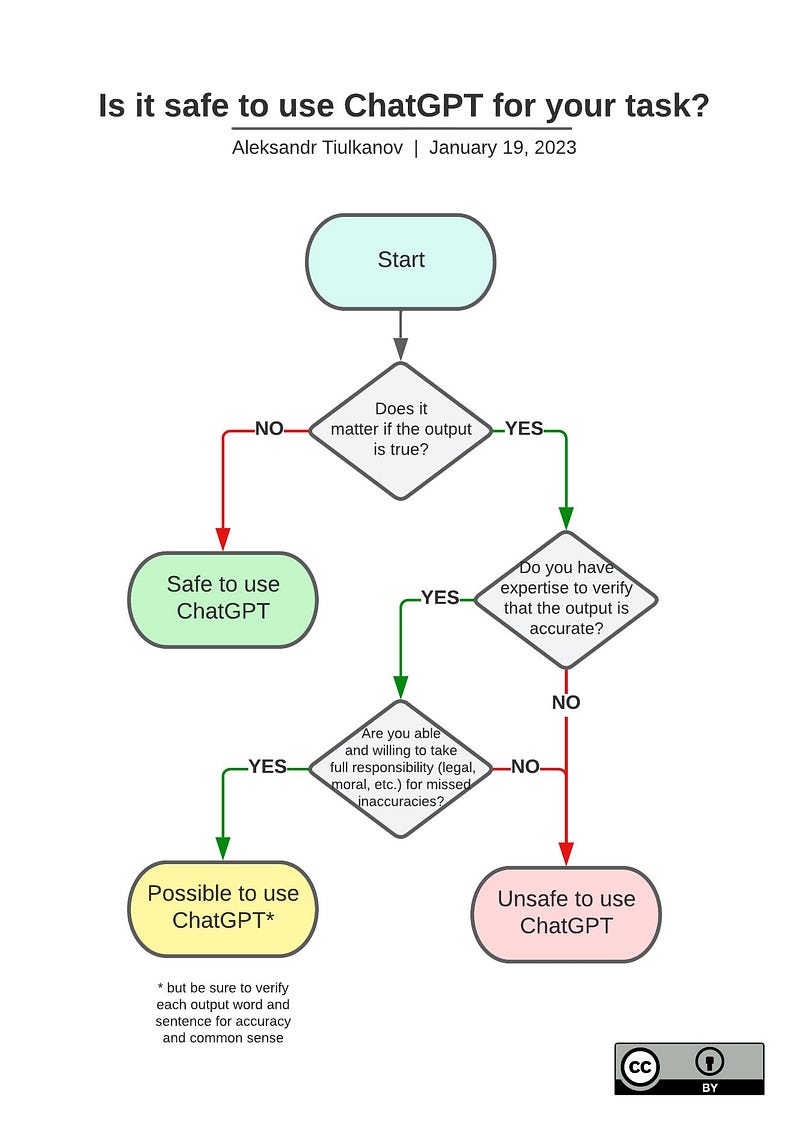
So, how can you make sure that it’s safe to use chatGPT? For starters, this flowchart is great —
As much as I like to call it lying or bullshitting, I do think the term “hallucinating” is probably more accurate. Both bullshit and lies imply an understanding of what the truth is and that it is crossed. There’s some intent in those words — intentional fabrication.
ChatGPT has neither the intent to fabricate nor the introspection to understand the validity of its information. In other words, it’s already insane in the sense that it doesn’t know what reality is. “Hallucination” still implies some level of perception that ChatGPT doesn’t have, but I think it’s closer to the mark. It also helps demonstrate why it’s so convincing — it’s as true to the AI as the truth is.
At the end of the day, I would caution over-relying on ChatGPT and I’d encourage the users to apply critical thinking to verify its outputs. I also think it’d be better if ChatGPT comes with a more prominent warning about its inherent design flaws and lack of reliability.
My other writings —
More content at PlainEnglish.io.
Sign up for our free weekly newsletter. Follow us on Twitter, LinkedIn, YouTube, and Discord.
Interested in scaling your software startup? Check out Circuit.