
Is It Possible to Escape From Solitude
A philosophical question from the great Orson Welles
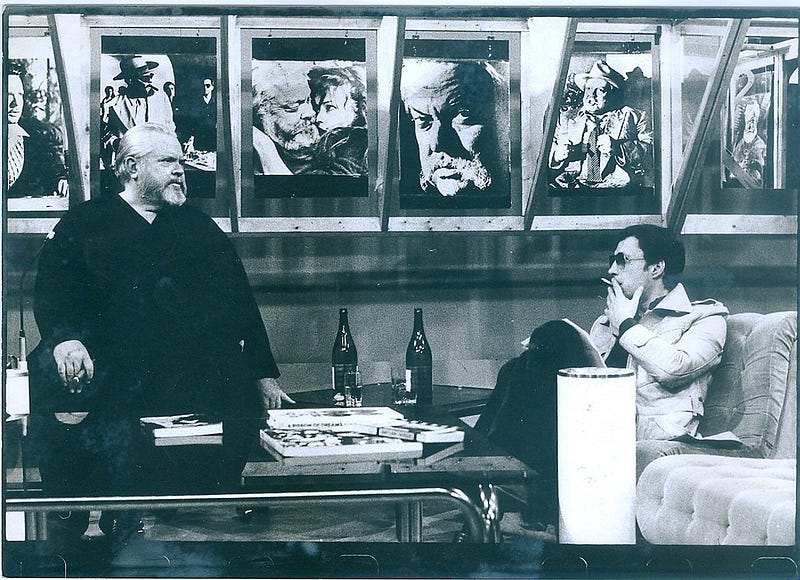
I recently watched Orson Welles’ final film, The Other Side of the Wind on Netflix. It is an intricate film combining two movies into one. The first, a story of J.J. Hanaford’s last day of life. Hanaford is a famous director, played by long-time Wells friend John Houston, who is hosting a screening party for his latest film. And the second story is the film that he is screening for an eclectic audience.
Throughout the film, which took almost 40 years to complete, we meet many of the people associated with the director and the production of this picture. Most of whom had been betrayed in one way or another by Hanaford. At the end of the film, one is left to ponder the value of friends. Is it to be collaborators in our accomplishments, or are the people in our lives only there to observe, transact with, and offer opinions of what they see?
In the complimentary documentary of this film, They’ll Love Me When I’m Dead, Wells poses that philosophical question in another way- which is worse, to compromise your values or your friendships?
His answer was that it is worse to compromise your friendships. His reason is that we all travel through life alone, and friendships are our only escape from that solitude. We can see this played out in many of his films. From Citizen Kane and The Magnificent Ambersons through Journey Into Fear, The Stranger, and finally The Other Side of the Wind, the same question arises, is the really any value to relationships?
Considering some of my friends who are feeling particularly isolated during the holiday season, this same dilemma confronts me. Friends who feel isolated despite being beloved and respected in their communities fight inner battles alone and unaffected by those around them. Despite offers to help and empathetic ears, we have difficulty in our attempts to talk our friends off their proverbial ledges.
We can not do anything of meaning for others. They must choose to do it for themselves. Even in my work as a professional development coach and consultant, this idea continually reminds me that all forms of conversation, consultation, education, and therapy are useless unless the recipient is ready to take action.
We can be steadfast friends. Choosing to turn a blind eye to those unappealing parts of our friends, like Joseph Cotton and Marlene Dietrich’s characters did for their dear friend, the corrupt Hank Quinlan, played by Wells, in the 1958 film A Touch of Evil. In the end, however, Quinlan deserts his friends in hopes of hiding his secrets. There is no way they can save him, despite their hope for Quinlan’s repentance and possible salvation.
Similarly, if we invite the confining solitude as George Amberson did in the 1942 film, The Magnificent Ambersons, we may find that we also push away opportunities and a sense of community that could vanquish those feelings of joy that life in community has to offer.
I have definitely felt the solitude of being unconnected to the world around me. Like all of my life was upon my own shoulders with no resources of use to separate me from the feeling of anguish. These were life’s lowest points. Yet in those times of despair, it was the connections that kept me from going over the edge.
Contrarily, in my finest hours, I realized that success does not come from my efforts alone. Rather, it is through collaboration with others, communication with friends, engaging those more experienced than myself, and a community of people that find value in my contributions that the high points of life are revealed.
Understanding the interconnectedness of people, and the need of individuals to make contributions to the world around them requires that one focus on reciprocation, not just giving, but also graciously receiving from others. In this way, we will be unique, but never alone. And that’s how to escape the solitude.
So what do you think? Are we really traveling through life alone or is there some connection between us that propels us through life?


,_right,_with_Orson_Welles_(3,_2,_1_…_kreni!_TV_show),_1979.jpg)