
Is it Normal to Still Grieve Our Stolen Childhood and Struggle with Depression, Anxiety, or Anger?
Some things we can do to move on
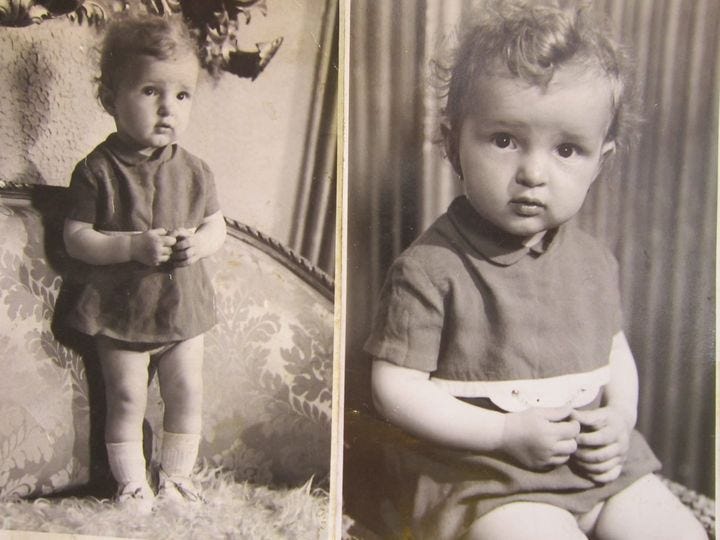
I was the black sheep of my family. Doing things to defy my parents… and, of course, confirming their prophecies. I came to believe I was evil. After all, what child would do what I was doing? Skip out school? Steal money out of dad’s pocket, lie, argue with parents and teachers? A bad one, huh?
I deserved the punishment, the beatings, and humiliation for that, didn’t I?
But, surprise, surprise, it didn’t work:
The more they punished me, the more I rebelled, and the more I drifted away from my parents, from my family, from anyone who could help me. And from my Self.
Now, with today’s mind, I realize my parents did not know any better. But back then I believed them.
I look at these pictures now… they’re among the few pictures I have left from my childhood. I don’t even know how I still have them. Maybe I get them from my sister or my cousin, because having moved so many times, I lost mine in one of the moves….
All I see is a baby. The same innocence in the eyes of the child I was as I see in the eyes of any other child. I seem a little afraid, facing a world too big, too much new, too many things I was not understanding. Any child sees the world as intimidating at times.
It was not until I came across Gabor Mate`s lectures on trauma and addiction that I understand where most of those struggles were coming from. Not just mine, my parents too.
Especially why my mother was so desperately trying to make me fit. Communist Romania was not a place for rebellious children with parents with “unhealthy origins” to thrive. Her family lost its wealth and some of her relatives went to prison. Those were dangerous times.
So she did everything she could think to stop me from freely speaking my mind. Looking back… I believe I had very well-trained guardian angels, otherwise, I could end up so much worse…
Well-trained as they were, my guardian angels could not protect me from my own internalized ager. How could they?
I was a very sensitive child. I still am sensitive. We use the word “empathy” a lot now.
“Empathy is the capacity to understand or feel what another person is experiencing from within their frame of reference, that is, the capacity to place oneself in another’s position. Definitions of empathy encompass a broad range of emotional states.” Source: Wikipedia
I've read a lot trying to understand what was wrong with me. From what I've learned, nothing was wrong with me. Just I did not know what to do with all the things I was feeling. My feelings and other feelings.
The word sensitive came to the Latin word sensitive to feel. So the sensitive person feels more so. The example I often give is and that can lead to both very positive and very difficult consequences. For example, if I tapped you on the shoulder right now, you wouldn’t feel any pain at all. But if you were not wearing your shirt and your skin was exposed. Furthermore, if you had a burn on your shoulders so your nerve endings were close to the surface, if I tacked you with the same force, you’d feel extreme excruciating pain, even though the external event was no different. Right. So sensitivity magnifies the pain that we have. Sensitivity also leads to more creativity. So very often the most creative people also have the most pain, which is why so many creative people escape from their pain through all kinds of dysfunctions like addictions and so on. So there’s a real link between creativity and sensitivity and creativity and sensitivity and suffering at the same time. (Dr. Gabor Maté Interview | The Tim Ferriss Show)
The good part of being an empath is that we can feel what others feel. The bad part is that we do not know why we feel what we feel — at least until we do not understand that we are picking someone else's feelings we do not have the capacity to understand what is happening, where those feeling are coming from, and how to deal with them.
So is not just we are frightened, confused, anxious, or enraged, but we feel scared about feeling so. Is this normal? Are we sane?
If we come to believe we are not… this is a sure path to a life of self-loathing, suffering, and depression.
The fact that we talk about feelings, something that is “just in our heads” makes everything harder. At least if the problem is external I can see it. I can name it. I can describe it.
But this? How can I describe to someone else how much I was loathing myself? How much of my rebellion was a scream for help?
Trauma is not what happens to you, it’s what happens inside you as a result of what happened to you. Trauma is that scarring that makes you less flexible, more rigid, less feeling and more defended.” (Dr.Dr Gabor Maté on Childhood Trauma, The Real Cause of Anxiety, Our ‘Insane’ Culture and Ayahuasca)
In other words, trauma is an interpretation. An internal story. A dysfunctional one.
I distinctly remember that moment when I realized I was not a child anymore. For some, this can come with shock, their careless days are over. My shock was a different one: I was seeing a movie of my childhood and asking: “WTF was that? WHY?”
A clear sense that I was robbed. And overwhelming grief.
Time did not heal that pain. I did not know what to do with it. I just wanted to forget. To numb me. This does not work. If something is just postponing the pain.
The sages say that pain is the best teacher. It was. I've reached a point when I had to look my anger in the face. And to stay with the pain instead of hiding.
I had good teachers. My Tantra practice taught me to cry. It was OK. I did not need to fake bravery anymore.
Crying was healing. I cried for everything. For me, for my mother, for the absurdity of everything. And it helped. I feel myself again.
So yes, grieving is not just normal, is necessary. The best part is that we can learn to navigate through this process.
What can we do?
We can ask for help.
This might be the hardest part. To ask for help means we have to recognize we need help. That we are vulnerable. And this is frightening.
But not asking for help when we need it is not a sign of resilience, is a sign of trauma.
We can write about what happened
Writing is therapeutic. Writing about what happened gives us the opportunity to revisit the past in a more focused way. We need to slow down our train of thoughts and stream them on the page.
This helps us to put some space between ourselves and our pain. It gives us a window into our minds. It makes us aware of our inner internal dialogue.
I lost count of how many times I was beating myself for being a bad person. Without journaling, my daily trauma-broadcasting station was busily playing hits like “I Am Not Good enough”, “Nobody Loves Me”, “Life Sucks” and “Should I Kill Myself Today?”
I am 100% sure that writing down this phrase: “I was a bad baby, a bad child and I deserved all the punishment I received during my childhood” would have such an impact on me that I would question it right away.
This is one of the best articles I found about the therapeutic effects of writing:
For a writer, this is a gold mine — we write, we learn, we create and we heal at the same time. Thank you, Nicole Hilbig!
The most important thing is to set an intention. Whatever we do, the intention has to be to heal, not to blame others or find justification for why are we so broken. We can find explanations, and most probably we will have our aha moments and this is a big part of the process, but not the goal itself.
We can name our loss
This might be a tricky one. Sadness can be so all the time present in our life that we cannot even name what we lost. Usually, we are either focusing on events, wishing for another past — “if only”…
Or we focus on people: my father/mother/caretaker did this or that.
And they did it. And maybe it was as bad as we remember. The problem is… No amount of “if only's” will change the past. No amount of blaming will solve the problem. And no amount of victimizing will heal us.
So instead, we name our loss. We recognize the hurt. As clear as we can. It took me a lot until I was able to find the words to describe what I was grieving for:
“I will never know who I would be without that childhood. I will never know what I would have been like if I had not had the childhood I had. What kind of person I would have been.
What a life I could have had if I had grown up in an environment that would have encouraged my dreams and celebrated my creativity and originality. Which would have encouraged me to find my voice, to be myself, and to dream big.”
Then, one powerful step: ask better questions. Powerful ones.
OK, I thought. I would never know. But can I at least imagine it?
I love it. I spent so much time swimming in the dark swamp of victimization, going around in circles, fighting reality. Imagining my better I is a meditation by itself. I have so many positive things to think about.
I once read a story about a 3yo who had a little baby sister.
As soon as the newborn was brought home from the hospital, the two-year-old son asked her sister. But when the infant was put into his arms, the boy said that he wanted to be ALONE with the baby.
The parents were unsettled, and they told him that he is too little for that. A few months went by and the 2yo was asking his parents again and again until they agreed to leave the two very young children in a room alone for a few minutes. They let the door slightly open. Standing outside the room, watching for anything out-of-the-ordinary.
In the beginning, the boy said with a loving look on his face. Then the two-year-old said to the newborn: “Little sister, tell me what God looks like, cause I’m starting to forget…”
Thinking about my Better I is like thinking about my Essence. About what I was before developing the persona. And how I can go there again.
We will never know what our life would be like if we had a better past. But we can choose the goal of becoming the best version of ourselves, starting from what we are now. Seems like the best thing we can do.
Thank you for reading until the end.
Welcome to the best online community you can find. A place to learn, write and grow. 🙂
Best way to start? Use somebody’s referral link. Start a virtuous circle. A fellow writer will receive a part of your subscription.
If you like what I am writing, please consider mine. Thank you!


