
Is Israel David or Goliath in the Middle East?
How we overcompensate for paradoxical ambiguity in the Middle East
Nothing is more certain than that folks will be divided on how to assess the Arab-Israeli conflict.
Are defenders and critics of Israel outfitted with cognitive filters somewhere so that they inevitably interpret every act of Islamist terrorism or every move by the Israeli military in opposite ways, blaming one side but never the other, no matter what happens in the Middle East?
Did Hamas murder Israeli civilians in an all-out pogrom in 2023 because Hamas militants are religiously compelled to demonize Jews? Or did they do so because they’re freedom fighters, resisting Israel’s oppression and killing of Palestinians?
Is Israel blockading and invading Gaza because Hamas needs to be destroyed in the name of all that’s good and holy? Or is Israel doing so because Israeli Jews have no respect for the rights of Palestinians, and are caught in a doom spiral, as if further violence will solve the conflict rather than create another generation of Islamist rebels/terrorists?
A clue to the problem is that progressives are prone to rooting for the underdog, whereas conservative intuitions are more authoritarian so conservatives are more likely to respect dominators. At the heart of the Arab-Israeli conflict, then, is some ambiguity about which side is David, as it were, and which is Goliath.

The ambiguity of the Arab-Israeli conflict
On the one hand, you can interpret the situation in the Middle East by taking Israel to be the superpower in the region, in which case Israel is Goliath. And the poor, helpless Palestinians in pockets of Israel are David. On that reading, progressives are obliged to view the Palestinians as heroic underdogs who are oppressed by a bully and whose ultimate victory should be assured if the absolute source of morality has anything to say about it.
(In the biblical story, the unarmed young man David represents Jews who saw themselves as righteous servants of the one true, yet mysterious and invisible God. Thus, David surprises everyone by defeating the much larger, more intimidating Philistine, Goliath, with a slung stone. Goliath has come to represent the Assyrians, Egyptians, Babylonians, Persians, Macedonians, Romans, or Christians who periodically conquered or oppressed Jews, according to tradition or history.)
On the other hand, you can interpret Israel as the underdog David by noting that Israeli Jews are few compared to their Muslim neighbours in Egypt, Palestine, Jordan, Lebanon, Syria, Iraq, Saudi Arabia, and Iran. In that case, progressives ought to be worrying mainly about the safety of Israel, given that this Jewish state is surrounded by a hostile Muslim world, most of which still doesn’t recognize Israel’s right to exist as an autonomous state.
Indeed, most of the Arab world has been consistent in its opposition to Israel since 1948. As Britannica points out about how the UN founded the country,
UNSCOP delivered two proposals: that of the majority, which recommended two separate states joined economically, and that of the minority, which supported the formation of a single binational state made up of autonomous Jewish and Palestinian areas. The Jewish community approved of the first of these proposals, while the Arabs opposed them both.
This ambiguity seems largely responsible for the opposite reactions to whatever transpires in the Arab-Israeli conflict. In certain ways, Israel is more powerful than each of its Muslim neighbours, and certainly more powerful than the Palestinians. Potentially, that makes Israel comparable to the bully Goliath who picks on weaker folks. But together, united in contempt for the idea of a Jewish state in their midst, the Muslim countries are likely more powerful than Israel.
There are around 465 million Arabs spread across 22 states in the Middle East and Northern Africa, and 7 million Jews in Israel. Israel itself is physically tiny compared to its Muslim neighbours, so if you’re looking at a map of the area, and you zoom out to encompass the whole of the Muslim world (the Middle East and Northern Africa), you can hardly even see Israel.
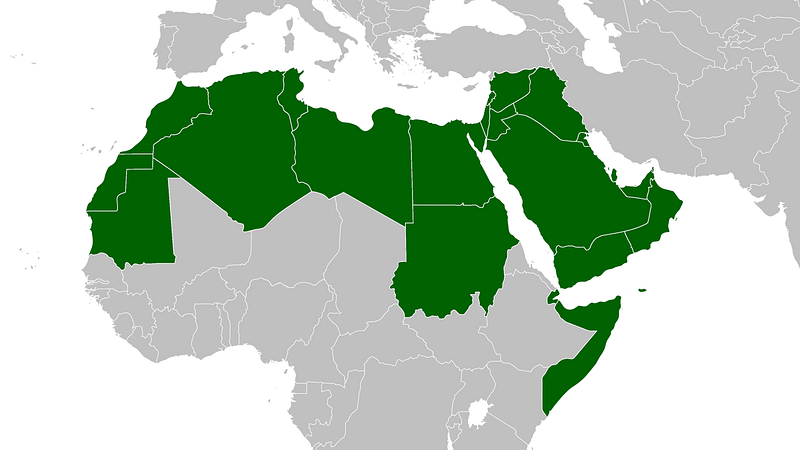

Now, population and geographical largeness don’t equate to military supremacy. Still, if we’re talking about the intuitions that underlie progressive reactions to conflicts, it’s hard to avoid the ambiguity: Israel is both David and Goliath, both the bully and the bullied, both the dominator and the underdog. So, what are progressives to do? Whom should they cheer for in the Arab-Israeli conflict?
Overcompensating for the ambiguity
This ambiguity accounts for critics’ knee-jerk reactions on both sides. We overcompensate when we assume the situation in the Middle East is black and white, as though there were only one possible interpretation, and our side is good while our opponents are evil. Instead of being so simple, the situation in the Middle East is paradoxical because Israel is a tiny, outnumbered, surrounded military superpower.
If you look just at the fact that Palestinians have no comparable military, and yet Israel bombs them into the Stone Age in its hunt for Hamas, killing many civilians as “collateral damage,” clearly Israel takes on the role of Goliath, which dictates the progressive’s repudiation of Israel.
Yet the opposite interpretation is always available, by a sort of gestalt switch, so that Israel looks like the heroic underdog David: like David who picked up a smooth stone and felled the gigantic challenger, Israel does what it must to attempt to defeat its greater enemy — such as Iran, which is pulling Hamas’s strings in Palestine.
That larger context, too, should dictate the progressive’s response, but it doesn’t. Instead, progressives are liable to compensate for the ambiguity by oversimplifying the issues. To avoid cognitive dissonance, the progressive filters the situation, ignoring the possibility that in the greater scheme, Palestinians are part of a Muslim world that’s threatened the existence of Israel as a homeland for Jews and Palestinians since that state’s founding in 1948.
Kneejerk Jewish and conservative defenders of Israel are just as likely to overcompensate by downplaying the plight of ordinary Palestinians and other Arabs who are caught up in Israel’s wars with terrorists. By viewing Israel as the underdog, defenders ignore the fact that Israel is a superpower that’s liable to abuse its military dominance.
Now, as a matter of historical fact, Israel hasn’t abused that power in an imperial fashion, by seeking to conquer, say, the whole Arab world, as the ancient empires had conquered Jews and other tribes. Modern Israel expanded its territory in self-defensive wars against its neighbours who were the aggressors, and who rejected the UN’s partition plan from the outset. Israel hasn’t nuked its neighbours despite the existential threat they pose to Israel. So, Israel hasn’t behaved like a bloodthirsty bully or power-mad imperialist.
Yet at the fine-grained level, no one can look at Israel’s bombing and siege of Gaza and think that Israel’s winning the propaganda war. Setting aside the big picture, Israel looks like the bully in its war with Hamas, even though Hamas attacked Israel in savage fashion with the Oct 7 pogrom, provoking the war to prevent Israel’s reproachment with Saudi Arabia and to continue the jihad in a sacred act of submitting to the perceived will of Allah.
But in attacking Israel, was Hamas the oversized bully who was picking on the underdog in the wider conflict, or the cunning David who knows how to trap his prey? The paradoxical ambiguity here is unpleasant to contemplate because we’d prefer to moralize and demonize by way of simplifying complexities, to make sense of the atrocities committed by both sides of the Arab-Israeli wars.
War is as mind-numbing as a black hole, its alienness to civilized conceits defeating our pride in being so-called rational persons. So, we simplify to grapple with the inhuman reality. One such simplification is the resort to conceptual filters that pick sides in ambiguities. When looking at the conflict between Hamas and Israel, for instance, we stamp our feet and insist there’s only one valid interpretation of it because we’ve blinded ourselves to the alternative.
Paradox and the moral need for certainty
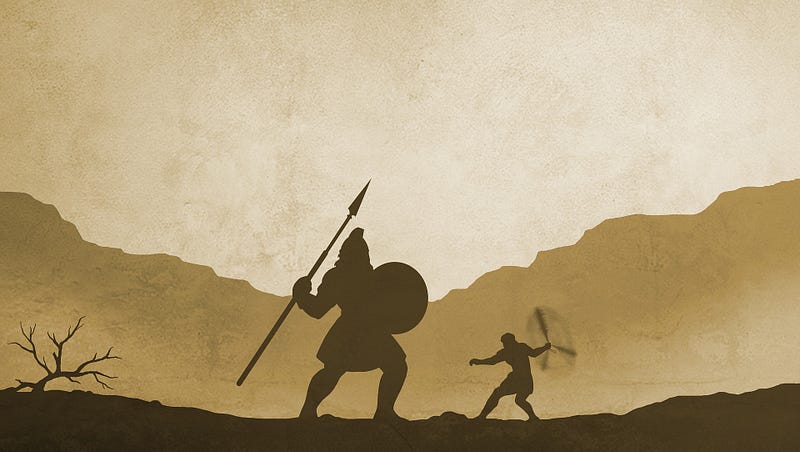
The paradox of Israel’s Mighty Mouse-like superpower is diabolical in how it subverts our moral expectations. We want clear distinctions between good and evil, strong and weak. That’s why in simplistic movies, the good guys wear white, and the bad guys black. In the biblical story about David and Goliath, too, there’s no confusion about who has the underdog status. First Sam. 17 makes Goliath seem fearsome indeed:
A champion named Goliath, who was from Gath, came out of the Philistine camp. His height was six cubits and a span [9 feet, 9 inches!]. He had a bronze helmet on his head and wore a coat of scale armor of bronze weighing five thousand shekels; on his legs he wore bronze greaves, and a bronze javelin was slung on his back. His spear shaft was like a weaver’s rod, and its iron point weighed six hundred shekels. His shield bearer went ahead of him.
And when Goliath issued his challenge to send an Israelite out to fight him in single combat, “On hearing the Philistine’s words, Saul and all the Israelites were dismayed and terrified.”
Saul said to David, “You are not able to go out against this Philistine and fight him; you are only a young man, and he has been a warrior from his youth.” Nevertheless, Saul dressed him in armour, but David removed it because he wasn’t used to fighting in that way.
Goliath ‘looked David over and saw that he was little more than a boy, glowing with health and handsome, and he despised him. He said to David, “Am I a dog, that you come at me with sticks?” And the Philistine cursed David by his gods. “Come here,” he said, “and I’ll give your flesh to the birds and the wild animals!”’
This, then, is a morality tale in which the lines are clearly drawn. In the modern Middle East, though, things aren’t so clear (and they never were so in history).
Hamas is backed by Iran, and Israel by the United States. Where is the good and where is the evil when innocent civilians die in any military conflict? Who is strong and who is weak, when Israel, the so-called superpower is humbled by paragliding Hamas fighters and by its strongman Prime Minister who divided and distracted his country with political shenanigans? What’s right and what’s wrong in any saga of retribution that plays out in a desert region that will outlast all the political actors by eons?
I collect my Medium writings in paperback and eBook forms, and I put them up on Amazon. Check them out if you’d like to have them handy and to support my writing in that way. The newest one is Questing for Epiphanies in a Haunted House, and its 600 pages include 99 recent, wide-ranging articles of mine.