
Is Harrison Barnes the Worst Pro Basketball Olympian of All Time?
Ranking the 12 most suspect inclusions since the 1992 Dream Team
The Olympics allowed professional basketball players for the first time in 1992. Since then, 66 men have donned the red, white, and blue, a unique class of athletes that represents 25 years of basketball greatness.
Usually.
Not every NBA great from the past 25 years has made an Olympic squad, and not every Olympic squad has been filled with only great players. Even ignoring guys like Isiah and ‘Nique who were older veterans by 1992, and players like Steph and Kawhi who should get another shot in four years after skipping Rio, plenty of other stars have missed out.
You can build quite a Team USA with guys that never made the Olympics. How about Billups, McGrady, Pierce, Webber, and Brand starting, with Francis, Roy, Arenas, Kemp, and Rodman off the bench, each guy better than many who actually made the squad. Sacrifices have been made in every selection process.
So, who are the 12 worst pro basketball Olympians to represent Team USA?
12. Kyle Lowry 2016
Lowry is a perfectly nice point guard who is coming off an excellent season, but he’s one of the worst pro points ever on Team USA. For a country that usually puts out athletic playmaking wizards at the position, Lowry leaves you wanting — the result of Steph and Russ and CP3 turning down invites.
Lowry is a career 18-4-6 guy who took a couple extra shots this year, and now we are sending the 30-year-old to the Olympics because injury and/or the Zika virus pushed our real PGs away. This is the equivalent of sending someone like Sam Cassell or Mookie Blaylock or Terrell Brandon to the Olympics. They’re all fine to lead your NBA team, but they’re really not the guy you want leading your country.
11. Stephon Marbury 2004
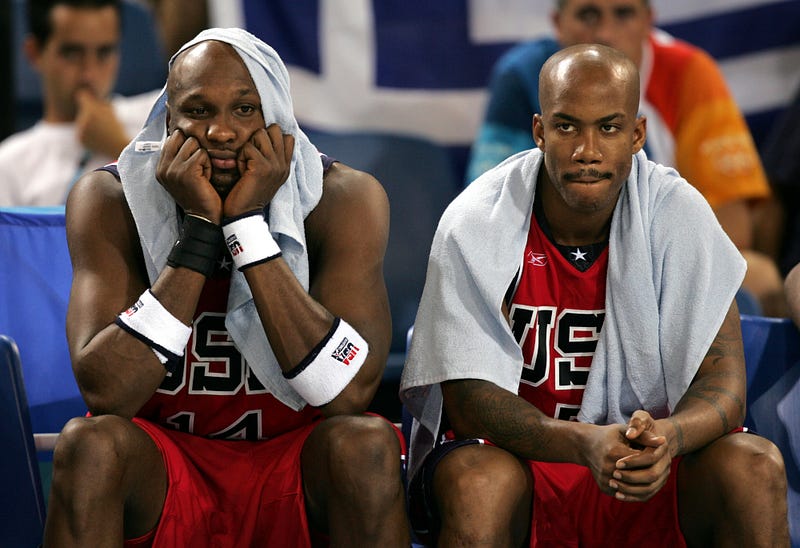
Lowry escapes the worst PG mantle, though. We’re giving that to Starbury, who was traded from the Suns to the Knicks in 2004, but whose subsequent downward spiral may have started with his disastrous Olympics that summer.
Marbury was a volume point guard, a 20-8 guy with poor shooting numbers (43 percent from the field and 30 percent from downtown) who got numbers by playing a lot on average teams. In 13 NBA seasons, he had just one season where his ORTG was any real amount better than his DRTG— roughly, he gave up just as much as he added.
In Athens, he took away a whole lot more. He was the handler and leader on our biggest Olympic basketball disaster since the controversial 1972 final, “leading” a team with Duncan, LeBron, Iverson, and others to a paltry 5–3 finish and a bronze medal. (On the bright side, that performance helped jumpstart the overhaul of USA Basketball and our return to dominance.)
10. DeMar DeRozan 2016
Sorry, Raptors fans. I promise this isn’t because your boys play in Canada and it’s hard to envision them in red, white, and blue.
DDR is what he is, and he’s just not a fit for Olympic-style basketball or Team USA … or today’s modern, efficient NBA, if we’re being technical. I mean, you watched the playoffs, right? DeRozan averaged 23 points a game this year, but he’s a high volume shooter who scores in the midrange and at the free throw line.
Fouls are tougher to draw in international play, DDR is a career 28 percent shooter from downtown, and he’s been a worse defender than he is a plus on offense almost his entire career. DeRozan is a 1990s SG stuck in a world that no longer appreciates his skill set, a throwback to the Kobe we no longer want in 2016.
9. Carlos Boozer 2004, 2008
Congratulations to Boozer, a guy who got by on reputation so well that he managed to make the Olympic team twice. Boozer first made the squad as a 15-11 hustle guy out of Duke who looked good next to LeBron, and momentum kept him on the team four years later.
Here’s the list of players who have played on multiple pro USA Olympic teams: Pippen, Malone, Stockton, Barkley, Admiral, Payton, Kidd, Wade, Melo, LeBron, Kobe, CP3, Durant, DWill … and Boozer. You tell me which one doesn’t belong.
8. Allan Houston 2000
Houston was a really good three-point shooter that didn’t shoot many of them, a player who belonged to the wrong era. His sweet shooting would be invaluable in 2016, but he was used ineffectively for much of his career.
Houston was a first-year All Star in 2000 with a career high 16.5 PER — remember, 15 is supposed to be an average player — and he had a career peak win share of 8.6, which is very low for a supposed star. But injuries and era derailed a better career and saved him from a more ignominious ranking.
7. Shareef Abdur-Rahim 2000
Abdur-Rahim is the classic “good stats on a bad team” guy. He went 275–555 in his career for an abysmal .331 winning percentage, making the playoffs just once in 12 seasons — as a bench player for the Kings. He never hit 10 win shares in a season, and made just one All-Star team.
Let’s just say Reef’s garbage time in Team USA blowouts that Olympics may have been the highest leverage basketball minutes he ever played.
6. Steve Smith 2000
Smith was a career journeyman who moved from Miami to Atlanta to Portland, making the Olympic squad as a 30-year-old despite the fact that he averaged under 15 points per game as a volume shooting guard.
Smith was an above-average player at his peak, breaking 10 win shares once and hitting 18.8 PER one year, but this selection was well past that; it was a career defining accomplishment for him.
By the way, notice all the 2000 guys on the list? Remember how the rest of the world was “catching up” to Team USA at that time? Maybe we just stopped sending world-class players for a spell.
5. Christian Laettner 1992
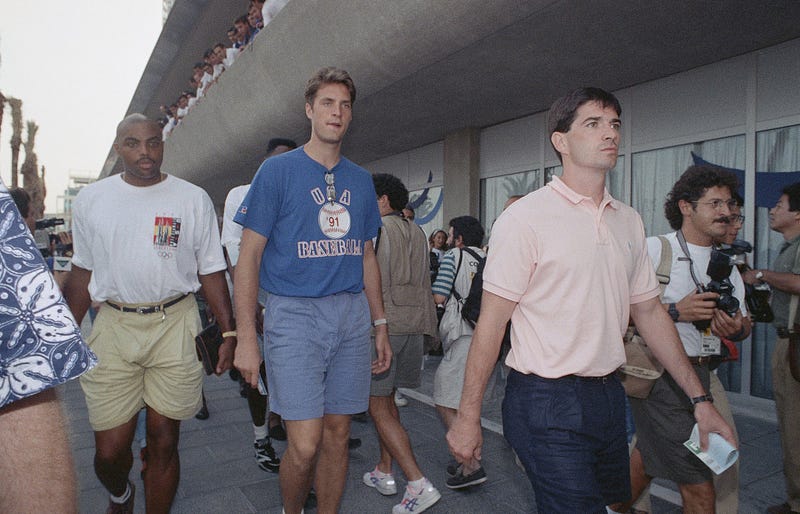
The Didn’t-Belong-There GOAT, Laettner — the mandated college basketball player selection on the Dream Team — was the lone non-Hall of Famer on the greatest team ever assembled in any team sport. His spot should’ve gone to Isiah Thomas or Shaquille O’Neal.
So why isn’t he No. 1 on the list? Laettner was the college basketball player of the year, the leader of back-to-back national champion Duke. He was one of the greatest college basketball players in history, peaking with a perfect 10-for-10 from the field for 31 points, including the historic game-winning fadeaway, to beat Kentucky in the Elite Eight that spring. That was the Laettner chosen to represent Team USA, and if they had to have a college guy on the roster, he was the pick.
He’s written off as a pro, but he did put up 18-9 as a rookie and peaked with 11.6 win shares and a 19 PER in his one All-Star season in Atlanta. In hindsight, injuries and era probably cost Laettner; he might be a pretty valuable stretch 4 in the league today.
4. Tayshaun Prince 2008
Prince was the worst starter on the Pistons’ 2004 championship team … which was four years prior to this selection. He never made an All-Star team and put up just 13-5-3 in 2008 with less than one combined block/steal — an all-around average player well past the afterglow of his championship run.
The 2008 squad was focusing on forming a team of winners after the stars had disappointed in 2004. He made the team on intangibles and reputation, the defensive glue guy every winning team is supposed to have.
3. Emeka Okafor 2004
Apparently Team USA didn’t learn its lesson in 1992, opting in 2004 for another rookie who had yet to see a professional court. Okafor was the best player on a title-winning team, but unlike Laettner, he hardly was dominant after an up-and-down college career full of injuries and offensive struggles.
Okafor was the No. 2 pick in the worst NBA draft of the last 15 seasons. He put up 15-11 his rookie year, and got worse from there, with a negative OBPM every year of his career. And though he was known for his defensive presence, he was just decent there, with only one season over two blocks a game.
The wildest thing about Okafor? He’s still only 33! It feels like he hasn’t been relevant in the NBA for almost a decade.
2. Vin Baker 2000
Baker was a confounding choice in 2000. Though he used to be pretty good — a classic 20-10 guy during a four-year All-Star run mostly in Milwaukee — that was ancient history by the time of his Team USA appearance.
By 2000, Baker was in Seattle in the aftermath of the Shawn Kemp trade. He put up a mediocre 15-7 with a 14 PER and a negative VORP as an oft-injured big man who couldn’t shoot or play defense. And he was even worse the year before that.
Imagine Zach Randolph or Al Jefferson playing on Team USA. Like, right now. That was 2000 Vin Baker. But Baker was at least good at one point in his career. And that’s more than we can say for No. 1 …
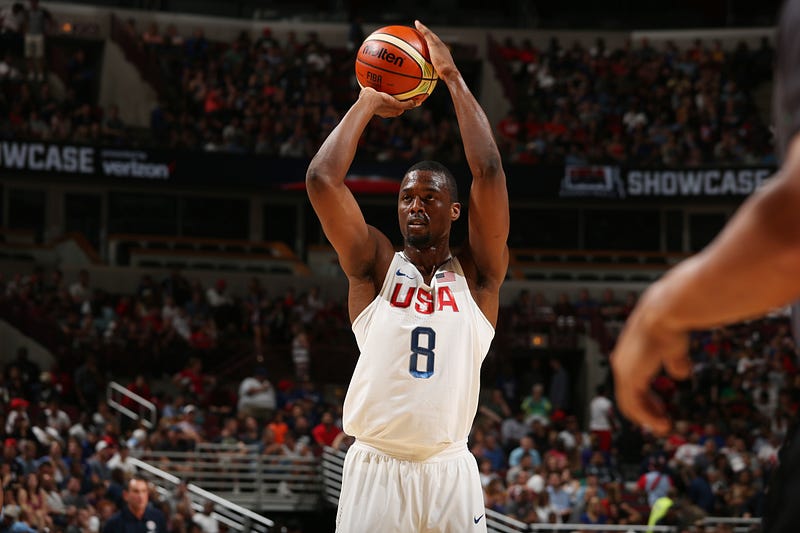
1. Harrison Barnes 2016
I actually defended HB throughout this past season. I like his defensive versatility and thought he was a valuable Warrior. I expected him to be in the bottom 12 of the pro Olympians list, but not as bad as everyone thought.
I was wrong.
Barnes is a pretty mediocre NBA player. He’s the answer to a future trivia question, the guy you already forgot from this year’s awesome Warriors team. Barnes scored 11.7 points per game, a career high, with average percentages on mostly wide-open shots. He’s peaked at 6.7 win shares, a 12 PER, and a 0.9 VORP. He’s the definition of an NBA replacement player — on his best day.
An incomplete list of swing men with numbers equal to or better than HB this year: Rudy Gay, Trevor Ariza, Jabari Parker, Kent Bazemore, Tobias Harris, Will Barton, Marcus Morris, Otto Porter … the list goes on and on.
If Barnes played anywhere but Oakland, he’d have been lucky to make the Olympic practice squad. Instead he’s $94 million richer this offseason and our newest forgettable Olympian, getting by on a combination of inflated prep/college reputation and right-place-right-time in Golden State.

Follow Brandon on Medium or @wheatonbrando for more sports, humor, pop culture, and life musings. Visit the rest of Brandon’s writing archives here.