
Is Deadpool the Most Enlightened Superhero?
Comic book subversions and the dread of superpowers
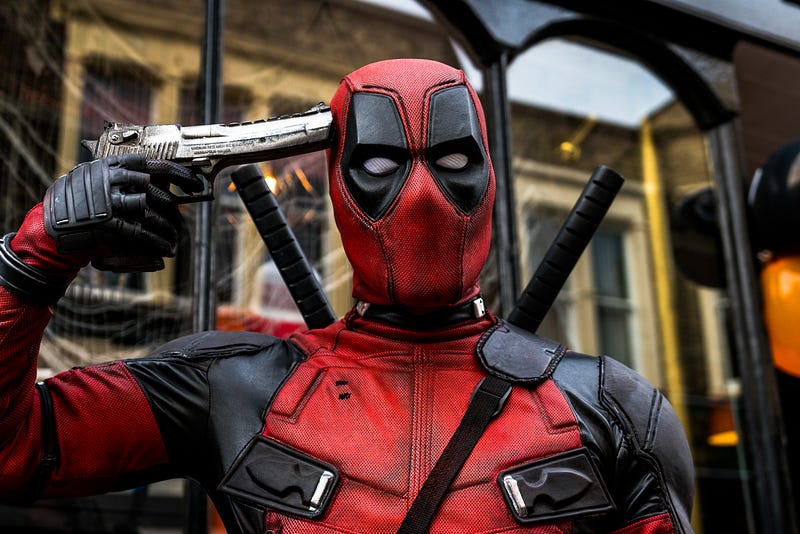
American comic books from the so-called golden and silver ages are full of esoteric and shamanic ideas as well as transhumanist philosophy, all packaged with pictures and cartoonish narratives for children and teenagers to counter the oppressive Christian sermons they had to endure to fit into the repressive mainstream, normie culture.
You might not have thought young people are ready to digest cosmic truths and subversive speculations, but looking through comic books, it’s hard not to notice the symbols.
WWII, Nietzsche, Lovecraft, and Marvel Comics
Two main influences on comics are WWII, which delimits the Golden Age, and the psychedelic 1960s, which define the Silver Age. Nazi fascism brought a warped version of Friedrich Nietzsche’s philosophy of the Overman to the US’s attention, and Jack Kirby, who worked in comics in both periods but who loomed largest in the Silver Age, served in the war.
What Kirby did in his most prolific period, working at Marvel in the 1960s, was to provide a cosmological, science-fictional perspective on the development of superhuman bodies. Think of the Fantastic Four, Silver Surfer, Galactus, Iron Man, the Hulk, Thor, the X-Men, Black Panther, the Inhumans, and many others which Kirby co-created with Stan Lee.
The focus in these superhero stories is on the action and specifically on the conflict between the good and evil superhumans, the so-called superheroes and supervillains. The exclusion or at least the deemphasis of the interior life of these superpowerful beings makes for an intriguing contrast with the weird fiction of H.P. Lovecraft.
Prior to WWII, Lovecraft likewise combined Nietzschean reflections on superbeings with a cosmological, science-fictional scope. In “At the Mountains of Madness,” he sets out a horrific evolutionary possibility in which our species was created as an afterthought by aliens in a vast saga of their cosmic exploits that mocks the conceits of our liberty and self-importance.
Both Lovecraft and Kirby explore the ancient astronaut hypothesis, familiar now from the pseudoscientific TV show Ancient Aliens. But unlike Kirby, Lovecraft emphasizes the psychological reaction to the cosmic dimension of deep time and of the higher forms of domination. The whole point of Lovecraft’s weird fiction is to insinuate that science’s disenchantment of nature, and philosophy’s undermining of anthropocentric religious myths ought to horrify us. That was Nietzsche’s point, too, about the threat posed by the so-called death of God.
Kirby was aware of the psychological implications, as when he has the Human Torch react to the planet-devouring Galactus by saying, “We’re like ants…Just ants…Ants!” But Kirby excelled at presenting action sequences, as when he pioneered the drawing style that showed the characters practically leaping off the page. Some of his characters brood, such as Silver Surfer and Doctor Doom, but even when he explores the existential or psychological implications of posthumanity, his oeuvre is marred by the cartoonish dualism between the good and the bad guys.
Nietzsche’s thesis that the aristocratic superhuman would be “beyond good and evil” belies that more propagandistic presentation, dictated as the latter was by the WWII mindset in the US which defined the Allies as the heroes and the Axis powers as the villains. That moral dichotomy was falsified by the facts that the US allied with the Soviet Union only for expediency, and that the two superpowers fell out in the Cold War.
Lovecraft also revelled in showing how enlightenment was equivalent to a form of insanity, as his scientific protagonists discover the cosmic dimension and the existence of superior forms of life and realize that the conventional values that prop up human civilization are mere vanities. These scientists become pariahs and harbingers of the alien overlords who could return at any time, “when the stars are right,” to regain their rightful hold over the solar system, and to enslave our species in the pursuit of some amoral purpose.
Psychedelics, the Multiverse, Doctor Strange, and Rick Sanchez
In short, Jack Kirby’s and Stan Lee’s comics are moralistic, which is perhaps one reason they were able to flourish in the American marketplace, and appeal to young people. Even as the second source of creativity swept over the US in the 1960s, namely psychedelic drugs, these comic books mostly held the line between right and wrong. Like Nietzsche’s dire reductive philosophy and Lovecraft’s cosmicist astrotheology, psychedelics threatened Americans’ imperialist fantasies by broadening people’s perspectives to encompass cosmic possibilities and radical doubts.
Of course, this uprising brought about the Civil Rights Movement and resistance to the Vietnam War. And in comics, Steve Ditko’s mystical character, Doctor Strange, was meant to reckon with this second challenge to American supremacy. Again, the point was to appeal to the young adults who were experimenting with mind-altering drugs, but to encourage them to retain their American values, to take pride in being American good guys.
Doctor Strange can thus be compared with Rick Sanchez, from Rick and Morty. Both have access to the multiverse, but Doctor Strange is portrayed as having mastered those dimensions mentally, due to his mystical training. Rick masters the multiverse technologically, making him godlike, but he’s portrayed as psychologically damaged, melancholy, and amoral. That’s the Nietzschean, Lovecraftian influence which would threaten American society by discounting simplistic condemnations even of the Nazis.
If you asked Rick Sanchez what he thought about the Nazis in WWII, he might resort to a snarky remark about their inferior weapons or about their obsession with Jews. But because he’d understand that the infinite multiverse contains every shade of moralistic appraisal of the Nazis, including worlds in which they’re condemned as losers, but also ones in which they’re praised as victors, he’d appreciate the arbitrariness in our — merely our — dismissal of Hitler as evil. Rick would understand how universes are created by morally neutral quantum processes, so his attitude towards what ordinary people would call pure evil would be transhuman in its aloofness and cynicism.
Rick is an antihero, whereas Doctor Strange is a superhero. Strange is more like a buddha or a bodhisattva, an enlightened spirit whose origin story features his renunciation of his ego. He was an arrogant surgeon who had to turn to the mystic arts, whereupon he broadened his perspective and eschewed materialism.
Mind you, the very same threat of amorality that hangs over Rick and Morty darkens Hinduism, Jainism, and Buddhism: the enlightened Eastern spiritualist’s compassion seems arbitrary in relation to the cosmic depths of the elite, transhuman perspective. According to the latter, for example, the personal self is an illusion, and everything is united in a divine whole that evolves through unfathomable eons of pure simplicity and illusory multiplicity. Why the dichotomy between heroes and villains should matter from that perspective is hard to justify.
Deadpool and Postmodern Enlightenment
There’s one comedic superhero, however, who represents an illuminating critique of the Marvel genre, and that’s Deadpool. This character is a mercenary with superhuman healing powers that make him immortal but that also warp his mind by rejuvenating his neurons. Deadpool is a chaotic ninja whose odd personality allows the writers to explore the psychological implications of a superhuman status. What would it be like not just to live forever but to know that you can’t die?
Deadpool’s character is cynical, and he frequently resorts to gallows humour. He jokes about death even as he murders hoards of villains, because death means nothing to him. Life is an absurd comedy for this immortal. Moreover, Deadpool breaks the fourth wall, which is to say that he knows he’s a comic book character. This enables the writers to tantalize the reader with pop cultural references, but it also models enlightenment as meta-knowledge.
Deadpool isn’t just an immortal superhero or antihero; his superhuman power is matched by his transhuman, enlightened mind. Deadpool stands outside the narrative in two respects: he outlives all the non-cosmic characters, and his mind reaches deeper than theirs too. Deadpool isn’t beholden to cultural conventions since he’s a postmodern ironist and cynic. As a side effect of his immorality, he appreciates how cultures rise and fall as glorified fads. Like Rick Sanchez, Deadpool’s a relativist who mocks our cultural values because he understands their arbitrariness.
The postmodern, hyperskeptical turn in philosophy and art has roots in the mid twentieth century. It flowered in the 1960s hippie movement, went into hibernation for the Reagan years of Christian conservatism, and burst back onto pop culture in the 1990s with cynical shows like The Simpsons, Gen X indie movies like Reality Bites, and alternative and grunge music. This cynicism, however, was only an undercurrent of Clintonian and techno optimism which prevailed throughout the decade after the end of the Cold War.
Postmodernity was supposed to be an enlightenment on top of the modern Enlightenment. Whereas the Enlightenment philosophers from Locke to Kant spoke of reason and liberty, while often excusing the institutions of patriarchy, slavery, and European imperialism, the postmodernists meant to bring modern values to their fruition, to extend human rights to everyone equally. Postmodernists did this by relativizing cultures and myths.
So European nations and America are merely some societies among others, and their importance is limited to their time and place. Each glorifies itself with a bid to transhistorical status, as the society that will never perish or that ought to influence all others. The postmodernist stands above such hubris, juggling value systems with the cynicism that lies at the end of liberal cosmopolitanism.
The moral dimension of Marvel comic book stories in the Golden and Silver Ages reflected America’s political role as a global superpower. Thus, those stories were largely propagandistic. But postmodern incredulity towards all politicized myths would enable late-modern comics to return to the early-modern, Nietzschean-Lovecraftian problem.
If Doctor Strange is enlightened in the Eastern sense, Deadpool is so in the postmodern one. Both are psychologically elevated, as well as possessing superpowerful bodies. Yet Deadpool is the more subversive personality, which speaks more directly to the underlying Nietzschean and cosmicist upshots of modernity.


