
Is Beauty the Hidden Law of the Universe?
Chimpanzee temples and the path to awe.
Is it necessary to argue in favor of beauty?
We all chase it. We travel around the world to seek it out. We bow at the altar of the beautiful and ignore the dull and the mundane. A truck and trailer loaded up with food for hungry people ought to be a far more beautiful thing than an offensively expensive Lamborghini, but it’s the latter that excites us more than the former. Partly because, as someone said far better than me, we only appreciate beauty if we don’t see it very often.
But there’s more to beauty than simple aesthetic pleasure. A beautiful thing reaches deep inside us, connecting with something old and strong. An appreciation of beauty is anything but frivolous. It is the most profound magic there is.
Even the apes know it.
Jane Goodall watched a chimpanzee family at a waterfall. They would sway back and forth, hurling rocks into the tumbling water. Afterwards, they would calm down and sit quietly, watching in a kind of trance. To Goodall, it seemed to represent an experience of awe that the chimps were sharing.
Hjalmar Kuhl and Ammie Kalan published a paper describing similar ritualistic behaviour among other groups of chimps. Certain trees, and no others in the forest, were struck over and over again with rocks. The chimps made sure to use the same rocks repeatedly. The researchers stopped short of calling the behaviour religious, but the media filled in the gaps. Scientists, the headlines proclaimed, had found a chimpanzee temple.
There’s nothing special about the chimp’s favourite trees or the rocks they hurl at them. At least, not that we can see. It’s a big leap to claim, as some attention-hungry media outlets did, that this strange behaviour means that chimps believe in God. But it’s much easier to believe that chimpanzees feel a kind of awe that grows out of the sensory experience of existence.
A strong sun casts cool and mobile shadows.
Forest smells hang in the humid darkness, the rot and bloom of infinite growth that turns hard-skinned cedars to spongy corpses. An old tin sign from the 1950s hangs precariously from a much older tree, describing how a fallen giant becomes a nursery for new life. Trees don’t die. They just turn into something else.
Closer to the sea, the sunlight breaks through. Watery ripples shine on trunks polished by salt-laden wind. The sea mutters and chatters in a bay of broken rocks and tumbled logs. Seals snort as they rise like watchdogs out of the cold water.
Stay for the day. You’ve come a long way to be here, and there’s no hurry. Watch the sun move across the great plain of the ocean, gray waves closing back over the wake of boats as though they were never there at all.
When the sun is high, the breathing ocean throws back a thousand separate stars to glitter and dance in front of your eyes. Later, the reflected light of a hundred million miles away becomes a single broad bar too bright to look at.
It’s beautiful. And everyone agrees. People come from around the world to walk the soft leaf-carpeted trails and stare out over the island-studded ocean. But you know that beauty doesn’t really work that way. The sea is just a lot of water. A mountain is just a lump of rock. We say that it’s a beautiful world, and from one perspective, it is. But from another, it’s just undifferentiated matter. The world is beautiful because we live in it. Because we think it is.
Lots of things are beautiful.
I’m thinking of flawless marble statues gathering dust in great museums. The Greeks and the Romans who copied them saw beauty in form, in harmony, in proportion. Even scenes of rape and murder are presented with an airy grace, exquisite horror transformed into frozen beauty by sculptors whose names we don’t know. Hogarth wrote about ‘the line of beauty,’ a quality possessed by the beautiful object itself. Buried underground or locked up in a cellar, these things would still be ravishing.
The world isn’t like that. Mountains are forbidding, dangerous places where predators hide and rivers rage and sudden drops yawn dizzyingly in front of clumsy feet. In Hawaii, they tell you to never turn your back on the ocean. The radiant water can kill in an instant, the smiling sun receding as you sink into the gloomy depths. In the damp forests of British Columbia, falling trees and falls from trees make logging one of the most dangerous jobs available.
The world was not made for us. Instead, we grew out of it, emerging from the same rot that feeds the deathless trees. We’re not meant to find the world beautiful. And many of the things that seem most lovely to us are perilous.
There’s us, and there’s the world.
A threat to be overcome. A resource to be exploited. A playground to be enjoyed. This is the line of thinking that we are taught to follow, and it seems as though our sensory experiences back it up. You are not physically connected to that tree over there in the same way you are to your hand or your foot. You can move your hand just by thinking about it, but the swaying branches don’t listen to you.
But this idea falls apart when you look into it. You can hold your breath until you pass out, but your body will take control again when you do. No amount of thinking can stop your heart from beating. You can’t grow your hair or heal a wound anymore than you can make the flowers bloom outside your front door.
That’s because the world is not an object we stand outside of. It’s a process we participate in. And it’s us that make the world beautiful. Just like our chimpanzee cousins. Our ability to see and appreciate beauty, even in dangerous things, is part of what we are and even a clue as to why we are here.
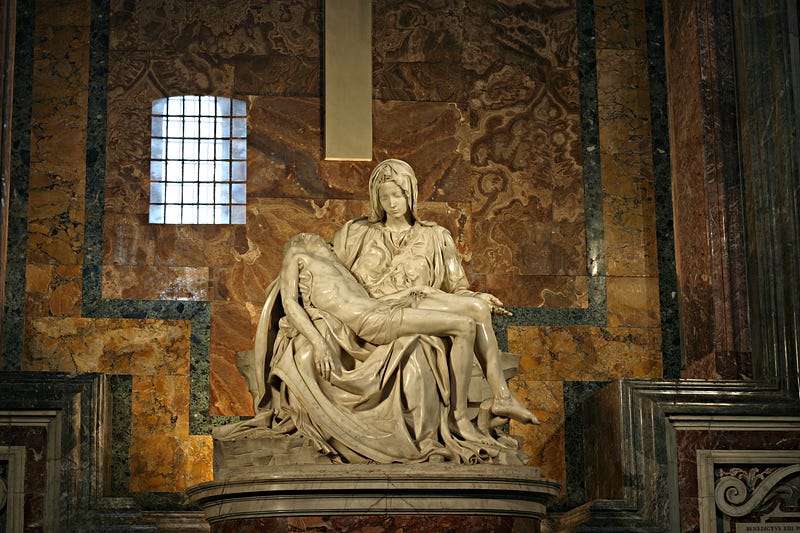
This isn’t just true of natural beauty. The same applies to any human work of art. Michelangelo’s Pieta is just another lump of rock until you see it. Every word Shakespeare wrote is abstract marks of ink on paper until you read them. Until someone of talent reads them aloud.
For an artist, it often feels otherwise. At its best, magic seems to crackle and hum in the loneliness of the studio or the study or the garden shed where creation happens. But the real miracle is something the audience creates. The real beauty is in the wild fire of your neurons that spark and ignite as you mine radiance out of what would otherwise be a flat and dreary world.
Hurling rocks at a tree in the forest does not constitute religion. Nor does this. But it is a signpost toward transcendence. There’s more to beauty than just something pleasing to the eye. Whether you find it in nature or art is immaterial.
A beautiful thing is a path back to awe, the strange and eerie feeling of recognition that lifts the matted hair on a chimpanzee’s neck. We like to tell ourselves that beauty is frivolous, that the ugly and profane is in some sense more real. That way, we can seem tough and hardheaded, averse to silly nonsense like the demands of the heart.
But the experience of awe in the face of something truly beautiful, truly magnificent, may go back to the very beginnings of our species, and beyond. It might be the most profound thing of all.