
Is Agile All About Better, Faster, and Cheaper?
Better, faster, and cheaper is not the goal of Agile
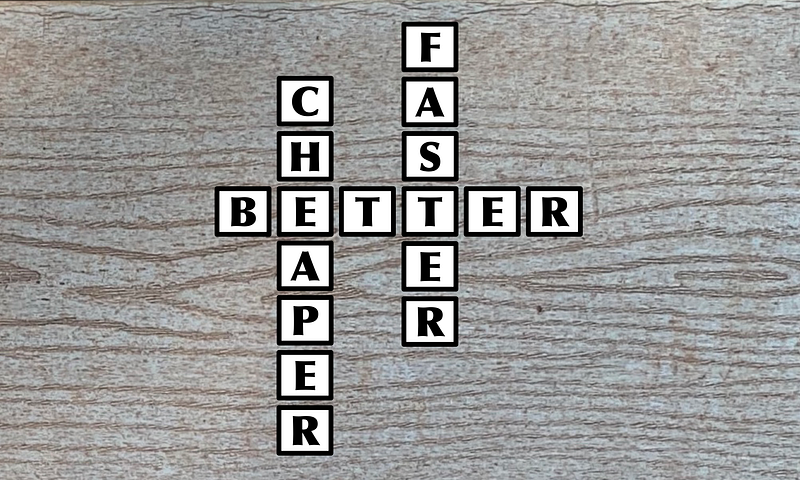
A few years back, I had a memorable initial meeting with one of my key client stakeholders. He first welcomed me as his new Agile coach. Next, he said, “I am so ready for Agile to make my department deliver better, faster, and cheaper. Let me know what you need from me.”
This took me off balance. In the moment, I was speechless. How could he have this belief about Agile? How could he be so misinformed?
You can’t blame him for thinking this. This is a common misperception of Agile. It is a typical selling point on Agile’s benefits. Agile consultants then must make the magic happen.
Better, faster, and cheaper sounds appealing to a manager. But it is not something that would get me out of bed in the morning eager to go to work.
The goal of Agile is much greater than this. But you may ask, “If not this, what is Agile all about?” It is a fair question. Let’s discuss.
Agile Is About People
At its core, Agile is about people working together to deliver customer value. It is about bringing people with needs to address together with the people who can address them. People includes team members, customers, stakeholders, vendors, and others in your product community.
It is not about Kanban, Scrum, or eliminating waste. These are all worthwhile tools to help you deliver in an Agile fashion. But these are not what Agile is about.
Consider the Heart of Agile and Lean Thinking
Alistair Cockburn speaks to the importance of people in his work on the Heart of Agile¹. The Heart of Agile focuses on people collaborating, delivering, reflecting, and improving. Without people, there is no Heart of Agile.
Lean thinking also focuses on people. The two pillars of lean are respect for people and continuous improvement. For people to work with people in an effective manner, respect must be present. With respect in place, teamwork emerges.
When teamwork is in play in a respect-driven environment, self organization will appear. The team will desire to get better. There will be discontent with the status quo, and the team will set challenges to improve. They will experiment to get better. Respect for people is necessary for continuous improvement to emerge.
Agile Is About Less, Not More
Agile is about simplicity². This means developing the “right” thing and developing it “right.” Nothing is added that is not necessary. And nothing is subtracted that is needed.
This is quite different from what people expect. When better, faster, and cheaper is the driver, we often focus on maintaining or increasing scope or on adding processes. As I describe below, these misperceptions manifest in an unhealthy focus on output. The recommended healthy pattern that follows is like a breath of fresh air.
An Unhealthy Focus on Maximizing Output
Does it make sense to deliver everything we can think of better, faster, and cheaper when 65% to 75% of of those things are not needed? No, it does not.
We all have ideas, and most are bad. The Standish Group publishes its Chaos Report³ once per year. Consistently, it reports between 65% and 75% of all software features delivered are rarely or never used. This is a staggering number.
People working well together on the wrong thing is not the goal. It is irrelevant to increase velocity or cycle time of features the customer does not need.
A Healthier Focus: Maximizing Outcomes and Minimizing Outputs
Thinking of doing less to satisfy the true needs of the customer brings me peace. Operating toward this goal is a joy. It will do the same for you and your team.
You will best maximize outcomes by prioritizing learning. This learning comes from direct customer engagement by the whole team. We learn by trying small experiments, evaluating the outcome, adjusting, and repeating until the right solution emerges. This results in a large pile of initial feature ideas that are not necessary to solve the user need.
Iterative learning with your customer will develop the precise solution that your customer needs.
The Result
Your focus is on people working together to deliver customer value. Respect for people is high. As a result, your people are working as a team. They have dissatisfaction with the status quo. This drives them to simplify the way they work. Anything that is not necessary to deliver value is being eliminated. The team is engaging directly with the customer. The goal is to maximize outcomes and minimize output.
So, what is the result? Happiness is in abundance. Your customers are happy because they are getting what they need. Your team is happy because they are delivering their way at a sustainable pace. They get satisfaction from delivering exactly what the customer needs and nothing more. Your stakeholders are happy because happy customers lead to positive business impacts.
Is this better? Yes. No doubt. Better for the customer, better for the team, and better for the stakeholders.
Is this faster? Of course. It takes much less time to deliver only what the customer needs. The other unnecessary features are not slowing you down. Plus, the team has streamlined the process and continues to streamline it.
Is this cheaper? Absolutely. Delivering only what the customer needs with minimal process is cheaper than the alternative.
So, Agile does result in better, faster, and cheaper, but it is not the goal. Respect for people and maximizing simplicity are the goals. The rest will follow.
Related Posts
- The Secret to Product Owner Success
- Limit What You Start to Go Faster: Priorities and Simplicity
- Customizing Coaching to a Team’s Product Context — New Products
References
- The Heart of Agile, Alistair Cockburn
- The Agile Manifesto for Software Development, 2001, Beck et Al.
- The Standish Group Chaos Report, Standish Group
Originally published on Coach Lankford.
You can connect with Todd on LinkedIn.


